Barking
Bored Dog Barking in the Evening? A Simple Daily Plan
Quick answer
Bored dog barking often shows up on long, quiet days and in the evening when the house is still. Fill the day with 1 sniff walk, 2 enrichment items, 2 short training sessions and 1 chew, and add a short sniff or chew session before your dog's usual barking hour.
- Boredom barking is a needs problem, so meet the needs first: exercise, sniffing, company, chewing and rest.
- A daily minimum is 1 sniff walk, 2 enrichment items, 2 short training sessions and 1 chew. Ask your vet to adjust it.
- Put one sniff or chew session just before your dog's usual barking hour.
- Check a video to tell boredom from distress when you are out.
Bored dog barking is easy to spot once you know the pattern: it happens on long, quiet days and in evenings with nothing to do, and it sounds steady and rhythmic. It is a needs problem, not a training problem, so the fix is a simple daily plan that fills the gaps before the barking starts.
Is it boredom, or something else?
Boredom is one of six common reasons dogs bark. Check your log and, if your dog is alone, a video.
| Looks like boredom | Looks like distress |
|---|---|
| Settles quickly and looks relaxed | Barks or howls soon after you leave |
| Barks at outside noises, then settles | Drooling, scratching at doors or windows |
| Barks on and off, then sleeps | Ignores food or the food toy |
| Eats the food toy you left | Pacing, toileting |
If you see the right-hand column, talk to your vet and don’t leave your dog alone longer than they can cope.
What does a bored dog need each day?
Here is a daily minimum for 30 days. It is our suggestion, so ask your vet to adjust it for age, breed and health.
- 1 sniff walk, with 10 or more minutes of free sniffing
- 2 enrichment items
- 2 short training sessions
- 1 chew
Swap one bowl meal a day for a food toy, snuffle mat or scatter feed. Do 10 minutes of scent games a day for at least two weeks.
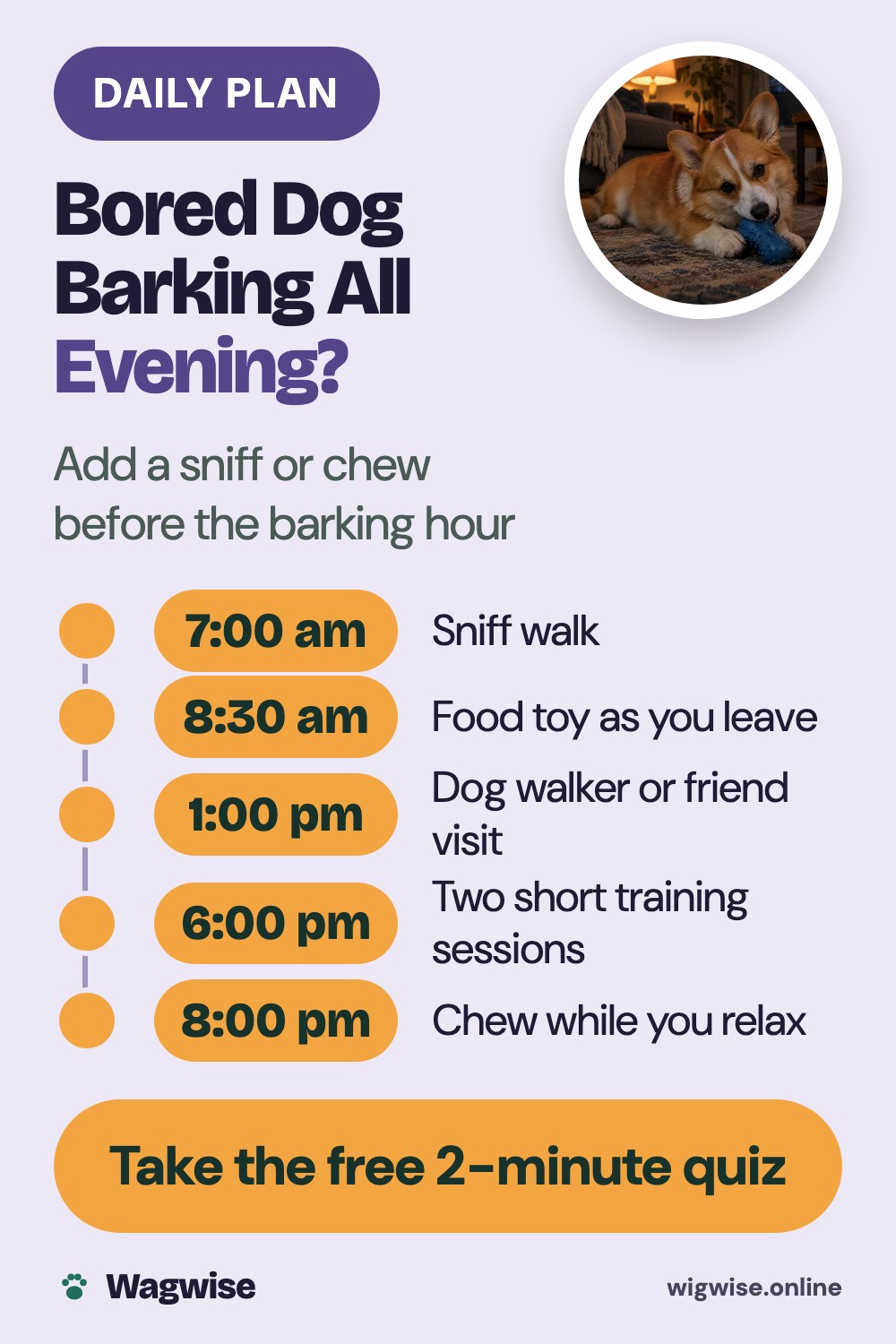
A sample weekday for a bored dog
- 7:00 am: Sniff walk
- 8:30 am: Food toy as you leave
- 1:00 pm: Dog walker or friend visit
- 6:00 pm: Two short training sessions
- 8:00 pm: Chew while you relax
For the evening barking hour, check your log for the time it starts and add one short sniff or chew session just before it.
Quick needs check before you start
Fix gaps before you train. Check these five things:
- Exercise: daily walks that suit age and breed
- Sniffing: time to nose around, not just march
- Company: not alone for long stretches
- Chewing: a safe chew or food toy daily
- Sleep: a quiet place to rest undisturbed
If any of these is a gap, fix it first. A dog who has had a proper sniff walk, a chew and a rest is much better placed to settle when the house goes quiet in the evening.
Build it over four weeks
- Week 1: Add the sniff walk and a daily chew.
- Week 2: Add food toys and scent games.
- Week 3: Teach one new trick each week.
- Week 4: Rotate the menu so nothing gets stale.
If your dog is alone more than 4 hours, add a midday walker, a friend or daycare, and a walk before work. Skip long, unsupervised yard time: dogs left outside alone for long periods often turn into barkers, so bring them in. Our list of 30 dog enrichment ideas has more to rotate in.
What if the barking doesn’t ease?
Results vary by dog, history and consistency, and some barking is normal. Track episodes, the longest episode and how fast your dog settles. Any one of these improving is a win. Find your dog’s main reason with the free quiz at /free/bark-quiz. If the barking is new, sudden or at night in an older dog, see your vet first.
Frequently asked questions
Why does my dog bark in the evening?
Evenings with nothing to do are a common time for boredom barking, often steady and rhythmic. Check your log to confirm the time, and make sure it isn't new or sudden. If it is, see your vet.
How do I tell boredom from separation distress?
Film the first 30 minutes after you leave. A dog who settles quickly, barks at outside noises then settles, barks on and off then sleeps, or eats a food toy is more likely bored. Barking or howling soon after you leave, drooling, scratching doors or refusing food points to distress.
How long should I do this plan?
Give it 30 days and track episodes, the longest episode and recovery time. Some barking is normal, so aim for progress, not perfection.
My dog is alone all day. What can I do?
If your dog is alone more than 4 hours, add a midday walker, a friend or daycare, and a walk before work.
More Wagwise guides for dog owners
 Stop Puppy BitingA gentle 4-week plan to stop the nipping and get through teething.$17 · instant PDFSee the guide →
 Get Rid of Dog Pee SmellRemove urine odor for good, then stop the accidents with a 14-day reset.$17 · instant PDFSee the guide →
 Help Your Itchy DogTrack triggers, soothe skin safely and know when to see the vet.$17 · instant PDFSee the guide →
Want all four? Get the complete library for $29.
Sources
This article is general education, not veterinary advice. It does not replace an examination by your vet or help from a qualified behaviourist.