Itchy dog
Itchy Dog Detective: Using a Body Map to Spot Patterns
Quick answer
An itchy dog often has more than one cause at the same time, so a body map helps. Tick every area your dog scratches, licks or chews this week, then show the map to your vet. It starts a conversation. It does not diagnose.
- Itch usually has more than one cause, and causes stack on top of each other.
- Where your dog itches gives your vet useful clues, but it is not a diagnosis.
- Fleas are the first thing to check, even if you have never seen one.
- Several ticked boxes is common. It is the stacking idea in action.
An itchy dog rarely has just one reason for scratching. Fleas, allergies, mites, skin infections and contact irritants can all be involved, and they can stack on top of each other. A simple body map lets you see where the itching happens so you can show your vet a pattern instead of a guess.
Why does an itchy dog have more than one cause?
Think of itch as a bucket. Fleas add a little. Pollen adds a little. A skin infection adds more. Each one alone might not tip your dog over, but together they overflow into constant scratching. That is why one quick trick rarely lasts.
Many dogs with a food allergy also have an environmental or flea allergy. And unmanaged environmental allergy can invite bacterial and yeast infections, which make the itch worse. That is one reason a vet check matters even when you are sure “it’s just allergies”.
How do you use a body map for an itchy dog?
- Draw or print a simple outline of a dog. Front, side and belly views are enough.
- Tick every area your dog scratches, licks or chews this week. Go by what you actually saw.
- Add a short note. Write the time of day, the walk or any new product.
- Repeat for a few weeks. Patterns show up over time, not in a day.
- Take it to your vet. Photos of the same four spots (belly, paws, armpits, ears) make it easier to compare.
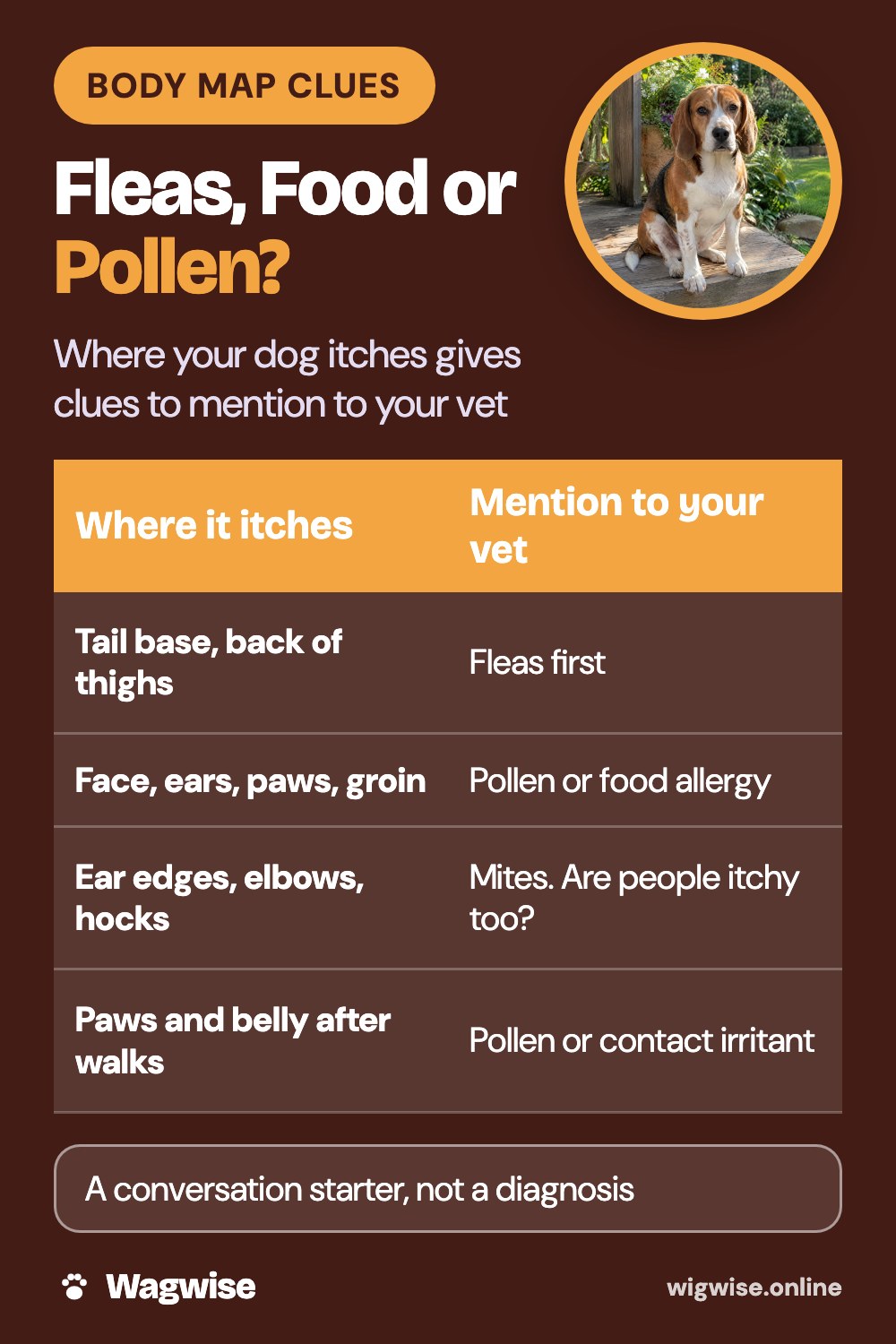
What can each area tell you to mention to your vet?
This is a conversation starter for your vet, not a diagnosis.
| Where your dog itches | What to mention to your vet |
|---|---|
| Lower back, tail base, back of the thighs | Fleas first |
| Face, ears, paws, armpits, groin | Environmental or food allergy |
| Ear edges, elbows, hocks | Mites, especially if people at home itch too |
| Sour smell, greasy coat, brown ear wax | Yeast, which usually follows another problem |
| Belly and paws after walks or a new product | Pollen or a contact irritant |
Why is it always worth checking fleas first?
Flea allergy itch centers on the lower back, tail base and back of the thighs. If that is where your dog chews, start there, even if you have never seen a single flea. Dogs that groom a lot can hide fleas.
Try the 5-minute flea check. Stand your dog on a white towel or white paper and run a flea comb along the lower back and tail base. Tip what you collect onto damp white paper. Reddish-brown smudges mean flea dirt. Whatever you find, ask your vet about flea control for every pet in the home.
What if several boxes are ticked?
That is common, and it is the stacking idea in action. Do not try to guess which cause is “the” cause. Your vet works through the usual suspects in a sensible order and may check a sample from the skin or ears.
What should you do next?
- Keep the body map and a daily itch score for a week or two.
- Note anything new: a cleaner, a detergent, a shampoo or a food.
- Change only one thing at a time, and tell your vet.
- Do not give any medicine, supplement or home mixture unless your vet has prescribed it for your dog.
The free itchy dog starter kit includes a 7-day itch score tracker, a red-flags card and a 5-minute flea check to go with your map.
Frequently asked questions
Why is my dog so itchy?
Itch can come from fleas, environmental allergy, food allergy, mites, yeast or bacteria, or contact irritants, and often more than one at once. Only your vet can work out which are involved.
Can the place my dog itches tell me the cause?
It gives clues to mention to your vet, not answers. For example, itch near the tail base is a reason to check fleas first.
Why does one fix rarely last?
Itch is like a bucket that fills from several sources. Removing one source may help, but the others can still keep it overflowing.
Should I wait to see if the itch passes?
If scratching is more than 4 to 5 times a day, or comes with hair loss, red skin or saliva-stained fur, book a vet visit.
More Wagwise guides for dog owners
 Stop Puppy BitingA gentle 4-week plan to stop the nipping and get through teething.$17 · instant PDFSee the guide →
 Get Rid of Dog Pee SmellRemove urine odor for good, then stop the accidents with a 14-day reset.$17 · instant PDFSee the guide →
 Stop Dog BarkingA quiz finds why your dog barks, then a plan made for that reason.$17 · instant PDFSee the guide →
Want all four? Get the complete library for $29.
Sources
This article is general education, not veterinary advice. It does not replace an examination by your vet or help from a qualified behaviourist.