Dog pee smell
Never Put Bleach on Dog Pee: What to Use Instead
Quick answer
For dog pee smell, never use bleach. Urine contains ammonia, and bleach plus ammonia makes chloramine gas, which can cause coughing, shortness of breath and chest pain. Use white paper towels and an enzymatic urine cleaner instead, and never mix cleaning products.
- Urine contains ammonia, and bleach plus ammonia makes chloramine gas.
- Bleach with vinegar or other acids releases chlorine gas, and peroxide with vinegar in one bottle makes peracetic acid.
- Use white paper towels and an enzymatic urine cleaner instead.
- Rinse and dry between products, because leftover residue blocks enzymes.
- If you breathe in fumes, leave the room, open windows and turn on fans.
When you’re fighting dog pee smell, never reach for bleach. Urine contains ammonia, and bleach plus ammonia makes chloramine gas, which can cause coughing, shortness of breath and chest pain. There are safer ways to remove the smell.
Why bleach and dog pee smell don’t mix
Chloramine gas forms when bleach meets ammonia. Because urine contains ammonia, bleach on a pee spot can release it, even if you didn’t add an ammonia cleaner. That is why bleach is on the never list for carpet, for pet urine and for grout.
Some grout guides suggest diluted bleach. Do not use bleach on urine, even there.
The never-mix list
| Never mix | What forms | Why it matters |
|---|---|---|
| Bleach + ammonia cleaners | Chloramine gas | Coughing, short breath, chest pain, fluid in lungs |
| Bleach + urine | Chloramine gas | Urine contains ammonia, so use non-bleach cleaners |
| Bleach + vinegar or acids | Chlorine gas | Irritates eyes, nose and throat; high levels can kill |
| Bleach + hydrogen peroxide | A reaction to avoid | Never combine them in any step |
| Peroxide + vinegar in one bottle | Peracetic acid | Corrosive to skin, eyes and lungs |
| Two cleaners on one spot | Unknown residues | Rinse and dry between, because residue blocks enzymes |
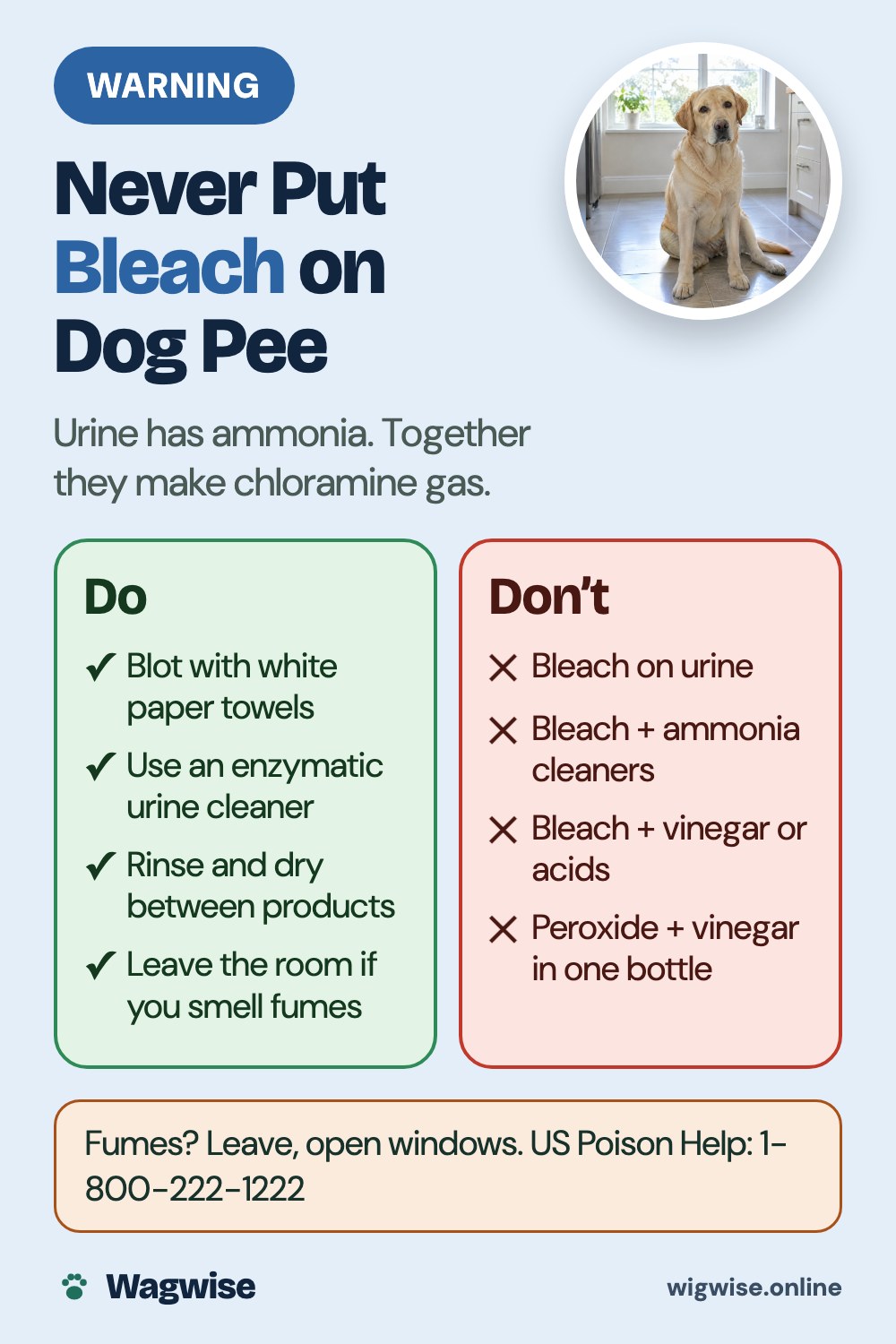
What to use instead of bleach on dog pee
Use the plain method, which needs no harsh chemicals:
- Blot with white paper towels. Never rub.
- Rinse with a little cool water on carpet, or wipe up every drop on hard floors.
- Soak with an enzymatic urine cleaner as deep as the urine went. Look for “enzymatic” and “urine” on the label.
- Cover, wait and dry fully, often 24 to 48 hours.
Test any product on a hidden spot first. Ammonia cleaners are best avoided too, because they may encourage your dog to go there again. Our right order for removing urine smell from carpet has the full routine. Our free Fresh Accident Kit includes a never-mix card you can stick near your cleaning supplies.
What else should you skip on a pee spot?
Bleach isn’t the only product that backfires on urine. Steer clear of these too:
- Ammonia cleaners. They may encourage your dog to go there again.
- Steam cleaners and hot shampooers. Heat sets stains and odor in synthetic fibers.
- A hair dryer or heater on the spot. Heat doesn’t help.
- Masking sprays. They cover the odor without removing it.
Laminate makers also list vinegar alongside ammonia and bleach as cleaners to avoid, so check your floor’s care guide before you reach for any bottle.
What if you already used bleach, or breathe in fumes?
Leave the room, open windows and turn on fans. In the US, call Poison Help on 1-800-222-1222. For serious symptoms, call your local emergency number (UK 999 or NHS 111, Australia 000, Europe 112). Keep dogs and children out until surfaces are dry.
How to set up your home safely
A few minutes of setup makes the next accident much less stressful.
- Move any bleach away from your pet-cleaning supplies.
- Keep vinegar in its own labeled bottle.
- Save Poison Help, or your local number, in your phone.
- Rinse and dry between products so residue doesn’t block the enzymes.
- Check your floor’s care guide too, because surfaces have their own limits. See the floor-by-floor cheat sheet.
Frequently asked questions
Can I use bleach on dog urine?
No. Urine contains ammonia, and bleach plus ammonia makes chloramine gas. It can cause coughing, shortness of breath and chest pain.
Can I mix bleach with vinegar for pee smell?
No. Bleach with vinegar or other acids makes chlorine gas, which irritates the eyes, nose and throat. High levels can kill.
Is it safe to mix hydrogen peroxide and vinegar?
Not in one bottle. They form peracetic acid, which is corrosive to skin, eyes and lungs. Keep vinegar in its own labeled bottle.
What should I use instead of bleach on dog pee?
Blot with white paper towels, then soak with an enzymatic urine cleaner and let it dry fully. Look for enzymatic and urine on the label.
What if I breathed in fumes?
Leave the room, open windows and turn on fans. In the US call Poison Help on 1-800-222-1222, and for serious symptoms call your local emergency number.
More Wagwise guides for dog owners
 Stop Puppy BitingA gentle 4-week plan to stop the nipping and get through teething.$17 · instant PDFSee the guide →
 Stop Dog BarkingA quiz finds why your dog barks, then a plan made for that reason.$17 · instant PDFSee the guide →
 Help Your Itchy DogTrack triggers, soothe skin safely and know when to see the vet.$17 · instant PDFSee the guide →
Want all four? Get the complete library for $29.
Sources
This article is general education, not veterinary advice. It does not replace an examination by your vet or help from a qualified behaviourist.