Dog pee smell
Dog Urine Smell on Every Floor Type: A Surface Cheat Sheet
Quick answer
How to get rid of dog urine smell depends on your surface. Carpet needs enzyme cleaner soaked to pad depth. Hard floors need an immediate wipe and a cleaner the floor maker approves. Grout needs enzyme and sealing. Never use bleach, and never mix cleaners.
- Carpet and rugs need enzyme cleaner soaked to pad depth. Hard floors need speed.
- Never steam laminate, wood or carpet that has urine on it.
- Laminate makers list vinegar alongside ammonia and bleach as cleaners to avoid.
- Grout is porous and holds odor. Use enzyme, a soft nylon brush and a sealer once dry.
- Dark gray or black stains on oak are chemical damage, not dirt.
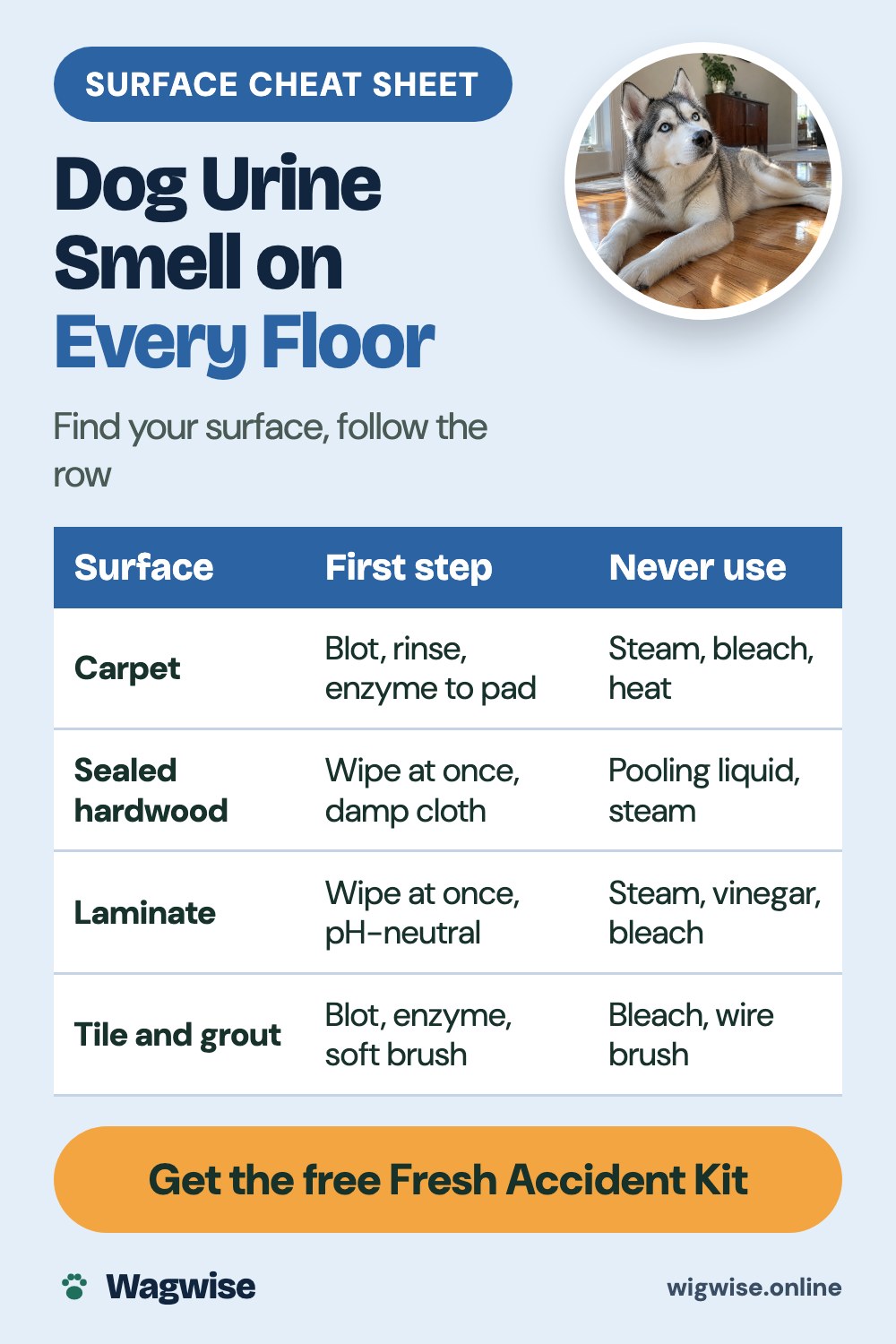
How to get rid of dog urine smell depends on what the urine landed on. Carpet holds odor in the pad, hard floors can swell or stain, and grout soaks it up. Find your surface in the cheat sheet, then follow the row. Test every product on a hidden spot first.
How to get rid of dog urine smell: the cheat sheet by surface
| Surface | Do this | Never use |
|---|---|---|
| Carpet | Blot, rinse and extract, then enzyme to pad depth, covered | Steam, bleach, ammonia, heat |
| Sealed hardwood | Wipe at once, damp cloth, wood-safe cleaner | Pooling liquid, steam, bleach |
| Laminate | Wipe at once, pH-neutral cleaner, lightly damp mop | Steam, flooding, vinegar, bleach, wax |
| Vinyl or LVP | Wipe, then a maker-approved cleaner | Bleach, steam, flooding |
| Tile and grout | Blot, enzyme, soft nylon brush, then seal | Bleach, hard wire brush |
| Sofa | Check the code tag | Water on S or X codes |
Carpet and rugs
Carpet holds odor because urine reaches the pad. Remove the liquid, rinse if anything else was used, soak with enzyme to the depth the urine went plus 2 inches, cover for the dwell time, then air dry for typically 24 to 48 hours with no heat. For area rugs, treat both sides and clean the floor beneath. Wool or silk rugs are a job for a professional.
Hardwood, laminate and vinyl
On hard floors, speed matters most. Urine seeps into seams, boards and the core.
- Sealed hardwood: wipe up immediately, then use a damp cloth and a wood-safe cleaner. Use enzyme cleaner only if the finish is intact, after a hidden-spot test, and never leave it pooling. Dark gray or black stains mean chemical damage, and the fix is sanding and refinishing or replacing boards.
- Laminate: never let liquid stand, and avoid ammonia, bleach, vinegar and wax. Swollen or lifted edges mean urine got into the core, so replace those planks. “Waterproof” laminate has different rules, so read your floor’s care guide.
- Vinyl and LVP: wipe up straight away and dry the seams. If a smell lingers in click-lock seams, urine may be underneath.
Tile and grout
Tile glaze wipes clean, but grout is porous and holds odor. Blot, apply enzyme cleaner, wait the label time and scrub with a soft nylon brush. Never use bleach on urine, even though some grout guides suggest it. Seal the grout once it’s fully dry, since sealed grout soaks up much less next time.
Sofas, mattresses and concrete
Look for the cleaning code on the sofa tag. W or WS can be blotted, treated with enzyme and dried. S or X should not get water. For a mattress, blot hard, then use baking soda for at least 8 hours and vacuum. Peroxide can damage foam or latex. Unsealed concrete needs enzyme scrubbed in, 24 hours under plastic, then sealing.
Safety rules for every surface
Check your floor maker’s own care guide, because “waterproof” products and special finishes can have different rules. Our sources didn’t cover natural stone, so avoiding vinegar and other acids there is general guidance. Check your stone supplier’s care guide before cleaning.
Never use bleach on urine, and never mix cleaners: bleach with ammonia cleaners, vinegar or peroxide, or peroxide and vinegar in one bottle. Rinse and dry between products. Our free Fresh Accident Kit has a printable surface cheat sheet preview, and our post on old urine in carpet goes deeper on carpet.
Frequently asked questions
Can I use vinegar on dog pee on laminate?
No. Laminate makers list vinegar alongside ammonia and bleach as cleaners to avoid. Wipe at once and use a pH-neutral laminate cleaner.
Why did dog pee turn my hardwood dark?
Dark gray or black stains on oak are urine ammonia reacting with oak tannins. It's chemical damage, not dirt. The fix is sanding and refinishing or replacing boards.
How do I get dog urine smell out of grout?
Blot, apply enzyme cleaner, wait the label time and scrub with a soft nylon brush. Seal the grout once it's fully dry. Don't use bleach on urine.
How do I get dog urine smell out of a sofa?
Check the cleaning code on the tag. W or WS can be blotted, treated with enzyme and dried. S or X should not get water, so call an upholstery cleaner.
Do I need to test cleaners first?
Yes. Test every product on a hidden spot and follow its label, because surfaces and finishes react differently.
More Wagwise guides for dog owners
 Stop Puppy BitingA gentle 4-week plan to stop the nipping and get through teething.$17 · instant PDFSee the guide →
 Stop Dog BarkingA quiz finds why your dog barks, then a plan made for that reason.$17 · instant PDFSee the guide →
 Help Your Itchy DogTrack triggers, soothe skin safely and know when to see the vet.$17 · instant PDFSee the guide →
Want all four? Get the complete library for $29.
Sources
This article is general education, not veterinary advice. It does not replace an examination by your vet or help from a qualified behaviourist.