Barking
Reactive Dog Training Tips: How to Find Your Dog's Green Zone
Quick answer
The first of the reactive dog training tips is distance. Find the green zone, the closest point where your dog notices a trigger and still eats. Practice there, step back when your dog stares or won't eat, and close in a few feet at a time only while your dog stays relaxed.
- Distance is your main tool. The green zone is far enough that your dog notices, then looks back at you.
- Your dog's threshold distance is the closest point where a trigger gets noticed and treats still get eaten.
- Amber means add distance now. Red means leave calmly, never push through.
- Progress takes weeks or months. A shorter threshold distance and faster recovery count as success.
The first of the reactive dog training tips is not a trick at all. It is distance. Your dog can only learn when they can think, and that happens at a distance where they notice a trigger but still feel okay. We call that the green zone.
If your dog lunges, snaps or has bitten or tried to bite, get a qualified behaviorist first and use only management steps until then.
Fear or frustration?
Many dogs show a bit of both, and the plan is the same. The clue helps you read your dog.
- Wants distance (fear): backs off, hides behind you, barks then retreats.
- Wants to reach it (frustration): pulls, whines, bounces and barks to get closer.
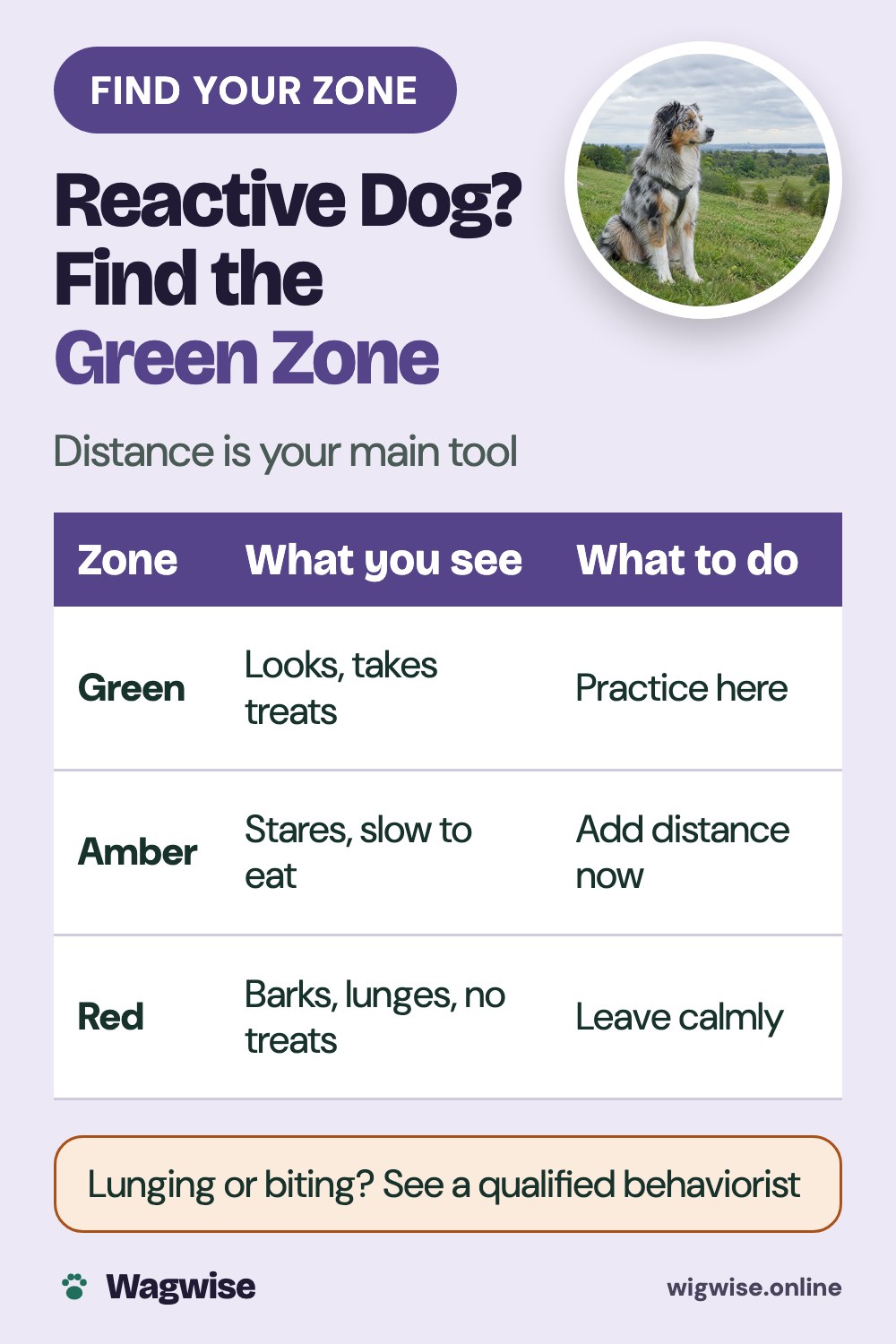
Reactive dog training tips: the three distance zones
| Zone | What you see | What to do |
|---|---|---|
| Green | Notices, looks back at you, takes treats, loose body | Practice here |
| Amber | Stares, tense body, slow to take food | Add distance now |
| Red | Barking, lunging, fixed stare, refuses treats | Leave calmly |
How to find your dog’s threshold distance
Your threshold distance is the closest point where your dog notices a trigger and still eats. It is the edge of the green zone.
- Walk at quiet times and in places with a long view. Scout routes on your own first.
- Use high-value treats such as chicken or cheese, in tiny pea-sized pieces.
- Spot a trigger early and stay well back.
- If your dog notices it, takes the treat and has a loose body, you are in the green zone.
- If your dog stares or is slow to eat, add distance. If they bark, lunge or refuse treats, turn around calmly and go home.
- Write down the distance in feet and copy it to your tracker.
Never force your dog to face the trigger. Forcing a dog closer can make fear stronger. No leash jerks and no forced greetings.
Three skills to practice at home first
- Find it. Scatter 5 treats on the floor. Use it on quiet walks too.
- Name check-in. Say your dog’s name and reward every glance at you.
- The U-turn. Use a happy cue like “this way!”, turn 180 degrees and give a treat after 10 to 15 feet.
Practice each one in short sessions of 3 to 5 minutes before you use it near a trigger. Gear matters, too: a well-fitted Y-shaped harness, a 4 to 6 foot leash (never retractable), and a treat pouch.
Management comes first
While you find the green zone, remove the stressful encounters. Use parked cars as barriers, swap some walks for a secure field or a long line, and keep to quiet times and places. No on-leash greetings for 30 days.
A basket muzzle, trained with treats, is fine as safety equipment for a reactive dog. It is for safety, not for stopping barking.
What does progress look like?
Progress takes weeks or months. A shorter threshold distance, faster recovery after a surprise dog, and glancing back at you for a treat sooner all count. After a big reaction, expect lower tolerance for 48 to 72 hours, so plan quiet walks and home enrichment.
Get a professional if there is any bite or contact, or no change in threshold distance after 4 weeks. The full plan in our guide walks through a four-week leash plan and a pocket card for the three zones.
Frequently asked questions
What is a reactive dog?
A reactive dog barks, lunges or reacts strongly to triggers such as other dogs, people or bikes on walks. The cause is often fear, frustration or a mix of both.
What is a threshold distance?
It is the closest point where your dog notices a trigger and still takes food. Write it down in feet, then check it again on day 30.
Can I use a bark collar on a reactive dog?
No. Punishment can add fear and doesn't teach what to do instead. Use distance, treats and a qualified professional.
How long does reactivity training take?
Progress takes weeks or months. In 30 days, success is a shorter threshold distance and faster recovery, not a dog who ignores everything.
Should I let my dog meet the other dog?
No on-leash greetings for 30 days, and never force your dog to face a fear.
More Wagwise guides for dog owners
 Stop Puppy BitingA gentle 4-week plan to stop the nipping and get through teething.$17 · instant PDFSee the guide →
 Get Rid of Dog Pee SmellRemove urine odor for good, then stop the accidents with a 14-day reset.$17 · instant PDFSee the guide →
 Help Your Itchy DogTrack triggers, soothe skin safely and know when to see the vet.$17 · instant PDFSee the guide →
Want all four? Get the complete library for $29.
Sources
This article is general education, not veterinary advice. It does not replace an examination by your vet or help from a qualified behaviourist.