Puppy biting
The 5-Step Gentle Mouth Method for Puppy Biting
Quick answer
Puppy training biting works best with one calm response, used the same way by everyone, every time teeth touch skin: freeze, swap, pause, pause the game, then reset and reward. Biting gets nothing, and gentle play keeps the fun going.
- Use the same five steps, from every person, every time teeth touch skin.
- Freeze and swap come first. Pulling away turns you into a chase toy.
- You leave the puppy, not the other way round.
- If you reach step 4 twice in 10 minutes, stop training and nap your puppy.
Puppy training biting works best when you use one calm response, every time teeth touch skin. Puppies learn fastest when the rule never changes: biting gets nothing, and gentle play keeps the fun going. The Gentle Mouth Method turns that rule into five steps your whole home can repeat.
What is the Gentle Mouth Method?
In the litter, a puppy who bites too hard gets a yelp and the game stops. That is how puppies learn bite inhibition. Your puppy left the litter at around 8 weeks, so now you teach it, without punishment, using the same five steps each time.
The 5 steps, one by one
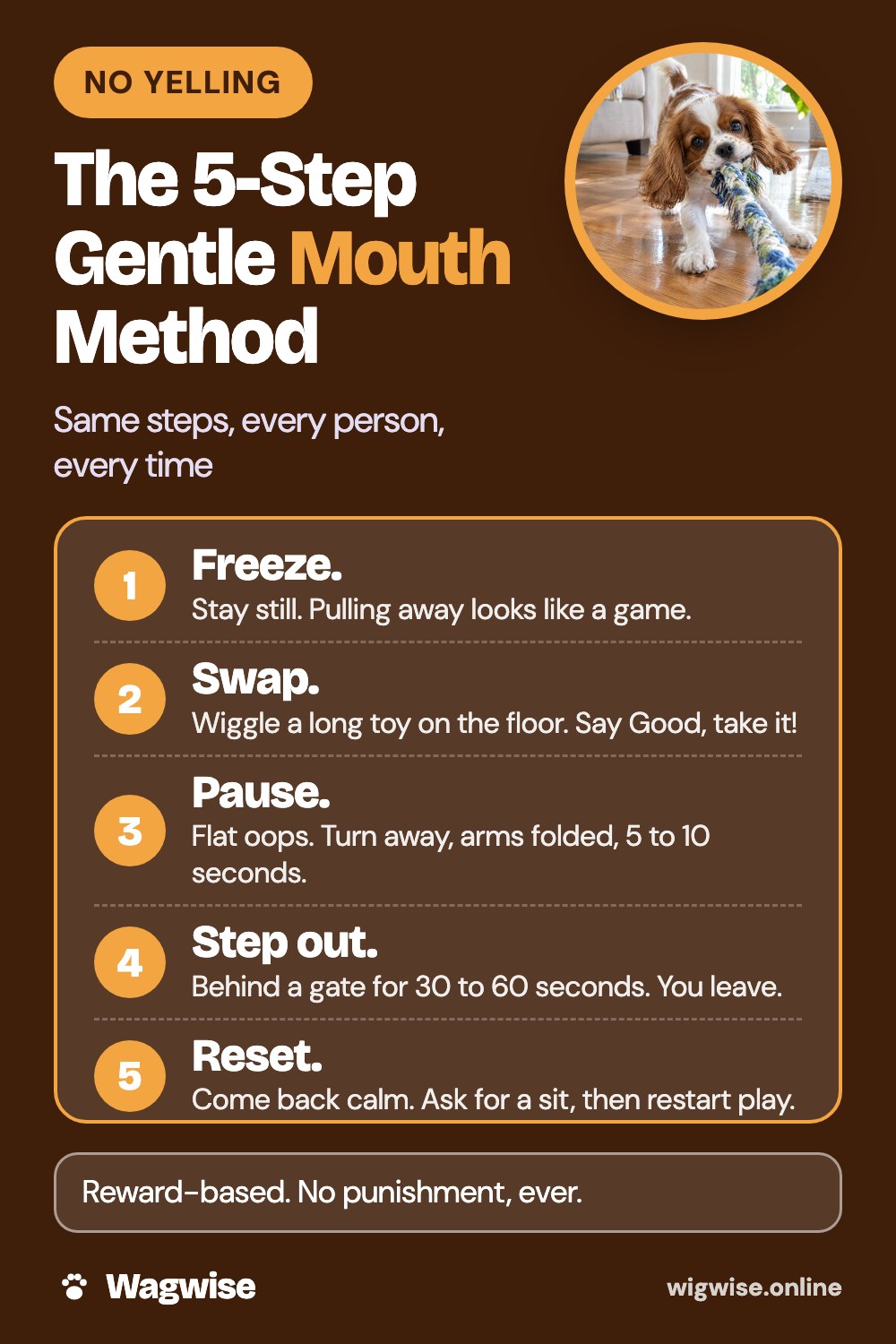
- Freeze. Stop moving the moment teeth touch skin or clothes. Pulling away turns you into a chase toy.
- Swap. Offer a long tug or soft toy and make it move along the floor. Praise when your puppy grabs it: “Good, take it!”
- Pause. If teeth come back to skin, say “oops” in a flat voice. Stand up, turn away and fold your arms for 5 to 10 seconds.
- Pause the game. If it continues, step behind a gate or door for 30 to 60 seconds. You leave, not the puppy.
- Reset and reward. Come back calm. Ask for a sit or a hand target, then restart play with a toy or scatter 5 kibbles on the floor.
What should you say, and not say?
| Moment | Say | Don’t say |
|---|---|---|
| Puppy takes the toy | “Good, take it!” | Silence |
| Teeth touch skin | “Oops.” (flat, calm) | “NO!”, “Bad dog!”, a shrieked “OW!” |
| You come back | “Sit” or “Touch”, then “Yes!” | A long apology or cuddle-fest |
What are the house rules, and the two-strikes rule?
- Use the same response every time, from every person.
- Never laugh or keep playing after a bite.
- Give the toy back only after your puppy is calm, never straight after a hard bite.
- Use the crate for naps only, so it stays a happy place.
The two-strikes rule: if you reach step 4 twice in 10 minutes, stop training. Your puppy is almost always tired. Go straight to the nap routine, because tired puppies cannot learn.
What are the common mistakes?
- Pulling your hand away. It feels like a game of chase. Freeze instead.
- Different rules per person. One person allows nibbles and another does not. Agree on the method together.
- Time outs that last too long. Thirty to 60 seconds is enough. Longer just confuses.
- Training a tired puppy. Check the clock first.
Optional: gentle-mouth shaping. In weeks 1 and 2, during calm play, allow very soft mouthing and pause only for pressure that hurts. Over 2 to 3 weeks, lower the bar until any tooth on skin pauses the game. This teaches pressure first, then no teeth on people.
What should you never do?
Never hold the mouth shut, tap the nose, pin your puppy or use alpha rolls. Skip spray bottles and shaker cans too. These can make puppies afraid of hands and defensive. If something here does not fit your puppy, the help box below tells you who to call. The full guide adds a 4-week plan.
Frequently asked questions
What should I say when my puppy bites?
Say Oops in a flat, calm voice. Avoid No, Bad dog, or a shrieked Ow. Say Good, take it! when your puppy grabs the toy.
Should I yelp when my puppy bites me?
Advice is split. Some puppies soften and many get more excited. Try a calm oops instead, and if you do try a yelp and your puppy bites harder, drop it for good.
Why do I leave the room instead of removing the puppy?
Carrying a puppy out can feel like play. Stepping behind a gate or door yourself is calmer. If you must move your puppy, use the house line calmly.
What if the method seems to make biting worse at first?
It can get worse for a few days when a reaction stops working. Stay consistent, check naps, and look at the troubleshooting list below.
More Wagwise guides for dog owners
 Get Rid of Dog Pee SmellRemove urine odor for good, then stop the accidents with a 14-day reset.$17 · instant PDFSee the guide →
 Stop Dog BarkingA quiz finds why your dog barks, then a plan made for that reason.$17 · instant PDFSee the guide →
 Help Your Itchy DogTrack triggers, soothe skin safely and know when to see the vet.$17 · instant PDFSee the guide →
Want all four? Get the complete library for $29.
Sources
This article is general education, not veterinary advice. It does not replace an examination by your vet or help from a qualified behaviourist.