Puppy biting
How to Train a Puppy to Stop Biting: A 4-Week Plan
Quick answer
To learn how to train a puppy to stop biting, follow four weeks: reset sleep and setup in week 1, use the Gentle Mouth Method every time in week 2, raise the bar in week 3, and practice real life in week 4. Success means fewer, softer bites.
- Week 1 resets sleep and setup. Week 2 uses the same response every time.
- Week 3 lowers the bar to any tooth on skin. Week 4 adds visitors and walks.
- Daily minimum: two 3-minute training sessions, 3 or more naps, one enrichment activity, one mouth check.
- Success is fewer bites, softer bites and faster recovery, not zero bites.
How to train a puppy to stop biting becomes much clearer when you split it into four weeks. Small steps, every day, keep you consistent, and consistency matters more than any single trick. Success is not zero bites. It is fewer bites, softer bites and a puppy who calms down faster.
What is the 4-week plan at a glance?
| Week | Focus | Goal |
|---|---|---|
| 1 | Reset sleep and setup | Naps run, every bite logged |
| 2 | The Gentle Mouth Method, every time | Fewer step-4 pauses than week 1 |
| 3 | Raise the bar | Any tooth on skin pauses the game |
| 4 | Real life | Visitors, kids, walks |
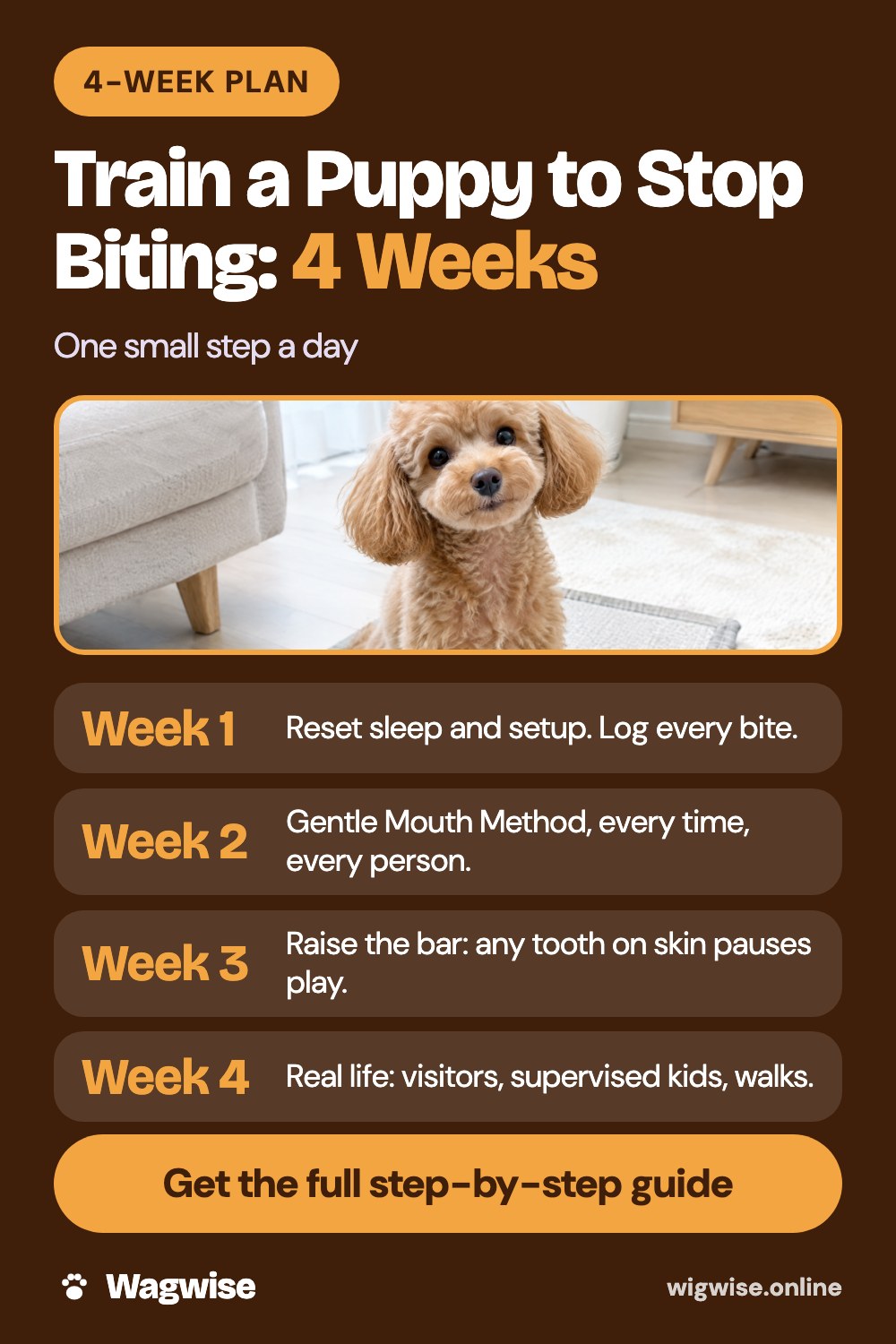
Weeks 1 and 2: reset sleep, then use the method every time
Week 1. Days 1 and 2: set up the pen, toy stations and house line, and remove temptations. Days 3 to 7: run the nap schedule and log every bite, with the time, trigger and what you did. Rate the pressure from 1 (gentle mouthing) to 2 (firm) to 3 (hurts). Do two hand-target sessions a day of 10 reps each. Expect bites to cluster before naps. That is the log doing its job.
Week 2. Everyone agrees on the five steps and the word “oops”: freeze, swap, pause, pause the game, reset and reward. Post the quick start on the fridge. Add sit for play and take it, drop it, and give a frozen toy before the witching hour. Your goal is fewer step-4 pauses than in week 1.
Weeks 3 and 4: raise the bar, then practice real life
Week 3. Lower the threshold: any tooth on skin pauses the game. Add settle on a mat, building to 2 minutes, and calm handling. Practice one of the six common biting moments each day, such as ankles, clothes or visitors.
Week 4. Practice with visitors, supervised kids and on walks. Build settle to 5 minutes and start fading the house line. Review your log. Fewer or softer bites mean keep going. If not, check the help box below.
What is the daily minimum, and what does success look like?
Each day, aim for:
- Two 3-minute training sessions
- Three or more scheduled naps
- One enrichment activity
- One mouth check
- Every bite logged
At the end of each week, count the bites in your log and note the average pressure and the number of step-4 pauses. Then look for three changes:
- Fewer bites. Your weekly bite log total goes down.
- Softer bites. Pressure drops from a 3 to a 1 on your log.
- Faster recovery. Your puppy calms down quicker after a pause.
What if something goes wrong?
If it got worse in week 2, that is normal for a few days when a reaction stops working. Stay consistent. If evenings are still hard, move the wind-down 30 minutes earlier and add a nap. If your puppy ignores toys, rotate them and make them move, because a still toy is boring. If one family member still gets bitten more, check they are freezing, not pulling away, and not playing rough.
If nothing has changed after 4 weeks, talk to your vet or a qualified professional. Never hold the mouth shut, shout or use a spray bottle to speed things up. Keep the routine going until 6 or 7 months. The full guide includes printable trackers and the nap planner.
Frequently asked questions
How long does it take to train a puppy to stop biting?
With consistent practice, most owners see improvement within a few weeks. Most puppies ease off by 5 to 7 months, and large breeds can mouth until 18 to 24 months.
What if biting gets worse in week 2?
It is normal for a few days when a reaction stops working. Stay consistent.
What is the daily minimum?
Two 3-minute training sessions, 3 or more scheduled naps, one enrichment activity, one mouth check, and every bite logged.
What if nothing has changed after 4 weeks?
Talk to your vet or a qualified professional. Pain, fear or guarding can need different help.
More Wagwise guides for dog owners
 Get Rid of Dog Pee SmellRemove urine odor for good, then stop the accidents with a 14-day reset.$17 · instant PDFSee the guide →
 Stop Dog BarkingA quiz finds why your dog barks, then a plan made for that reason.$17 · instant PDFSee the guide →
 Help Your Itchy DogTrack triggers, soothe skin safely and know when to see the vet.$17 · instant PDFSee the guide →
Want all four? Get the complete library for $29.
Sources
This article is general education, not veterinary advice. It does not replace an examination by your vet or help from a qualified behaviourist.