Barking
The Thanks Trick: Let Your Dog Bark 3 Times, Then Settle
Quick answer
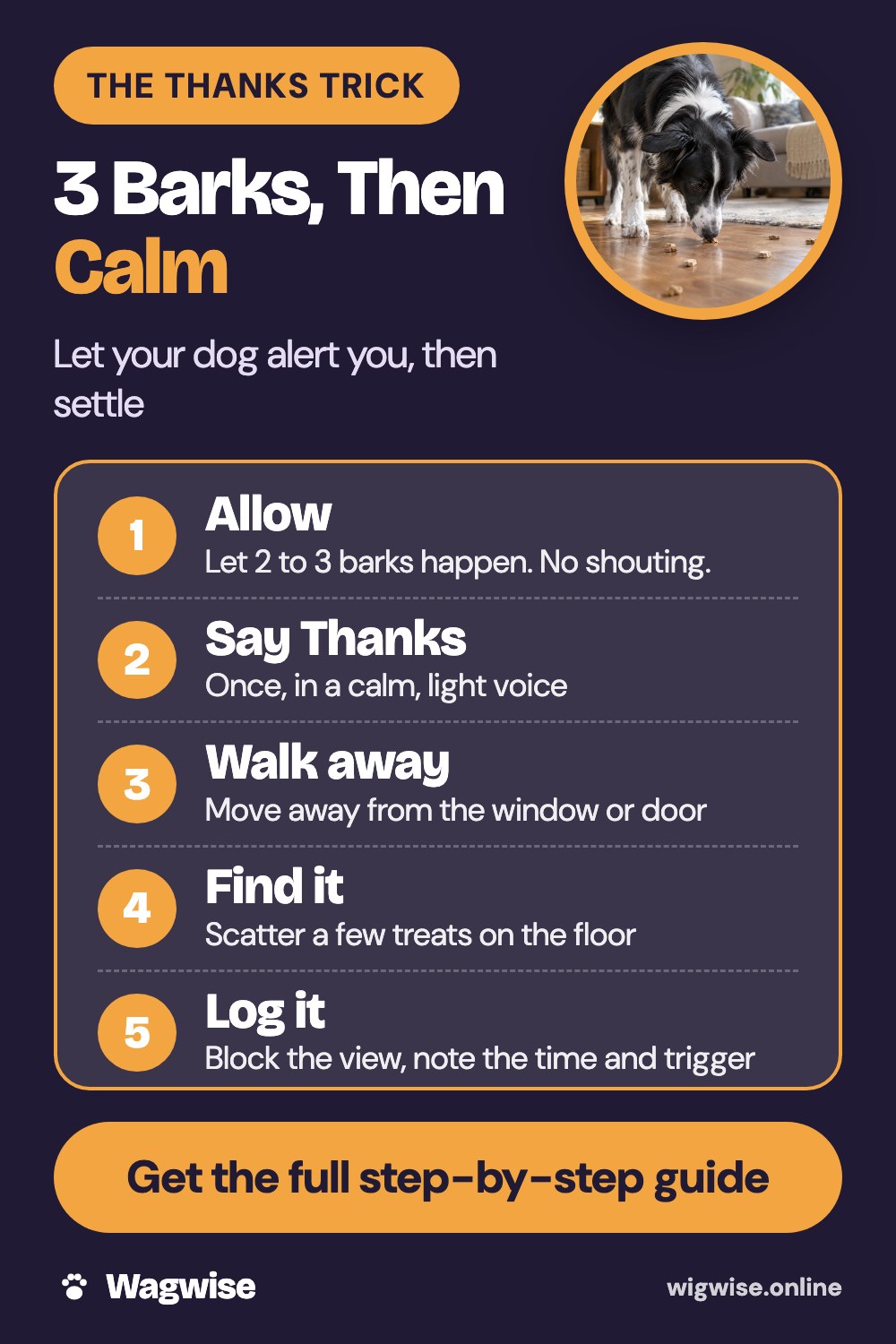
The thanks trick lets your dog do their job and then ends the barking calmly. Allow 2 to 3 barks, say Thanks once in a light voice, walk away from the trigger, then scatter treats for Find it. Your dog gets to alert you, and you skip the shouting.
- Your dog is allowed to alert you. Two to three barks is the allowance, not zero.
- Say Thanks once, calmly. Yelling can sound like you are joining in.
- Walking away and scattering treats gives a sniffing nose a job, and a sniffing nose is a quieter nose.
- Practice Find it on quiet walks too, so it doesn't come to mean trigger nearby.
The thanks trick is a calm routine for the moment your dog is barking right now. You let your dog alert you for two or three barks, say thanks, and then move your dog on to a better job. It keeps the useful alert and drops the shouting match.
The routine is based on ASPCA’s allowance of 3 to 4 barks and Richmond SPCA’s idea of a bark limit.
The thanks trick in 4 moves
| Move | What you do | Why it works |
|---|---|---|
| Allow | Let 2 to 3 barks happen | Your dog may alert you |
| Thank | Say “Thanks!” once, lightly | Acknowledges the message |
| Move | Walk away from the trigger | Most dogs follow you |
| Find it | Scatter a few treats | A sniffing nose is quieter |
Step by step
- Don’t shout. Yelling can sound like you’re joining in, and the attention can pay off the bark.
- Allow 2 to 3 barks, then say “Thanks!” Your dog told you something. Acknowledge it once, in a calm, light voice.
- Walk away from the trigger. Move away from the window or door.
- Cue “Find it.” Scatter a few treats on the floor.
- Block the view, then log it. Close the blind or shut the door, and write down the time and the trigger.
How do you teach Find it first?
Find it is the skill that makes the trick work, so teach it before you need it. Say “find it” and scatter 5 treats on the floor. Practice indoors first, then in the yard, then on walks. Success looks like your dog’s nose dropping to the floor as soon as you say it.
Use it on quiet walks too, so it doesn’t come to mean “trigger nearby.” Keep sessions to 3 to 5 minutes, two or three times a day, with pea-sized treats.
What if your dog barks past three?
First, check the setup. If your dog keeps going at the window, block the view and keep your dog out of the front room. Then add a quiet cue in short practice sessions:
- When your dog barks, wait for a pause, even 1 second. Say “yes” and reward.
- Once you can predict the pause, say “quiet” just before it.
- Over several days, stretch the quiet before the treat: 2, 5, 10, then 20 seconds.
- If your dog never pauses, hold a treat right at the nose. Dogs can’t sniff and bark at the same time.
RSPCA Australia describes another route: teach “speak” first so barking is on cue, then “quiet”. It only works after accidental rewards for barking have been removed.
Common mistakes with the thanks trick
- Saying “Thanks” in an excited voice. Keep it calm and light, once.
- Asking “Who’s there? Who is it?” Excited questions wind your dog up even more.
- Staying at the window. Walking away is the point, because it ends the guard duty.
- Leaving your dog to guard alone. Close a blind or shut the door to the front room.
- Skipping the log. A quick note of the time and trigger shows which window, door or sound needs a management fix next.
What the thanks trick is not
It is not a way to silence every bark. Some barking is normal, and the aim is fewer and shorter episodes with a faster recovery. It is also not for a panicked dog. If your dog barks from fear or distress, or the barking is new, talk to your vet first. Never use sprays, shaker cans or collars. The full plan in our guide shows where the trick fits in a 30-day plan.
Frequently asked questions
Why let my dog bark at all?
Barking is normal communication, and the aim is fewer, shorter episodes, not silence. Allowing 2 to 3 barks lets your dog alert you, then you move things along.
Should I shout Quiet?
Skip the shouting. Yelling can sound like you are joining in, and the attention can pay off the bark. Teach a calm Quiet cue in training sessions instead.
What if my dog keeps barking after Thanks?
Keep walking and scatter the treats. If it happens often, block the view, shorten the triggers and practice Find it and the mat in short sessions.
How do I teach Find it?
Say find it and scatter 5 treats on the floor. Practice indoors first, then in the yard, then on quiet walks.
Does the thanks trick work on walks?
It is built for home alerts. For barking at dogs and people on walks, use distance first and get a qualified behaviorist if your dog lunges.
More Wagwise guides for dog owners
 Stop Puppy BitingA gentle 4-week plan to stop the nipping and get through teething.$17 · instant PDFSee the guide →
 Get Rid of Dog Pee SmellRemove urine odor for good, then stop the accidents with a 14-day reset.$17 · instant PDFSee the guide →
 Help Your Itchy DogTrack triggers, soothe skin safely and know when to see the vet.$17 · instant PDFSee the guide →
Want all four? Get the complete library for $29.
Sources
This article is general education, not veterinary advice. It does not replace an examination by your vet or help from a qualified behaviourist.