Barking
Why Is My Dog Barking? 6 Common Reasons and What Helps
Quick answer
Why is my dog barking? Most dogs bark for one of six reasons: something outside, wanting your attention, boredom, fear or alone-time distress, a trigger on walks, or a health, age or night-time change. Four questions about when, where, at what and what happens next point to the reason, and each reason has a different fix.
- Barking is normal dog communication, so the goal is fewer, shorter episodes, not silence.
- Ask four questions: when and where it happens, who or what it is aimed at, what sets it off, and what your dog gets from it.
- Body language is a clue: stiff and leaning forward points to alarm, loose and wagging points to greeting.
- New or sudden barking, or barking from pain or panic, needs a vet visit first.
Why is my dog barking? Almost always because the barking has a job: it warns, asks, fills time, shows worry or reacts to something on a walk. Barking is normal dog communication. Your dog isn’t being spiteful, and you’re not a bad owner.
The goal isn’t a silent dog. It is fewer, shorter barking episodes and a dog who settles faster.
Four questions that point to the reason
Behavior charities suggest the same starting point. Before you try any fix, answer these:
- When and where does it happen? Time of day, room, indoors or out.
- Who or what is the target? A window, a person, another dog, or you.
- What sets it off? A sound, a sight, you leaving, or nothing you can see.
- What does your dog get from it? The thing leaves, you look at them, or nothing happens.
Write the answers down for a few days. A simple diary of what happens before and after each bark is the first tool behavior charities recommend.
Why is my dog barking? Read the clues
Body language and timing narrow things down fast.
| What you see | What it often means |
|---|---|
| Stiff body, leaning forward with each bark | Alarm barking at a sight or sound |
| Loose body, wagging tail, often whining | Greeting or excitement |
| Barking gets louder as a person comes closer | Fear is likely part of it |
| Single barks with pauses, eyes on you | Asking for food, play or attention |
| Steady, rhythmic barking on long, quiet days | Often boredom |
| Whining or howling when you leave | Possible alone-time distress |
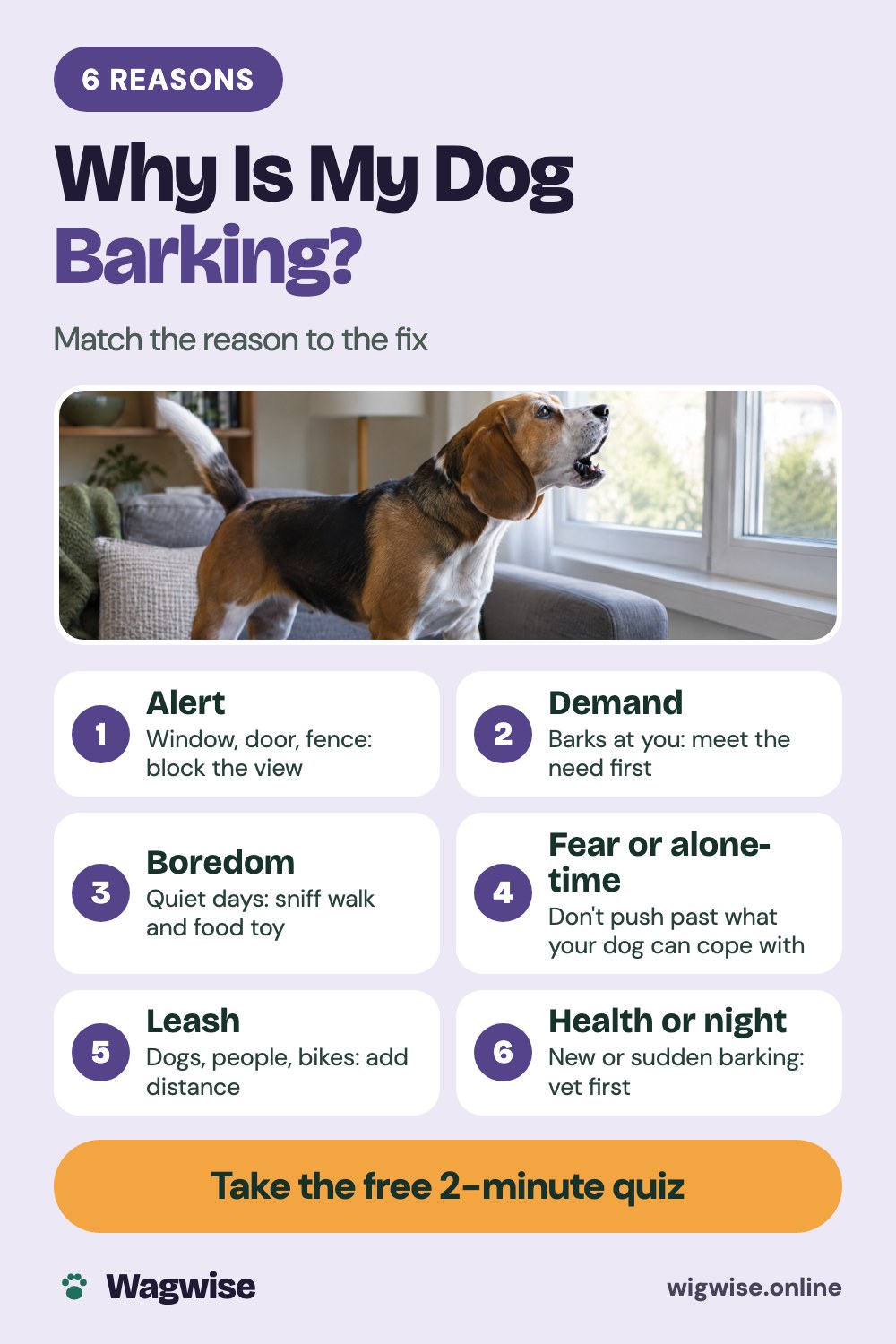
The six common reasons and what helps
- Alert. Something passes the window, door or fence. Each time it leaves, your dog learns barking worked. What helps: block the view with frosted film or blinds, and shut the door to the front room.
- Demand. Your dog barks at you for food, play, the couch or attention. What helps: meet the need before the bark, such as a chew before you sit down, and teach a polite ask like a sit or nose touch.
- Boredom. Too little exercise, brain work or company. What helps: a sniff walk, a food toy and a daily chew.
- Fear or alone-time distress. Scary sounds, or barking and howling when you leave. What helps: film your dog for the first 30 minutes alone, and never leave them longer than they can cope with.
- Leash barking. Barks at dogs, people or bikes on walks, from fear or frustration. What helps: more distance from the trigger.
- Health, age or night. New or sudden barking, night barking, pacing or repetitive habits. What helps: a vet visit first.
What to do this week
Keep a 3-day bark log: time, place, trigger, body language, how long it lasted, what happened after, and how long your dog took to settle. Change nothing except stopping the yelling, which can sound like you are joining in. Film one episode of each type you see.
Then take the free quiz at /free/bark-quiz. It starts with five safety questions, then asks 12 quick ones, and points to the reason that fits your dog best.
When barking needs a vet first
Pain and age changes are common causes of new barking. If it started suddenly, if an older dog paces at night, or if you see limping, stiffness or changes in eating, drinking or toileting, call your vet before you train anything. Punishment tools do not address any of these causes.
Frequently asked questions
Why is my dog barking at nothing?
Barking at nothing you can see is a reason to keep a bark log and note the time and place. If it is repetitive and rigid, with pacing, spinning or shadow chasing, or it is new or at night, see your vet and ask about a veterinary behaviorist.
Why is my dog barking at me?
Single barks with pauses, aimed at you, often mean your dog is asking for food, play or attention. Barking works when you look, talk or give something. Meet the need before the bark and teach a polite way to ask.
Why is my dog barking more than before?
A sudden change is a reason to call your vet first, because pain and age changes can cause new barking. Changes at home, such as a move, a new pet or a new schedule, can also play a part, so note those too.
Is it normal for a dog to bark a lot?
Some barking is normal communication. The aim is fewer, shorter episodes and a dog who settles faster, not a silent dog.
More Wagwise guides for dog owners
 Stop Puppy BitingA gentle 4-week plan to stop the nipping and get through teething.$17 · instant PDFSee the guide →
 Get Rid of Dog Pee SmellRemove urine odor for good, then stop the accidents with a 14-day reset.$17 · instant PDFSee the guide →
 Help Your Itchy DogTrack triggers, soothe skin safely and know when to see the vet.$17 · instant PDFSee the guide →
Want all four? Get the complete library for $29.
Sources
This article is general education, not veterinary advice. It does not replace an examination by your vet or help from a qualified behaviourist.