Home alone
Covering the Hours Your Dog Can't Yet Be Alone
Quick answer
If your dog can't be left alone yet, write down every hour your dog is alone in a normal week, then decide who covers the long ones while you train. Options include family, a friend or neighbor, a sitter or walker, daycare, a dog-friendly workplace or days off. Be honest about what your week allows.
- A cover plan stops your dog being pushed past its limit again and again while it learns.
- List every hour your dog is alone in a normal week, then assign someone to each long stretch.
- No cover at all? Shorten the time as much as you can, get professional advice quickly, and talk to your vet.
- Low-cost cover counts: a neighbor swap, family or friend for an afternoon, or a volunteer walker.
If your dog can’t be left alone yet, the kindest fix is a cover plan: a written list of who looks after your dog during the long hours while you train. While your dog learns, it shouldn’t be pushed past its limit again and again. Cover the long hours, make one room safe, and be honest about what your week allows.
Why cover the hours at all?
Dogs Trust says to avoid long absences, and Merck says to leave a dog alone as rarely as possible to prevent further sensitization. Training only works if your dog isn’t regularly pushed past what it can cope with. So a dog in training should not be left past its current level at all.
How to make a cover plan when your dog can’t be left alone
- Write down every hour your dog is alone in a normal week. Mon to Sun, with start and end times.
- Mark the long ones, the stretches longer than your dog can handle right now.
- Put a name against each long stretch.
- Add a back-up person for a bad day.
- Add up the hours still uncovered, and talk to your vet or behaviorist about those.
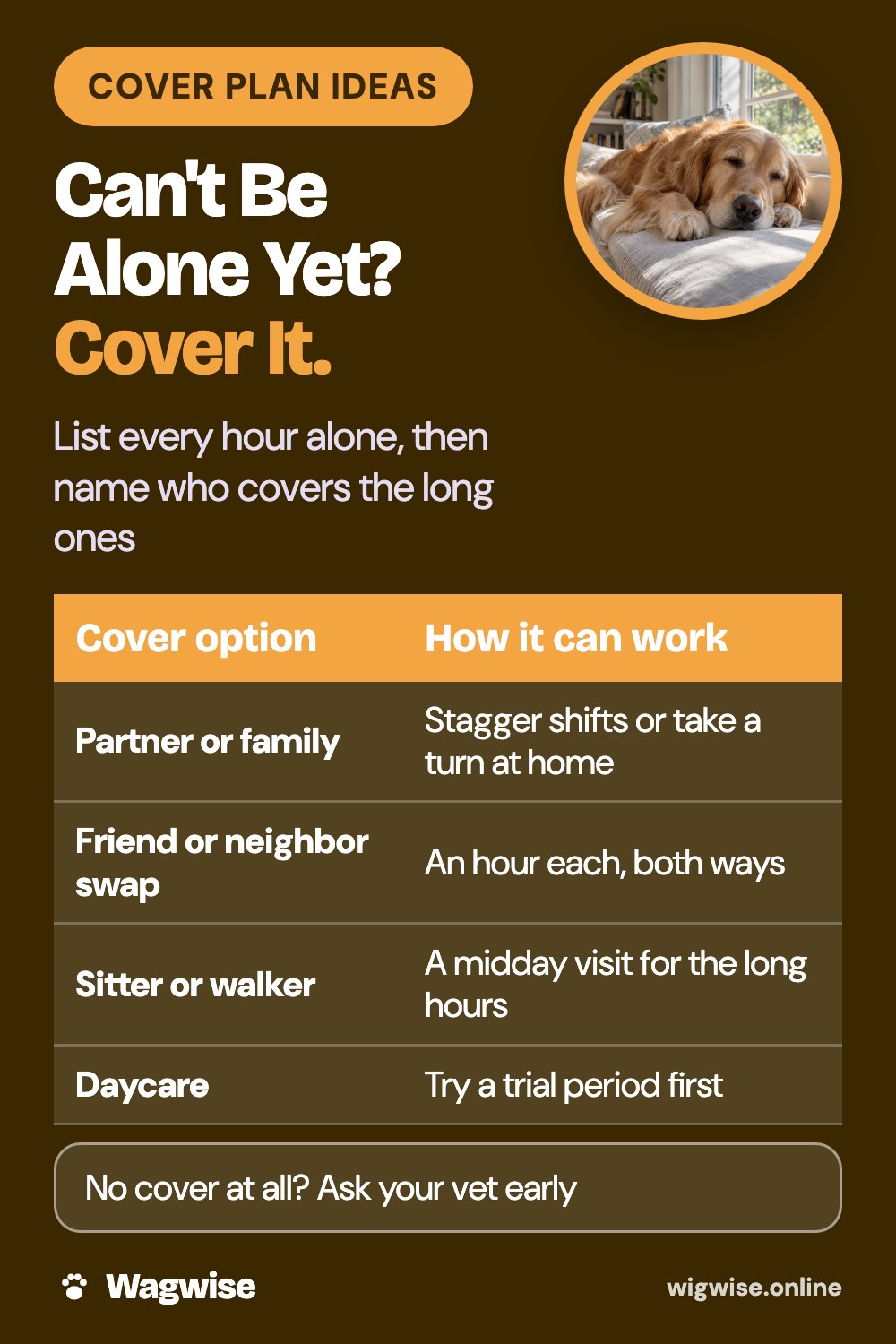
Cover options at a glance
| Option | How it can work |
|---|---|
| Partner or family | Stagger shifts, or take a turn at home |
| Friend or neighbor swap | An hour each, both ways |
| Dog sitter or walker | A midday visit for the hours your dog can’t yet manage |
| Daycare | A trial period first |
| Dog-friendly workplace | Take your dog along |
| Work from home or flexible days | Plan around practice slots |
Low-cost cover counts too. Even one afternoon a week from family or a friend helps. You can also ask local rescues and community groups about a volunteer walker.
What if you really have no cover?
Be honest with yourself. Here are the options to try, in rough order:
- A dog-friendly workplace, or work-from-home days.
- Sitter or neighbor swaps.
- Daycare for a trial period.
- Reduced hours for a few weeks.
- Your vet and a behaviorist, as early as possible.
If nothing works, the kindest choice for your dog may mean changing the household’s routine for a while. That is a hard conversation, and it is worth having early. A short line to your boss can help: you are training your dog to be comfortable alone on a plan from your vet, and a flexible start, two days working from home or a short midday break would help for the next few weeks. Keep it short, specific and with an end date.
What about the four-hour guideline?
UK charities Dogs Trust and RSPCA say a relaxed adult dog should be left alone for no more than about four hours, and puppies for much less. Many US workdays are longer, so treat the number as a guideline, not a law. What matters most is that a dog in training should not be left past its current level.
Plan your week around your work schedule and a safe setup. The Wagwise home alone guide has a cover plan sheet you can fill in. It is general education and can’t replace advice from your vet.
Frequently asked questions
What counts as cover for my dog?
Family, a friend or neighbor, a sitter or walker, daycare, a dog-friendly workplace, working from home or days off, or taking your dog with you.
Why not just leave my dog and hope they get used to it?
Dogs Trust says to avoid long absences, and Merck says to leave the dog alone as rarely as possible to prevent further sensitization. Long absences can make the problem worse.
How long can a dog be left alone?
Dogs Trust and RSPCA, two UK charities, say a relaxed adult dog should be left no more than about four hours, and puppies much less. That is a UK guideline, not a legal limit. A dog in training shouldn't be left past its current level at all.
What if I really have no cover?
Be honest. Shorten the time as much as you can, get professional advice quickly, and talk to your vet about options. Don't pretend a nine-hour day suits a dog in training.
More Wagwise guides for dog owners
 Stop Puppy BitingA gentle 4-week plan to stop the nipping and get through teething.$17 · instant PDFSee the guide →
 Get Rid of Dog Pee SmellRemove urine odor for good, then stop the accidents with a 14-day reset.$17 · instant PDFSee the guide →
 Stop Dog BarkingA quiz finds why your dog barks, then a plan made for that reason.$17 · instant PDFSee the guide →
 Help Your Itchy DogTrack triggers, soothe skin safely and know when to see the vet.$17 · instant PDFSee the guide →
 House-Train Your PuppyA kind 4-week plan with a schedule by age, a night plan and printable trackers.$17 · instant PDFSee the guide →
 Stop Leash PullingA 4-week force-free plan for calmer walks and a loose leash.$17 · instant PDFSee the guide →
 Puppy Sleeps Through the NightA realistic, age-by-age plan for calmer nights, without cry-it-out or crate fights.$17 · instant PDFSee the guide →
 Less Dog Hair, Less SmellA 4-week brushing, bath and home routine for a calmer-smelling house.$17 · instant PDFSee the guide →
Want all four? Get the complete library for $49.
Sources
This article is general education, not veterinary advice. It does not replace an examination by your vet or help from a qualified behaviourist.