Barking
Doorbell Barking: Teach Your Dog to Go to a Mat in 4 Weeks
Quick answer
Doorbell barking improves when your dog learns a better job: go to a mat and wait for a treat. Over four weeks, set up the home, teach the mat away from the door, practice a quiet recorded bell, then add real deliveries and visitors. Keep sessions to 3 to 5 minutes.
- Teach the mat away from the door first, then add the door, the knock and the bell step by step.
- Move up only after about 8 out of 10 successes across 2 to 3 sessions.
- Record your doorbell and play it at the lowest volume, then give a treat.
- Do 10 mock visits in a row before real guests.
Doorbell barking is rarely about the bell alone. The chime has become a trigger, and each bark ends with a visitor at the door, so your dog learns barking works. The fix is to give your dog a better job, going to a mat, and to build it up in four short weeks.
Sessions last 3 to 5 minutes, two or three times a day. Use pea-sized treats, and never yell, spray or use a collar.
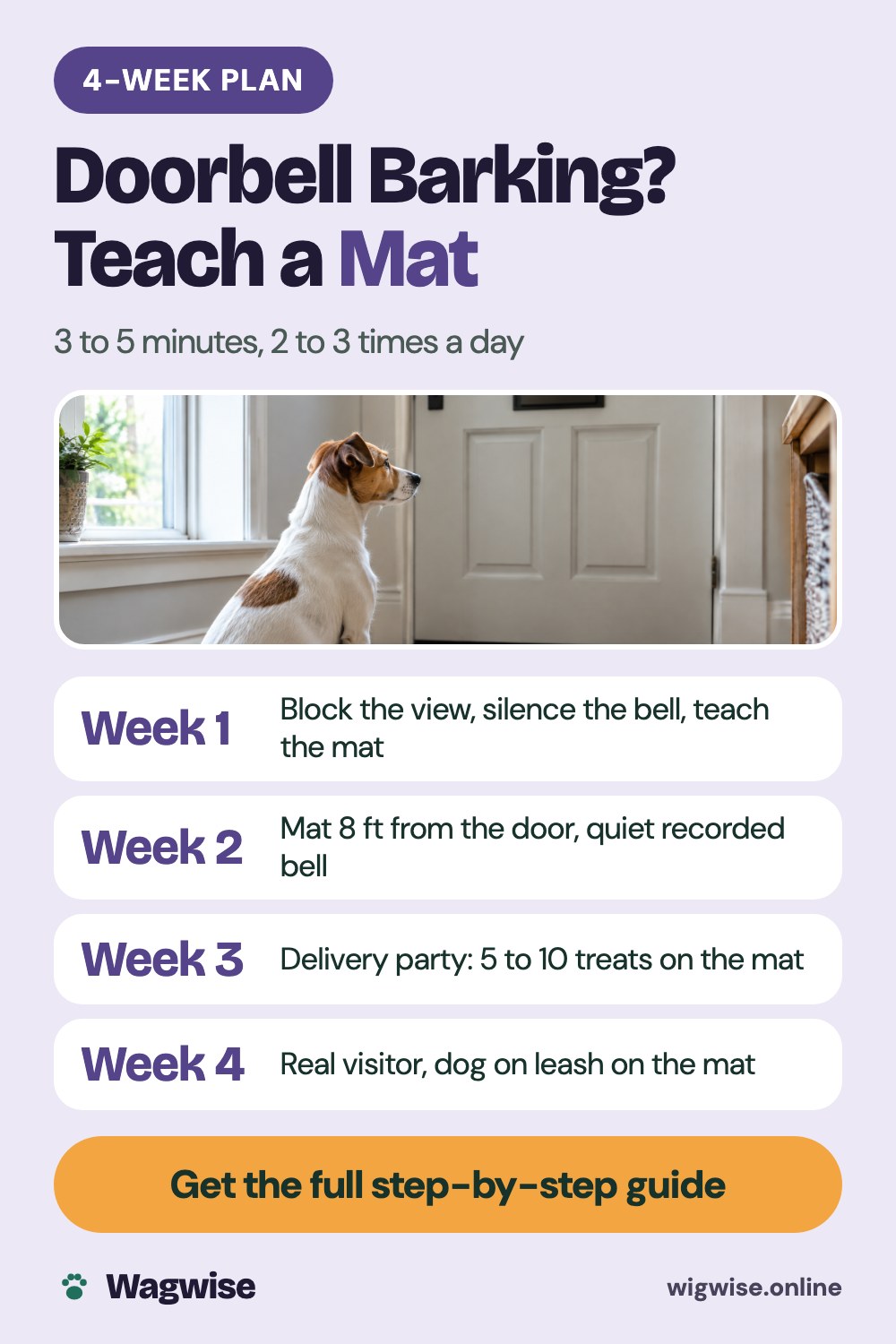
The 4-week doorbell barking plan at a glance
| Week | Focus |
|---|---|
| 1 | Management: remove the view, change the bell, teach the basic mat |
| 2 | Mat by the door, plus a quiet recorded doorbell |
| 3 | Delivery party and calm window watching |
| 4 | Real visitors and real life |
Week 1: set up the home
Block the view with frosted film or blinds at your dog’s eye height, and use a gate to keep your dog out of the front room. Change or silence the doorbell during training, and put up a note asking visitors to phone or text so real knocks don’t undo your work.
Teach the basic mat skill first. Lure all four paws onto the mat with a treat, reward, and do 10 repetitions. Once your dog steps on 8 out of 10 times, add a cue word such as “mat” or “bed”. Build the stay from 5 to 30 seconds, then send your dog from 3 feet and later 10 feet.
Week 2: the mat by the door
Pick a spot at least 8 feet (2.5 m) from the door where your dog can see it. Work up this ladder, moving on after about 8 out of 10 successes across 2 to 3 sessions:
- Send to the mat and reward.
- Add a stay on the mat.
- You walk toward the door while your dog stays.
- You touch the door handle.
- You open and close the door.
- You knock on the inside of the door.
- A helper knocks from outside.
- Do 10 mock visits in a row before real guests.
Alongside the ladder, record your doorbell on your phone. Play it at the lowest volume, then give a treat, for 10 rings a session. After 2 to 3 calm sessions, raise the volume one notch. If your dog stops taking treats, drop back a notch.
Week 3 and 4: deliveries and real visitors
In week 3, when the mail or a parcel arrives, your dog goes to the mat and you feed 5 to 10 treats, one at a time. The truck now predicts treats, not danger. Add window watching: sit by a gap in the film with your dog on a mat and a chew, and reward calm looking.
In week 4, invite a real visitor. Keep your dog on a leash, on the mat. After about a minute, release your dog with a chew. The week 4 goal is simple: you get the parcel, and your dog stays settled.
What if the plan stalls?
Step back one stage if your dog refuses treats, barks in 2 of 5 tries or stares fixedly at the door. A stepped-back stage is normal. After a stressful day, expect more barking for 24 to 48 hours and drop back a level. For unplanned knocks, use the thanks routine: allow 2 to 3 barks, say “Thanks!”, walk away and cue “Find it”. The full plan in our guide adds trackers and a household rules card.
Frequently asked questions
How long does it take to stop doorbell barking?
Plan on four weeks of short daily practice to build the routine, though some dogs are faster or slower. Your tracker shows progress: fewer barks per trigger, faster recovery and a look at you after the bell.
Where should the mat go?
Put it at least 8 feet (2.5 m) from the door, in a spot where your dog can see the door.
My dog won't take treats when the bell rings. What now?
That means the step is too hard. Go back one stage, or lower the volume, for a few sessions.
What if my dog loves fetch?
Try Get your toy as the door behavior. A dog holding a toy can't easily bark.
Can I use a bark collar for the doorbell?
No. Bark collars punish every bark, including useful ones, and they don't teach your dog what to do instead.
More Wagwise guides for dog owners
 Stop Puppy BitingA gentle 4-week plan to stop the nipping and get through teething.$17 · instant PDFSee the guide →
 Get Rid of Dog Pee SmellRemove urine odor for good, then stop the accidents with a 14-day reset.$17 · instant PDFSee the guide →
 Help Your Itchy DogTrack triggers, soothe skin safely and know when to see the vet.$17 · instant PDFSee the guide →
Want all four? Get the complete library for $29.
Sources
This article is general education, not veterinary advice. It does not replace an examination by your vet or help from a qualified behaviourist.