
Puppy sleep
Make the Crate a Place Your Puppy Loves
Quick answer
To crate train a puppy without fights, make the crate a great place to be and keep the door open until your puppy is happy with that. Crate fights usually start when a step goes too fast. Never force, trick or punish, and go back a step when your puppy struggles.
- Your puppy should walk in because the crate is a great place to be, with the door open at first.
- Crate fights usually start when a step goes too fast, so go back to the last relaxed step.
- Never use the crate as punishment, push your puppy in, slam the door or leave a panicking puppy to get used to it.
- Daytime crate time has limits for puppies under 6 months.
You can crate train a puppy without fights if the crate becomes a place your puppy chooses to enter. The door stays open until they are happy with that, and you never force or trick them. Start by day, alongside the night plan.
How do you crate train a puppy without a fight?
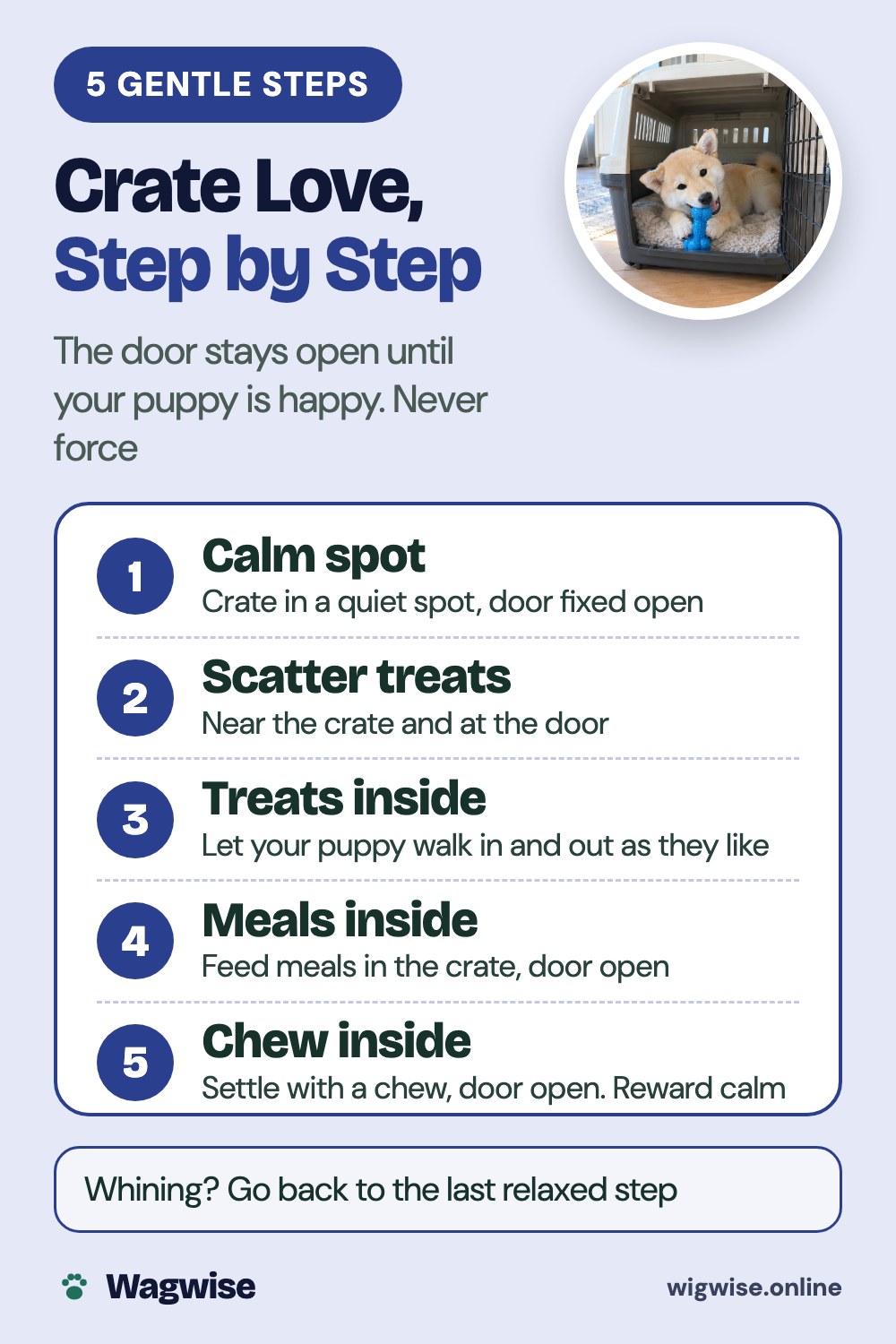
Crate fights usually start when a step goes too fast. The idea is a gentle ladder of small steps:
- Put the crate in a calm spot with the door fixed open.
- Scatter treats near it and at the door.
- Drop treats just inside so your puppy can walk in and out as they like.
- Feed meals inside, door open.
- Settle inside with a chew, door open, and reward calm.
Keep practice sessions to about 3 minutes, and trim your puppy’s normal food a little to allow for treats. For the full seven rungs and how to know when to move up, see The Crate Ladder.
What is the step-back rule?
Whining or scrabbling means you moved up too fast. Go back to the last step where your puppy was relaxed. That is not failure. It is how the ladder works.
How do I fix the common crate fights?
| If this happens | Try this |
|---|---|
| Puppy won’t go in | Do not push. Lure with a treat, make the inside tasty, and go back a step. |
| Puppy runs out when the door closes | The door was closed too soon. Leave it open longer and keep closed time to a second or two. |
| Noisy once the door is closed | Use shorter closes. In daytime practice, open the door on a pause in the noise so your puppy does not learn that noise opens it. |
| Fine by day, cries at night | Night is harder. Go back to the crate beside the bed with the door open. |
What does a happy crate setup look like?
Think of the crate as the best spot in the house. Put it in a calm place, not an isolated one, and let nobody disturb your puppy when they are resting in it. Use a soft, inexpensive blanket, and avoid wool blankets or mats that can be chewed into strings. Take the collar off in the crate, because it can catch on the bars. A wire crate can be covered to keep it dim and cozy, with the door side left open.
The size matters too. The crate should be just big enough for your puppy to stand up, turn around and lie down. If you buy for a growing puppy, choose adult size with a divider, or an adjustable crate. Treats, a chew and meals inside all say the same thing: good things happen here.
What should you never do with a crate?
- Use the crate as punishment.
- Force or push your puppy in.
- Slam the door.
- Leave a panicking puppy to “get used to it.”
These create fear and can injure a puppy. A crate is a tool, not a babysitter.
Is crate training cruel?
Used gently, a crate or pen is a calm, safe space your puppy chooses. It becomes unkind when it is used for punishment, for too long, or before the puppy is ready. Humane World says puppies under 6 months should not be crated for more than 3 to 4 hours at a time, or for most of the day. That figure is about daytime confinement. Night is different because you are close and you will be taking your puppy out. Ask your vet what is right for your puppy’s age.
What if my puppy dislikes a closed crate?
Use an open-topped pen with the same ladder. Pens usually suit nights better. A crate does not fix separation anxiety, and a panicking dog can be badly hurt. If your puppy seems panicked, stop and ask your vet. To choose between a crate and a pen, read Crate, Pen or Bedside?.
Frequently asked questions
Is crate training cruel?
Used gently, a crate or pen is a calm, safe space your puppy chooses. It becomes unkind when it is used for punishment, for too long, or before the puppy is ready.
My puppy won't go in the crate. What now?
Do not push. Lure with a treat, make the inside a tasty place, and go back a step. Never trap them.
How long can a puppy be crated in the day?
Humane World says puppies under 6 months should not be crated for more than 3 to 4 hours at a time, or for most of the day. Ask your vet what is right for your puppy's age.
Will a crate fix separation anxiety?
No. A crate does not fix separation anxiety, and a panicking dog can be badly hurt. If your puppy seems panicked, stop and ask your vet.
More Wagwise guides for dog owners
 Stop Puppy BitingA gentle 4-week plan to stop the nipping and get through teething.$17 · instant PDFSee the guide →
 Get Rid of Dog Pee SmellRemove urine odor for good, then stop the accidents with a 14-day reset.$17 · instant PDFSee the guide →
 Stop Dog BarkingA quiz finds why your dog barks, then a plan made for that reason.$17 · instant PDFSee the guide →
 Help Your Itchy DogTrack triggers, soothe skin safely and know when to see the vet.$17 · instant PDFSee the guide →
 House-Train Your PuppyA kind 4-week plan with a schedule by age, a night plan and printable trackers.$17 · instant PDFSee the guide →
 Stop Leash PullingA 4-week force-free plan for calmer walks and a loose leash.$17 · instant PDFSee the guide →
 Leave Your Dog AloneFilm, sort and build calm alone time with a vet-first plan and a step-by-step ladder.$17 · instant PDFSee the guide →
 Less Dog Hair, Less SmellA 4-week brushing, bath and home routine for a calmer-smelling house.$17 · instant PDFSee the guide →
Want all four? Get the complete library for $49.
Sources
This article is general education, not veterinary advice. It does not replace an examination by your vet or help from a qualified behaviourist.