Dog pee smell
Potty Training Puppy: A 14-Day Reset Plan With a Printable Calendar
Quick answer
Potty training puppy works best as a 14-day reset: clean every old spot, pick one outdoor toilet spot, take your puppy out before they need to go, reward within 2 seconds of finishing, supervise or confine, and log every trip.
- Use one outdoor toilet spot, on leash, and reward within 2 seconds of your puppy finishing.
- Take your puppy out on waking, after meals and drinks, after naps, after play and before bed.
- Supervise or confine your puppy whenever you can't watch.
- Keep the routine up for at least two weeks, and log every trip so patterns show.
- Never punish, shout or rub a nose in a mess. It teaches nothing about where to go.
Potty training puppy goes smoother when you follow a plan instead of guessing. The 14-day reset below uses one toilet spot, trips before your puppy needs to go, close supervision and a simple log. Keep it up for at least two weeks.
The 8 ground rules for potty training puppy
Set these up on day 1 and keep them the same all fourteen days.
- Clean every known spot first. Use an enzymatic cleaner, and never mix cleaning products or use bleach.
- Pick one toilet spot outside, on leash. On day 1, leave a little soiled paper there for scent.
- Use a cue word. Say “Go potty” or “Be quick” calmly as your puppy starts.
- Reward within 2 seconds of finishing. Give a tiny high-value treat and praise, then a short sniff walk.
- Nothing after 5 minutes? Go back inside with the crate or leash at your side, then try again in 10 to 20 minutes.
- Supervise or confine. Keep eyes on your puppy, use a house line, or use a crate or gated pen. The crate should let your puppy stand, turn and lie down, and no more.
- Caught mid-pee? Make a neutral interrupting sound, calmly take your puppy out, and reward if they finish outside. Found it later? Clean it quietly with your puppy out of the room.
- Log every trip.
Your 14 days at a glance
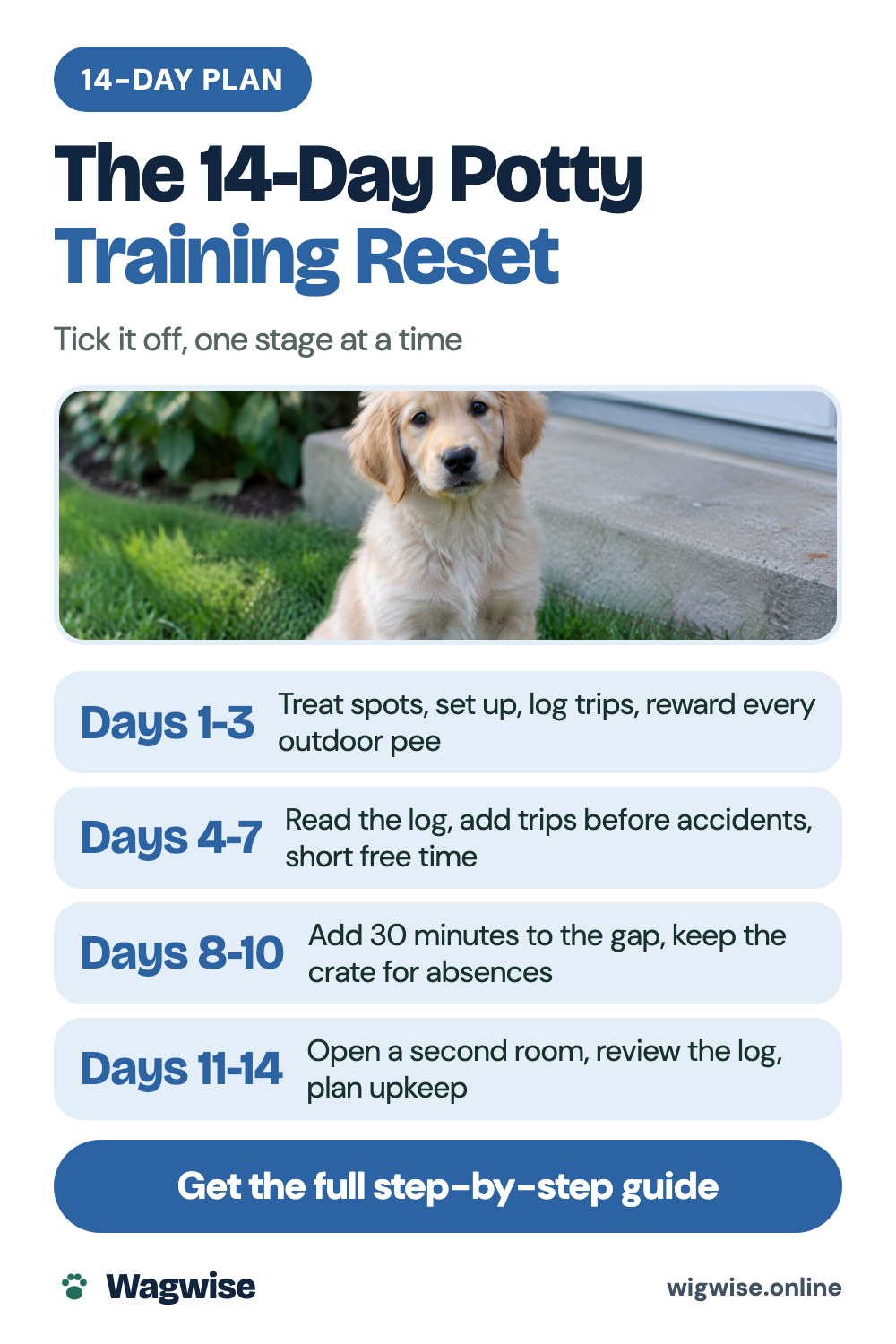
Tick off each stage and move on only when the last column is true. The day ranges and 30-minute steps are a suggested rule of thumb, built on the advice to keep the routine up for at least two weeks and stretch gaps gradually.
| Days | What you do | Move on when |
|---|---|---|
| 1 to 3 | Finish treating spots, set up a crate or pen, start the log. Trips on every trigger plus a regular interval. Reward every outdoor pee. Full supervision. | Spots treated, setup done, 2 days logged |
| 4 to 7 | Read the log. Add a trip 15 minutes before typical accident times. Fixed meal times. Practice the cue word. Short supervised free time in one room after a pee. | Fewer than 1 accident a day, then 3 accident-free days in a row |
| 8 to 10 | Add 30 minutes to the interval. Free time in one room grows. Keep the crate for absences. | No accidents at the new interval for 2 days |
| 11 to 14 | Add another 30 minutes. Open a second room, supervised. Review the whole log and plan upkeep. | 7 accident-free days in a row |
When should a puppy go out?
Take your puppy out on waking, after meals and drinks, after naps, after play or chewing, after crate time and before bed. Eight-week-olds need trips every 1 to 2 hours while awake. At night, puppies may need one or two calm trips with no play, then straight back to bed. For a full age chart, see our puppy potty schedule by age.
What if there is a setback?
One accident means going back one stage, not back to day 1. Clean the spot fully and shorten the interval again. Most setbacks follow too much freedom too soon, so shrink free time to one room again. If you see three or more accidents in a day, or any red flag, pause and call your vet.
What never to do
- No punishment, shouting, shaking, spraying or nose-rubbing, ever.
- No shock, prong or spray collars.
- No withholding water all day. Scheduled water times are only for vet-advised cases.
Early trips are part of the plan. Keep them calm and boring. The full plan includes a printable calendar and potty log, so you can tick each day off and see your puppy’s pattern.
Frequently asked questions
How long does potty training a puppy take?
Keep the routine up for at least two weeks. The day ranges in this plan are a suggested rule of thumb, and your log shows your puppy's real pace.
How often should a puppy go out?
Eight-week-old puppies need trips every 1 to 2 hours while awake. Also go out on waking, after meals and drinks, after naps, after play and before bed.
What should I do if my puppy has an accident?
If you catch it mid-pee, make a neutral interrupting sound, calmly take your puppy out and reward if they finish outside. If you find it later, clean it quietly with your puppy out of the room.
Should I scold my puppy for accidents?
No. Your puppy can't link a telling-off to a puddle made earlier, and anxiety makes indoor peeing more likely.
What size should a crate be for potty training?
Big enough for your puppy to stand, turn around and lie down, and no larger.
More Wagwise guides for dog owners
 Stop Puppy BitingA gentle 4-week plan to stop the nipping and get through teething.$17 · instant PDFSee the guide →
 Stop Dog BarkingA quiz finds why your dog barks, then a plan made for that reason.$17 · instant PDFSee the guide →
 Help Your Itchy DogTrack triggers, soothe skin safely and know when to see the vet.$17 · instant PDFSee the guide →
Want all four? Get the complete library for $29.
Sources
This article is general education, not veterinary advice. It does not replace an examination by your vet or help from a qualified behaviourist.