Dog pee smell
Puppy Potty Schedule by Age: How Often to Go Out
Quick answer
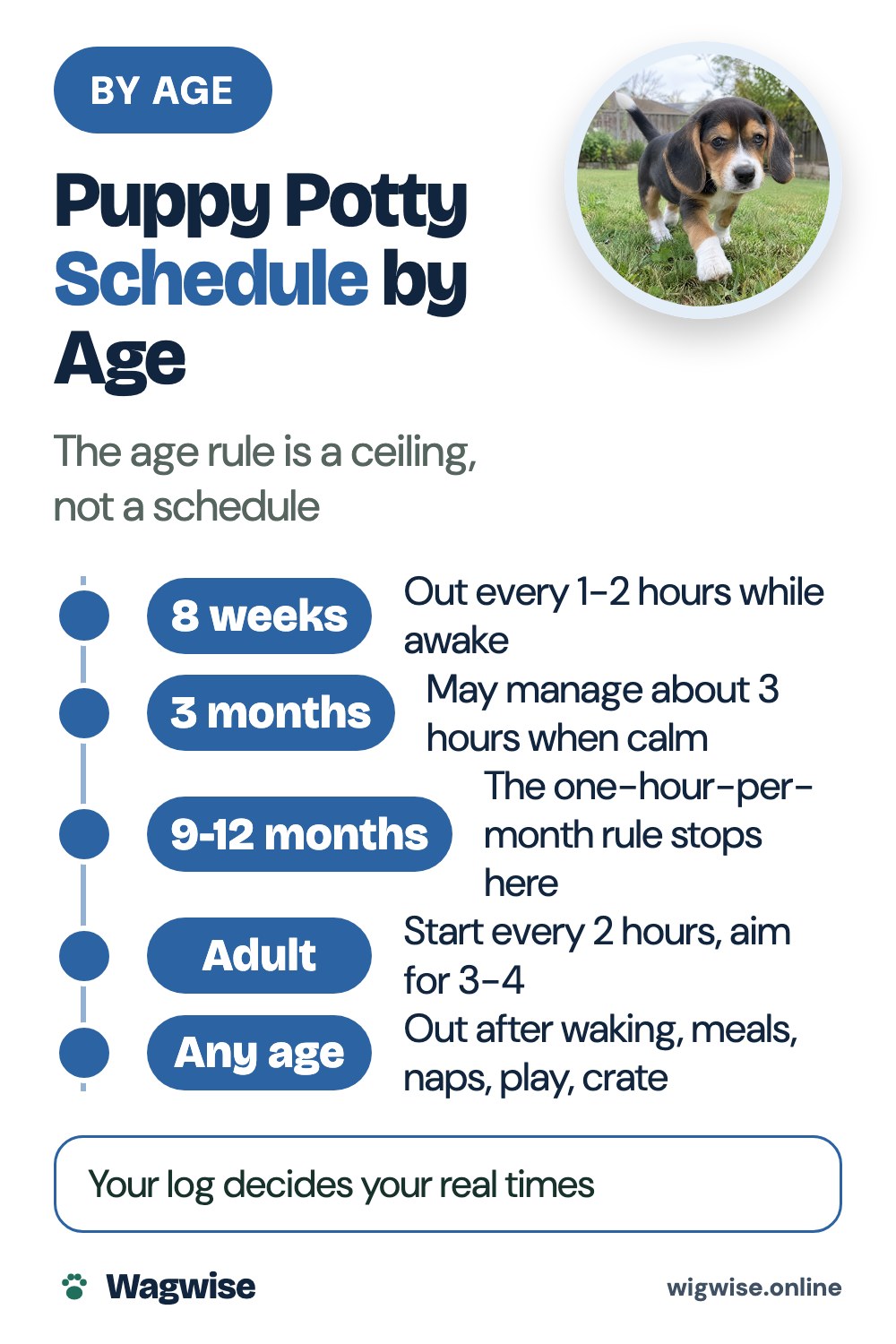
A puppy potty training schedule starts with trips every 1 to 2 hours while awake for an 8-week-old. Puppies can hold urine roughly one hour per month of age, until about 9 to 12 months, but that is a ceiling for calm periods, not a schedule.
- Eight-week-olds need trips every 1 to 2 hours while awake.
- The rough rule is one hour per month of age, up to about 9 to 12 months.
- That rule is a ceiling for calm periods, not a schedule. Your log shows your puppy's real times.
- Always go out on waking, after meals and drinks, after naps, after play or chewing, after crate time and before bed.
- Adults start at every 2 hours and aim for 3 to 4 hours. Active dogs need to go more often.
A puppy potty training schedule works best when it matches your puppy’s age. The chart below gives starting points, but it is not a rulebook. Use it with a simple log and your own puppy’s pattern.
Puppy potty training schedule by age
| Age | How often to go out | Notes |
|---|---|---|
| 8 weeks | Every 1 to 2 hours while awake | Plus triggers like waking and meals |
| 3 months | About 3 hours at most, when calm | One hour per month of age |
| 9 to 12 months | The month rule stops working | Move toward an adult routine |
| Adult | Start at every 2 hours, aim for 3 to 4 | Active dogs go more often |
What is the caveat nobody mentions?
Puppies can hold urine roughly one hour per month of age, until about 9 to 12 months. So a 3-month-old may manage about 3 hours. But that is a ceiling for calm periods, not a schedule.
Do not plan your day around the longest time your puppy can possibly hold it. Plan trips around the triggers below and your own log, and let the numbers in the chart be a limit, not a goal.
Which trips never change with age?
Whatever the age, take your puppy out:
- On waking.
- After meals and drinks.
- After naps.
- After play or chewing.
- After crate time.
- Before bed.
Go out with your puppy every time, so you can reward right on the spot. Say your cue word calmly as they start, then give a tiny high-value treat and praise within 2 seconds of finishing, followed by a short sniff walk. If nothing happens after 5 minutes, go back inside with the crate or leash at your side and try again in 10 to 20 minutes.
What if you work long days or live in an apartment?
Long workdays and apartments make frequent trips harder. An indoor potty station, or a dog walker in the middle of the day, can fill the gaps. Whatever you choose, keep the routine the same each day, and use a crate or gated pen when you can’t watch your puppy. The crate should be big enough to stand, turn and lie down in, and no larger.
What about the night?
Puppies may need one or two trips at night. Keep them calm and boring, with no play, then straight back to bed. Early trips are part of the plan.
How to build your own schedule from a log
A few filled-in lines are enough to start. For example, you might see an accident on a hall rug about 2 and a half hours after breakfast, which tells you where to add a trip.
Write down every pee, inside and out, plus meals, water and what happened just before. After a couple of days you can see the pattern. Then:
- Add a trip about 15 minutes before the time accidents usually happen.
- Set fixed meal times.
- Stretch gaps by about 30 minutes only when the new interval has gone accident-free for two days. These steps are our suggested rule of thumb.
- If an accident happens, go back one stage rather than back to the start.
If a puppy has an accident, clean it quietly with an enzymatic cleaner, and never use bleach or mix cleaning products. Don’t punish, shout or rub a nose in it: your puppy can’t link it to the earlier act. Our 14-day potty training reset turns this into a day-by-day plan.
Frequently asked questions
How often should an 8-week-old puppy go out?
Every 1 to 2 hours while awake. Add trips on waking, after meals and drinks, after naps, after play and before bed.
How long can a puppy hold its pee?
Roughly one hour per month of age, until about 9 to 12 months, so a 3-month-old may manage about 3 hours. That is a ceiling for calm periods, not a schedule to aim for.
Do puppies need to go out at night?
Puppies may need one or two trips at night. Keep them calm with no play, then straight back to bed.
How often do adult dogs need to go out?
Adults can start at every 2 hours and build toward 3 to 4 hours. Active dogs need to go more often.
Should I limit my puppy's water to avoid accidents?
Don't withhold water all day. Scheduled water times are only for specific cases on your vet's advice.
More Wagwise guides for dog owners
 Stop Puppy BitingA gentle 4-week plan to stop the nipping and get through teething.$17 · instant PDFSee the guide →
 Stop Dog BarkingA quiz finds why your dog barks, then a plan made for that reason.$17 · instant PDFSee the guide →
 Help Your Itchy DogTrack triggers, soothe skin safely and know when to see the vet.$17 · instant PDFSee the guide →
Want all four? Get the complete library for $29.
Sources
This article is general education, not veterinary advice. It does not replace an examination by your vet or help from a qualified behaviourist.