Puppy biting
The Thumbnail Test: Is This Chew Safe for Your Puppy?
Quick answer
The best teething puppy tips begin with two quick checks before any chew. Press your thumbnail into it, and a safe chew should dent. If you would not hit it against your kneecap, it is too hard. Chews must also be too big to swallow, and always supervised.
- Veterinary dentists say: don't let your dog chew anything that won't bend.
- Thumbnail test: a safe chew dents under your thumbnail.
- Knee test: if you wouldn't hit it against your kneecap, it is too hard.
- Size rule and supervision: a chew must be too big to fit fully in the mouth, and no toy is 100 percent safe.
Teething puppy tips often start with chew safety, because tender puppy teeth can crack on the wrong chew. The thumbnail test takes five seconds and tells you whether a chew is too hard. Veterinary dentists have a simple rule behind it: don’t let your dog chew anything that won’t bend.
What are the thumbnail test and the knee test?
For the thumbnail test, press your thumbnail into the chew. A safe chew should dent. If your nail makes no mark at all, the chew is likely too hard for tender teeth. Soft rubber teething toys bend and dent, so they pass.
For the knee test, ask whether you would hit the chew against your own kneecap. If you wouldn’t, it is too hard for your puppy’s teeth. Use it as a second check on anything that passes the thumbnail test but still feels like wood, stone or bone.
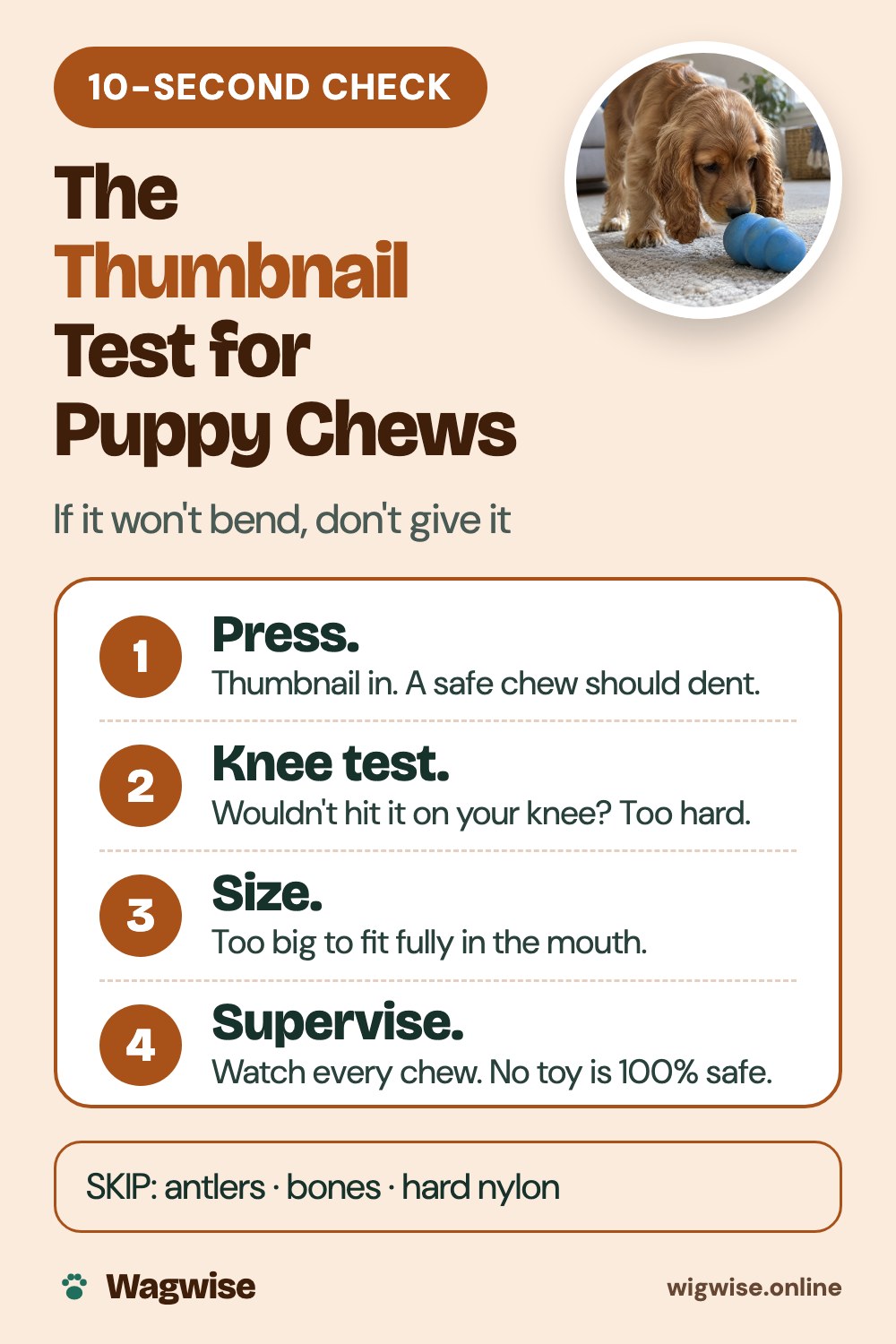
How to use the tests, step by step
- Press. Push your thumbnail into the chew and look for a dent.
- Knee test. Ask yourself if you would hit it against your kneecap.
- Check the size. A chew must be too big to fit fully in your puppy’s mouth.
- Supervise. Stay close while your puppy chews and replace damaged toys.
Which chews usually fail?
The big back teeth, called carnassials, break most often on hard chews. If a chew in your home fails either test, bin it or put it out of reach, and swap in a soft rubber toy. Items to skip include:
- Antlers and hooves
- Cooked or raw bones
- Hard nylon bones
- Ice cubes and rocks
VCA also lists rawhide, pig ears, bully sticks and tennis balls for choking or blockage risk. Do not use clove oil, human teething gels or human pain medicine either.
Which chews usually pass?
| Passes the tests | Notes |
|---|---|
| Soft rubber puppy toys | Stuff and freeze them for sore gums |
| Rope toys | Supervise and trim loose threads |
| Soft plush toys | Check seams and replace when damaged |
| Frozen knotted washcloth | Remove it if threads come loose |
| Puppy teething rings | Check the size rule |
No toy is 100 percent safe, so supervision matters more than the label. If a toy cracks, shreds or gets small enough to swallow, take it away.
How does cold help sore gums?
Cold soothes sore gums. Serve frozen food inside a rubber toy or on a lick mat, never as a hard frozen block, and let it sit for 5 minutes so it softens slightly. Count treats as part of the day’s food.
The same tests apply to cold chews. A cold carrot is chilled for 2 hours, or frozen for just 30 minutes, so it is cold but still has some give. Hold one end at first so your puppy gnaws, take it away once it is small enough to swallow, and give no more than one carrot a day.
Will the right chew stop puppy biting?
Teething drives chewing on objects, while biting people is mostly play. A safe chew gives sore gums something to do, but it will not fix hand biting on its own. For the calm response to teeth on skin, read the 5-step method.
Run the thumbnail test on every chew in your home today and bin anything that fails. If your puppy swallows pieces or shows signs of a broken tooth, use the help box below.
Frequently asked questions
What is the thumbnail test for dog chews?
Press your thumbnail into the chew. A safe chew should dent. If it is too hard to dent, it can be hard enough to damage teeth.
What is the knee test?
If you wouldn't hit the chew against your kneecap, it is too hard for your puppy's teeth.
Are antlers safe for puppies?
No. Antlers, hooves, cooked or raw bones, hard nylon bones, ice cubes and rocks are too hard and can crack teeth.
Is any chew 100 percent safe?
No. Supervise all chews and replace damaged toys, because no toy is 100 percent safe.
More Wagwise guides for dog owners
 Get Rid of Dog Pee SmellRemove urine odor for good, then stop the accidents with a 14-day reset.$17 · instant PDFSee the guide →
 Stop Dog BarkingA quiz finds why your dog barks, then a plan made for that reason.$17 · instant PDFSee the guide →
 Help Your Itchy DogTrack triggers, soothe skin safely and know when to see the vet.$17 · instant PDFSee the guide →
Want all four? Get the complete library for $29.
Sources
This article is general education, not veterinary advice. It does not replace an examination by your vet or help from a qualified behaviourist.