
Puppy sleep
What Sleeping Through the Night Really Means
Quick answer
When do puppies sleep through the night? Wood Green says most puppies manage it by about 16 weeks, and the AKC says night trips usually end by 4 to 5 months. Some take longer. Sleeping through means a stretch long enough for you to rest, not eight hours at eight weeks.
- Sleeping through the night means fewer wake-ups as bladder control grows, not eight hours at eight weeks.
- A puppy under 12 weeks needs at least one night trip, and once or twice a night is usual for the first couple of weeks.
- The age in months plus one hour rule is a daytime ceiling, not an alarm schedule.
- Sources differ, so the honest range is often 16 weeks to 6 months, with no promise.
When do puppies sleep through the night? Wood Green says most puppies manage it by about 16 weeks, and the AKC says middle-of-the-night trips usually end by 4 to 5 months. Some puppies take longer. The honest answer is a range, not a date.
What does sleeping through the night really mean?
It means a stretch of sleep long enough for you to rest, with fewer wake-ups as your puppy’s bladder control grows. It does not mean eight hours at eight weeks. Puppies are not ready to sleep through “like human babies,” and night toilet breaks are normal.
The reasons are simple: a small bladder, control that is still developing, and a huge need for sleep that comes in short blocks. Young puppies sleep about 16 to 20 hours a day.
How long can a puppy hold it overnight?
The AKC and Humane World both suggest a puppy can comfortably wait about their age in months plus one hour between toilet breaks. A 3-month-old can wait about 4 hours. Puppies tend to hold it longer while asleep, so treat that number as a daytime ceiling, not an alarm schedule.
Under 12 weeks, expect at least one night trip. Once or twice a night is usual for the first couple of weeks.
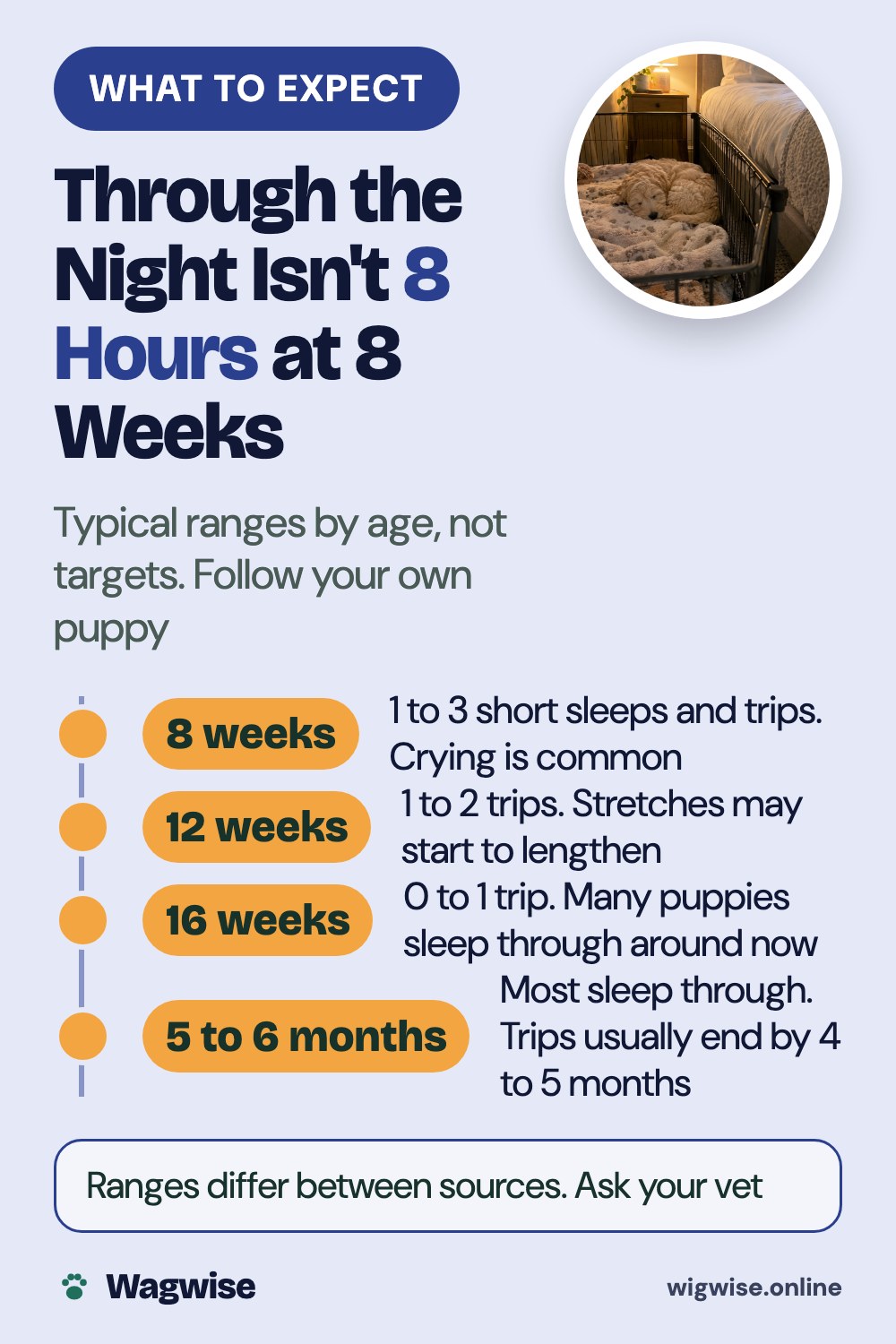
What does a good night look like at each age?
These are typical ranges, not targets. Every puppy is different, so follow your own puppy and your vet.
| Age | Daytime ceiling between toilet breaks | A typical night |
|---|---|---|
| 8 weeks | about 3 hours | 1 to 3 short sleeps and trips. Crying is common in the first nights. |
| 12 weeks | about 4 hours | 1 to 2 trips. Stretches may start to lengthen. |
| 16 weeks | about 5 hours | 0 to 1 trip. Many puppies sleep through around now. |
| 5 to 6 months | about 6 to 7 hours | Most sleep through. Trips usually ended by 4 to 5 months. |
Why do the experts disagree?
Wood Green says most puppies sleep through by about 16 weeks. The AKC says night trips usually end by 4 to 5 months. Plenty of owners report longer. The Wagwise guide says “often 16 weeks to 6 months,” with no promise. Large breeds tend to develop control faster than small ones, and small or toy breeds may need more frequent meals and trips, so ask your vet.
Three myths to drop tonight
- “He’s doing it on purpose.” A young puppy who cries is small, new here and often needs the toilet.
- “If I respond, he’ll never learn.” A young puppy is learning that you are nearby and safe. That is the first lesson.
- “He should do 8 hours by 12 weeks.” Physically, most cannot yet.
How do I set a goal I can actually reach?
Write down your puppy’s age in weeks, then pick one realistic goal, such as one toilet trip and a calm return to bed. Tell everyone at home that a good night for now means a calm night, not a long one. Fewer and shorter wake-ups are the win, not a specific number of hours. If your puppy is going out far more often than the chart suggests, ask your vet to rule out a medical cause. For what to do on those trips, see Night Toilet Trips, Done Boringly.
Remember that a 16-week-old is still a baby on a night shift. Compare your puppy with the right row of the chart, not with a friend’s dog or a puppy twice their age, and ask your vet if your puppy’s size or breed changes how often they should eat and go out.
Frequently asked questions
How long can a puppy hold it overnight?
The AKC and Humane World suggest a puppy can comfortably wait about their age in months plus one hour between toilet breaks. A 3-month-old is about 4 hours. Puppies tend to hold it longer while asleep, so treat the number as a daytime ceiling.
How many hours do puppies sleep in total?
Sources give about 16 to 20 hours a day for a young puppy, in short blocks.
Is my puppy doing this on purpose?
No. A young puppy who cries at night is small, new here and often needs the toilet. Crying is communication, not manipulation.
Do small breeds take longer?
Wood Green says large breeds tend to develop control faster than small ones. Small and toy breeds may need more frequent meals and trips, so ask your vet.
More Wagwise guides for dog owners
 Stop Puppy BitingA gentle 4-week plan to stop the nipping and get through teething.$17 · instant PDFSee the guide →
 Get Rid of Dog Pee SmellRemove urine odor for good, then stop the accidents with a 14-day reset.$17 · instant PDFSee the guide →
 Stop Dog BarkingA quiz finds why your dog barks, then a plan made for that reason.$17 · instant PDFSee the guide →
 Help Your Itchy DogTrack triggers, soothe skin safely and know when to see the vet.$17 · instant PDFSee the guide →
 House-Train Your PuppyA kind 4-week plan with a schedule by age, a night plan and printable trackers.$17 · instant PDFSee the guide →
 Stop Leash PullingA 4-week force-free plan for calmer walks and a loose leash.$17 · instant PDFSee the guide →
 Leave Your Dog AloneFilm, sort and build calm alone time with a vet-first plan and a step-by-step ladder.$17 · instant PDFSee the guide →
 Less Dog Hair, Less SmellA 4-week brushing, bath and home routine for a calmer-smelling house.$17 · instant PDFSee the guide →
Want all four? Get the complete library for $49.
Sources
This article is general education, not veterinary advice. It does not replace an examination by your vet or help from a qualified behaviourist.