Barking
Why Bark Collars Backfire (and What to Do Instead)
Quick answer
Bark collars backfire because they punish every bark, including useful ones, and they ignore why your dog barks. They only work while worn, and they can raise anxiety and cause pain. Find the reason, manage the trigger and teach your dog what to do instead.
- Bark collars punish every bark, ignore the cause and teach nothing new.
- They only work while worn, and most dogs learn to bark with the collar off.
- Veterinary behavior experts recommend reward-based methods for all training.
- The alternative is simple: find the reason, remove the rehearsals and teach a replacement behavior.
Bark collars backfire for a simple reason: they punish the sound and ignore the reason. A dog barking at the window, at you or when left alone is communicating something, and a collar does nothing about the need behind it. They can add stress and teach nothing new.
What do bark collars actually do?
Bark collars punish every bark, including appropriate ones. They ignore the cause and teach no alternative. They only work while worn, and most dogs learn to bark with the collar off. Ultrasonic and noise types are inconsistent.
| Tool | Problem |
|---|---|
| Shock or electronic bark collars | Cause pain; no efficacy advantage in the study below |
| Spray collars | Cause fear; ignore the reason |
| Ultrasonic or vibration collars | Inconsistent; punish every bark |
| Spray bottles, rattle or shaker cans | Intimidation; cause fear |
Why bark collars backfire: what the evidence says
Veterinary behaviorists recommend reward-based methods for all training. The American Veterinary Society of Animal Behavior says there is “no evidence that aversive training is necessary,” and lists shock, prong and choke collars, squirt bottles and shaker cans as tools to avoid.
In a 63-dog controlled study of remote electronic collars, dogs trained with e-collars spent more time tense and yawned more. E-collars worked no better: about 92% of dogs improved in every group. That study tested remote training collars rather than bark collars, but it speaks to the same idea: pain-based tools added stress without a benefit.
Anti-bark collars can raise anxiety and cause pain, burns or injury. Remote shock-based collars have been banned in England since 1 February 2024, and in Wales for over a decade.
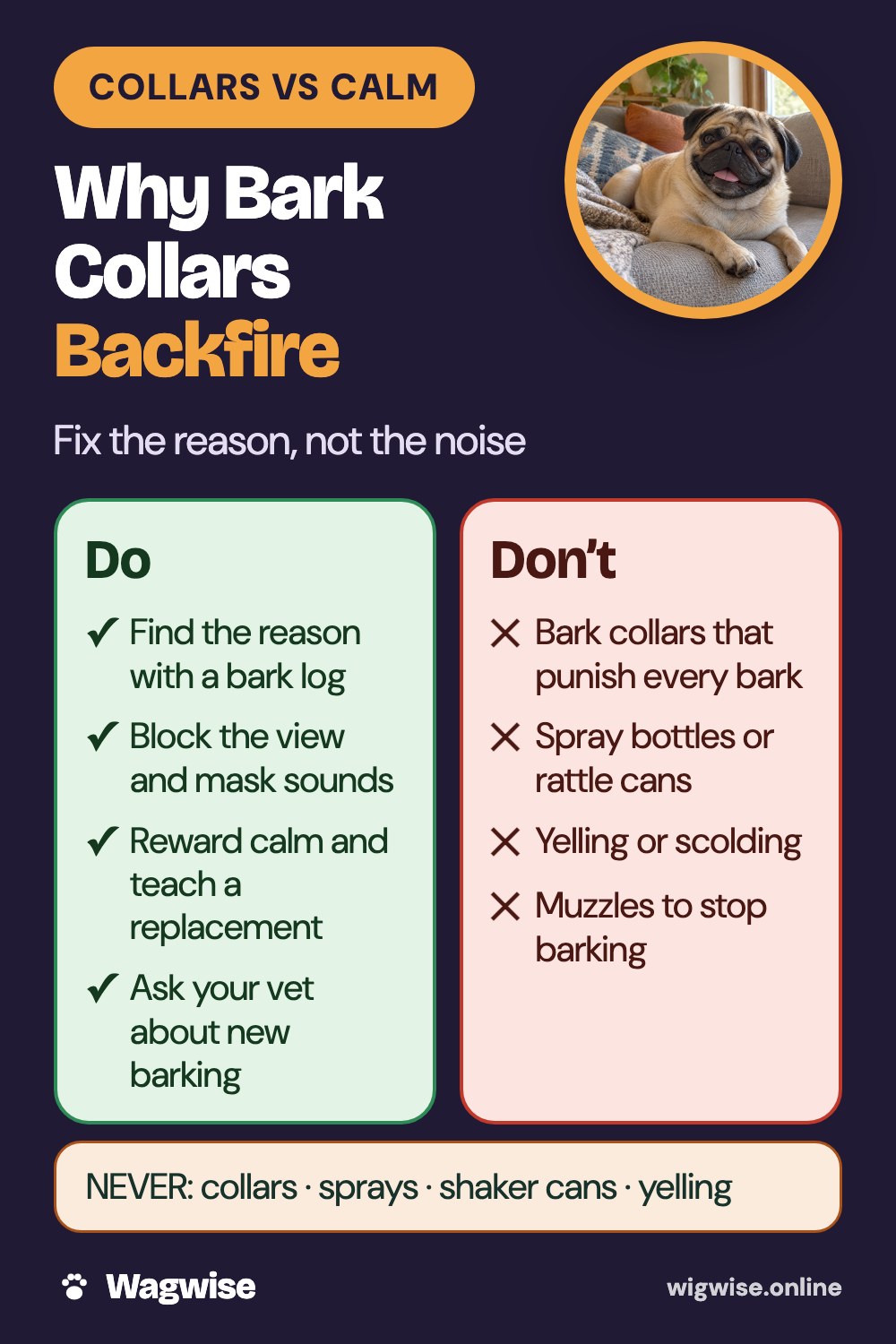
What to do instead of a bark collar
- Find the reason. Keep a 3-day bark log: time, place, trigger and what happened after.
- Check health. New or sudden barking goes to the vet.
- Remove the rehearsals. Frosted film, blinds, a gate and white noise stop the habit from growing.
- Meet your dog’s needs. Exercise, sniffing, company and a daily chew.
- Teach a replacement. Use the thanks routine, “Find it”, a mat and a reward for pauses.
The sessions are short: 3 to 5 minutes, two or three times a day. Move up a step after about 8 out of 10 successes.
What should I buy instead?
A short list: window film, a baby gate, a white noise machine, a lick mat, a food toy and a treat pouch. Skip shock, spray, ultrasonic and vibration collars, spray bottles and rattle cans. Muzzles do not change the feeling behind a bark, so don’t use one to stop barking.
Who can help if the barking won’t ease?
Your vet handles health checks and, if needed, medication. For fear, bites or stubborn habits, look for a veterinary behaviorist (DACVB or equivalent), a certified applied animal behaviorist (CAAB), a behavior consultant (IAABC CDBC or CCBC-KA) or a trainer with CCPDT or IAABC-ADT certification. In the UK, look for ABTC-registered practitioners.
Ask any trainer what methods they use, what their credentials are and how they keep learning. Walk away from “balanced”, “pack leader” or dominance talk. Feeling overwhelmed is a reason to get help, not a failure.
What if I’m being pressured to use one?
Neighbor complaints or a landlord letter can make a collar tempting. Read our calm plan for neighbor complaints first. If you already own a collar, spray or rattle can, return it or give it away. Results vary by dog, history and consistency, and some barking is normal. If you feel stuck, a vet or a reward-based trainer or behaviorist can help. The full plan in our guide covers all six reasons.
Frequently asked questions
Do bark collars work?
They only work while worn, and most dogs learn to bark with the collar off. They punish every bark, including useful ones, and do not teach your dog what to do instead.
Are bark collars safe?
Anti-bark collars can raise anxiety and cause pain, burns or injury. Spray collars and rattle cans cause fear too.
Are they legal?
Remote shock-based collars have been banned in England since 1 February 2024, and in Wales for over a decade. Rules vary by country, state and area, so check locally. This is not legal advice.
What should I use instead?
Window film, a baby gate, white noise, a lick mat, a food toy and a treat pouch. Nothing fancy, and nothing that hurts.
Can a collar help a reactive dog?
No. Punishment can add fear. Use distance and treats, and ask a qualified behaviorist for help if your dog lunges or bites.
More Wagwise guides for dog owners
 Stop Puppy BitingA gentle 4-week plan to stop the nipping and get through teething.$17 · instant PDFSee the guide →
 Get Rid of Dog Pee SmellRemove urine odor for good, then stop the accidents with a 14-day reset.$17 · instant PDFSee the guide →
 Help Your Itchy DogTrack triggers, soothe skin safely and know when to see the vet.$17 · instant PDFSee the guide →
Want all four? Get the complete library for $29.
Sources
This article is general education, not veterinary advice. It does not replace an examination by your vet or help from a qualified behaviourist.