Shedding and smell
Brush Types by Coat: Short, Double, Long, Curly
Quick answer
The right types of dog brushes depend on the coat. Short coats suit a rubber brush or mitt, then a bristle brush. Double coats need a slicker, an undercoat rake and a steel comb. Long coats suit a slicker, a pinhead brush and a comb. Curly coats suit a slicker and a comb.
- Choose tools and frequency from the coat your dog actually has, not the breed label.
- Double coats have a dense undercoat that needs more than a top-coat brush.
- Sources differ on how often to brush, so start in a range and adjust.
- Matted coats, or skin you can't see under thick fur, are a job for a groomer or vet.
The right types of dog brushes depend on the coat your dog actually has. Go by what you can feel at the skin, not by the shop shelf. A mixed breed with a soft, dense layer under longer top hairs should be treated as a double coat.
Types of dog brushes by coat
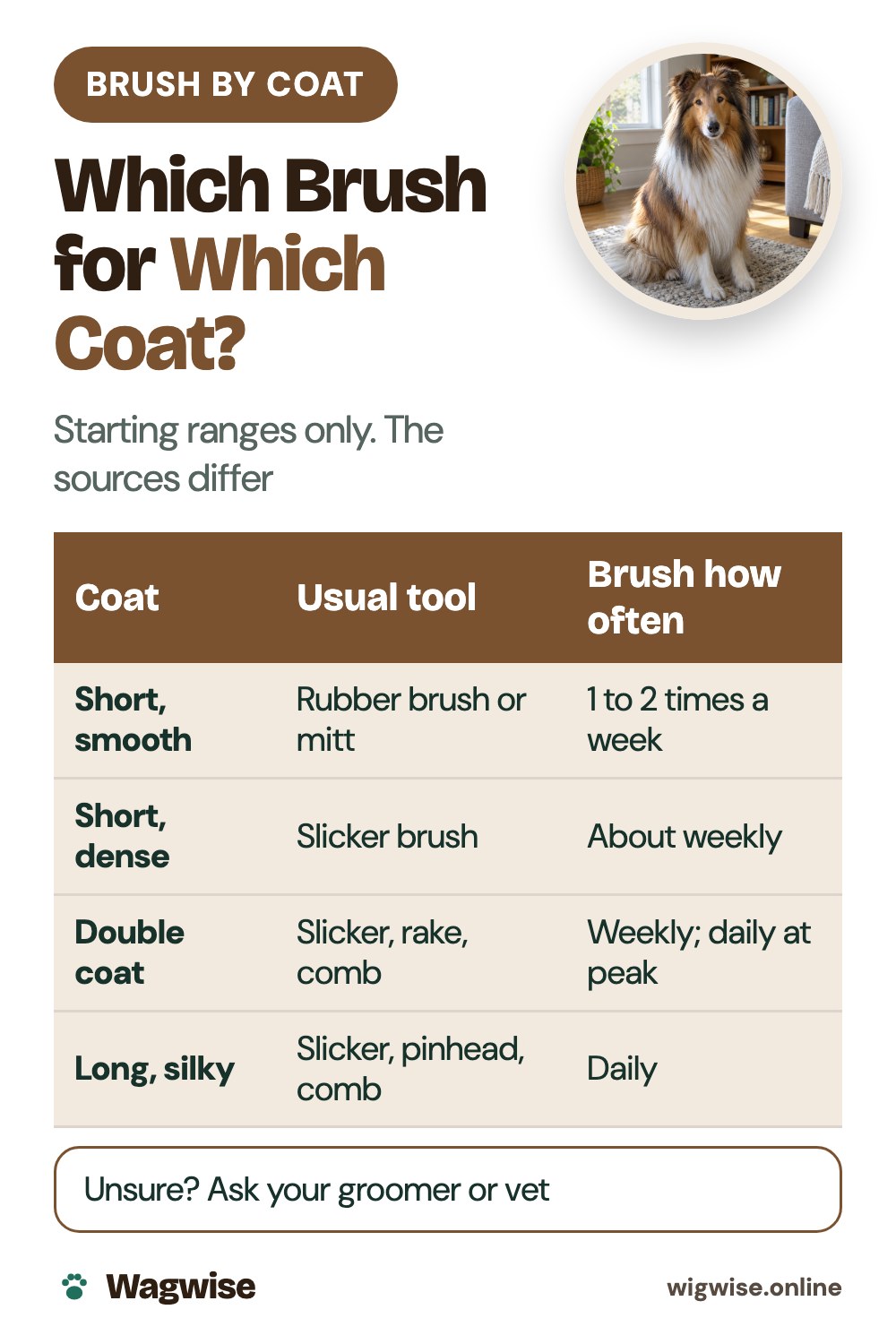
| Coat | Usual tool | Starting frequency |
|---|---|---|
| Short, smooth | Rubber brush or mitt, then a bristle brush | 1 to 2 times a week |
| Short, dense | Slicker brush | About weekly |
| Medium or long, double | Slicker, undercoat rake, comb | At least weekly; daily at peak shed |
| Long, silky | Slicker, pinhead finishing brush, comb | Daily |
| Curly or wool-type | Slicker, comb | Daily or every other day (our estimate) |
| Wire | Slicker for upkeep; ask a groomer about hand-stripping | A few times a week (our estimate) |
Example breeds in the sources: Beagle, Pug and German Shorthaired Pointer for short coats; Pomeranian, Collie, Pembroke Welsh Corgi and Golden Retriever for medium or long double coats.
Short coats: rubber first
A rubber brush or mitt lifts loose hair gently and is a good first tool for a nervous dog. A bristle brush smooths the coat afterward. On a thick double coat the rubber tool is too light. For a short, dense coat, a slicker is the usual choice.
Brush for a double coat: slicker, rake, comb
A double coat has a dense undercoat that needs more than a top-coat brush. Use the slicker first, then the undercoat rake, which reaches what the slicker skims over. Match the rake’s pin length to the coat length. A steel comb is your “did I get it all?” test. The rake is most useful at peak shedding, and heavy shedders may need brushing daily then.
Long and curly coats
Long, silky coats suit a slicker, a pinhead brush as a finisher and a comb, and need daily brushing. Curly and wool-type coats suit a slicker and a comb. Long coats that tend to mat need daily attention. Comb before a bath too, since wet fur mats more.
If tangles do form, a mat splitter can tease at the edge of a small tangle, only if your dog allows it. Matted skin is a job for a groomer or vet.
How often to brush: the sources differ
ASPCA says weekly for a smooth short coat, weekly for a short dense coat and daily for a long silky coat. PDSA says long-haired dogs once a day and short-haired dogs twice a week. The AKC says heavy shedders several times a week, or daily at peak, and double coats at least weekly with a slicker, then a comb.
That is why the table gives a range and not one number. Start in the range for your dog, then adjust from what the coat and skin tell you. If you’re unsure, ask your groomer or vet.
Use any tool with a light touch
With a slicker, brush the hair, not the skin. Stop if your dog flinches or the skin looks pink. Introduce any new tool slowly, with a treat after each step. The short brushing routine covers the teaching steps, and how to pick the right brush covers the starter set and what to skip.
What not to buy
You don’t need five brushes. A de-shedding shampoo is optional and unproven, hard metal rakes pulled through tangles can hurt, and anything that cuts a double coat down to the skin does not stop shedding. One right tool, used often, beats five used rarely.
Frequently asked questions
What brush is best for a double-coated dog?
A slicker brush, an undercoat rake with pins that match the coat length, and a steel comb to check your work. Brush at least weekly, and daily at peak shedding.
What brush should I use on a short-haired dog?
A rubber brush or mitt lifts loose hair gently, and a bristle brush smooths the coat afterward. Starting frequency is weekly or twice a week, depending on the source.
How often should I brush a long-haired dog?
ASPCA and PDSA both say daily for long coats. Long coats that tend to mat need brushing daily.
What about wire or curly coats?
A slicker and a comb suit curly coats, and a slicker handles upkeep on wire coats. Ask a groomer before trying hand-stripping, which is specialist work. Our starting frequency for these coats is our own estimate, not from a source.
More Wagwise guides for dog owners
 Stop Puppy BitingA gentle 4-week plan to stop the nipping and get through teething.$17 · instant PDFSee the guide →
 Get Rid of Dog Pee SmellRemove urine odor for good, then stop the accidents with a 14-day reset.$17 · instant PDFSee the guide →
 Stop Dog BarkingA quiz finds why your dog barks, then a plan made for that reason.$17 · instant PDFSee the guide →
 Help Your Itchy DogTrack triggers, soothe skin safely and know when to see the vet.$17 · instant PDFSee the guide →
 House-Train Your PuppyA kind 4-week plan with a schedule by age, a night plan and printable trackers.$17 · instant PDFSee the guide →
 Stop Leash PullingA 4-week force-free plan for calmer walks and a loose leash.$17 · instant PDFSee the guide →
 Leave Your Dog AloneFilm, sort and build calm alone time with a vet-first plan and a step-by-step ladder.$17 · instant PDFSee the guide →
 Puppy Sleeps Through the NightA realistic, age-by-age plan for calmer nights, without cry-it-out or crate fights.$17 · instant PDFSee the guide →
Want all four? Get the complete library for $49.
Sources
This article is general education, not veterinary advice. It does not replace an examination by your vet or help from a qualified behaviourist.