
House-training
Potty Training Regression: What to Do
Quick answer
Potty training regression, a return to accidents after a good stretch, is common and fixable. Check health with your vet first, then ask whether your puppy had too much freedom or a change in routine. Step back one level on the freedom ladder instead of starting over.
- A setback does not mean the earlier work was wasted.
- Vet first for sudden accidents in a puppy who had been reliable.
- Common causes are too much freedom, rewards stopping too soon, changes, stress, adolescence and marking.
- Step back one level and tighten the routine. Do not go back to day one.
Potty training regression, a return to accidents after a good stretch, is common and fixable. It is easy to feel like all your work was wasted, but it was not. A setback is information, and it points to a small change you can make.
What causes potty training regression?
A veterinarian’s article on regression says it may appear around 4 to 6 months, or in adolescence, which is usually before a year. Tick what applies to your puppy:
- More freedom than your puppy was ready for
- Rewards stopped too soon
- A change: moving, travel, a new person or pet, a new schedule
- Stress or a busy week
- Adolescence, or marking
- A health problem
What should I do first?
Check health first. Accidents that start suddenly in a puppy who had been doing well deserve a vet visit before you tighten any plan. Blood in the urine, straining, drinking much more than usual or tiredness are not training problems.
If your vet gives the all-clear, follow the recovery plan.
- Step back one level on the freedom ladder.
- Use the pen or crate when you cannot watch, and a leash to the spot at set times.
- Reward every success at the spot.
- Clean up with no reaction, and never scold.
- Write down each trip in your log.
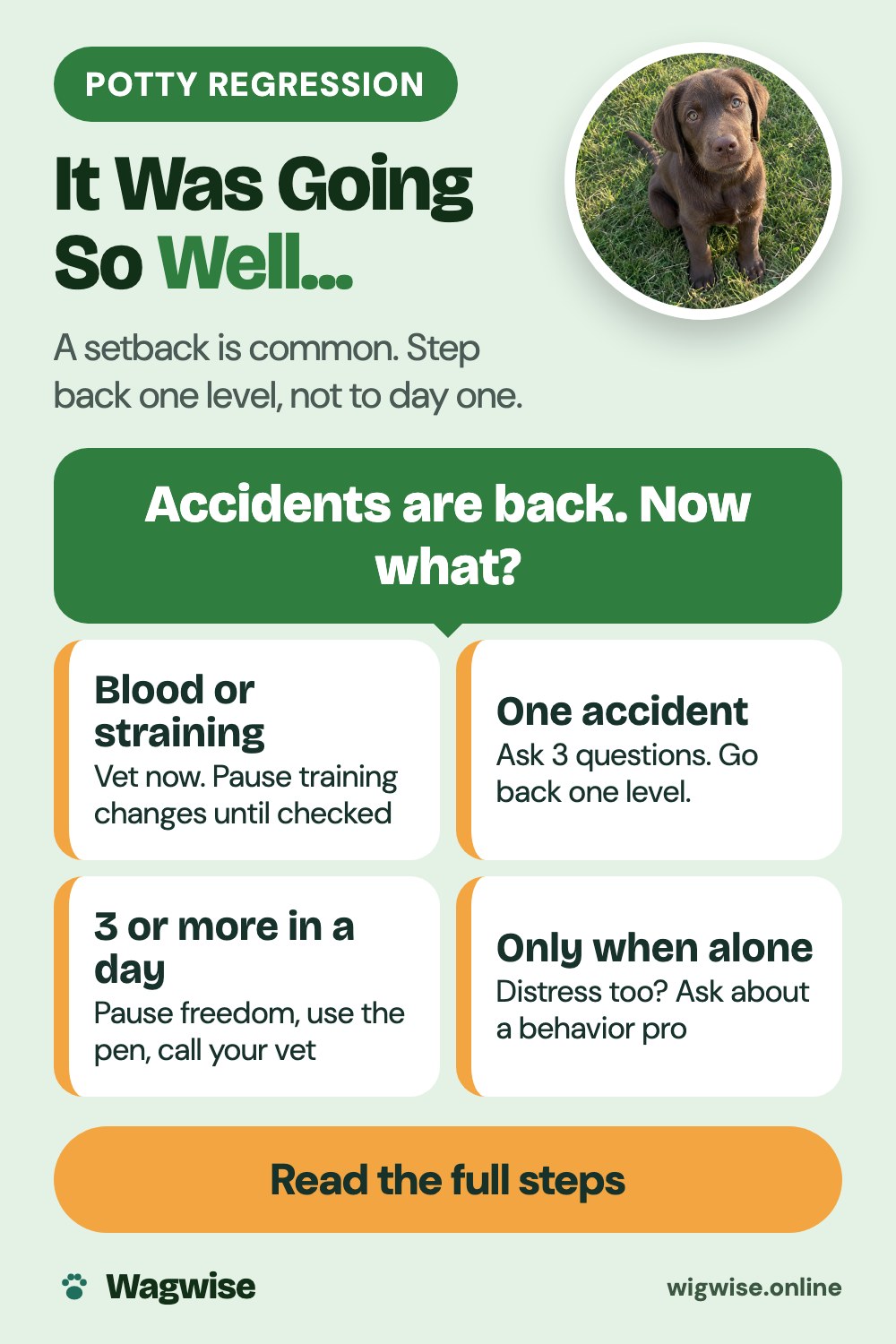
Expect progress in days for mild cases, or 2 to 4 weeks for deeper setbacks. Some dogs need supervision until 12 to 18 months, so be patient with the middle.
How many accidents mean what?
| What is happening | What to do |
|---|---|
| One accident | Ask three questions: Was my puppy watched? Was a trip overdue? Too much space too soon? Go back one level. |
| Three or more in a day | Pause freedom. Use the pen plus a tight schedule. Call your vet. |
| Blood, straining, drinking more, or sudden onset | Vet now. Stop training changes until checked. |
| Only when left alone, with distress | Ask about a behavior professional. |
The “three or more in a day” rule is our own rule of thumb, not a clinical standard.
What about marking, excitement and fear peeing?
Peeing on upright surfaces, or when greeting, excited or scared, can be marking or excitement or submissive urination, which most often affects puppies and young females. These are not the same as a missed trip. Mention them to your vet, and keep greetings calm.
What about travel, guests and new places?
Keep the schedule. Take a bag of your usual treats, go to a set spot soon after you arrive, and stay eyes-on. New places are new to your puppy, so be ready for extra trips.
How do I stop it from happening again?
After a perfect week, an accident is not a failure. Ask the three questions, go back one step, and check for routine changes and stress. Giving the whole house too early is a top cause of relapse, so earn each room with clean days. See the freedom ladder for the steps, and the medical red flags for what to bring to the vet. The House-Train Your Puppy guide has the full recovery plan, and our free Fresh Accident Kit helps with cleanup.
Frequently asked questions
Why is my puppy having accidents again?
Common causes are more freedom than the puppy was ready for, rewards stopping too soon, a change like moving or travel, stress, adolescence or marking, and health problems. Check with your vet first, then look at the routine.
When does potty training regression happen?
A veterinarian's article says it may appear around 4 to 6 months, or in adolescence, which is usually before a year.
How long does it take to recover?
The same veterinarian says mild cases may improve in days, and deeper setbacks may take 2 to 4 weeks. Some dogs need supervision until 12 to 18 months.
Should I start over from day one?
No. Step back one level on the freedom ladder, tighten supervision and keep rewarding successes. One accident means one step back.
More Wagwise guides for dog owners
 Stop Puppy BitingA gentle 4-week plan to stop the nipping and get through teething.$17 · instant PDFSee the guide →
 Get Rid of Dog Pee SmellRemove urine odor for good, then stop the accidents with a 14-day reset.$17 · instant PDFSee the guide →
 Stop Dog BarkingA quiz finds why your dog barks, then a plan made for that reason.$17 · instant PDFSee the guide →
 Help Your Itchy DogTrack triggers, soothe skin safely and know when to see the vet.$17 · instant PDFSee the guide →
 Stop Leash PullingA 4-week force-free plan for calmer walks and a loose leash.$17 · instant PDFSee the guide →
 Leave Your Dog AloneFilm, sort and build calm alone time with a vet-first plan and a step-by-step ladder.$17 · instant PDFSee the guide →
 Puppy Sleeps Through the NightA realistic, age-by-age plan for calmer nights, without cry-it-out or crate fights.$17 · instant PDFSee the guide →
 Less Dog Hair, Less SmellA 4-week brushing, bath and home routine for a calmer-smelling house.$17 · instant PDFSee the guide →
Want all four? Get the complete library for $49.
Sources
This article is general education, not veterinary advice. It does not replace an examination by your vet or help from a qualified behaviourist.