House-training
Potty Training When You Work Full Time
Quick answer
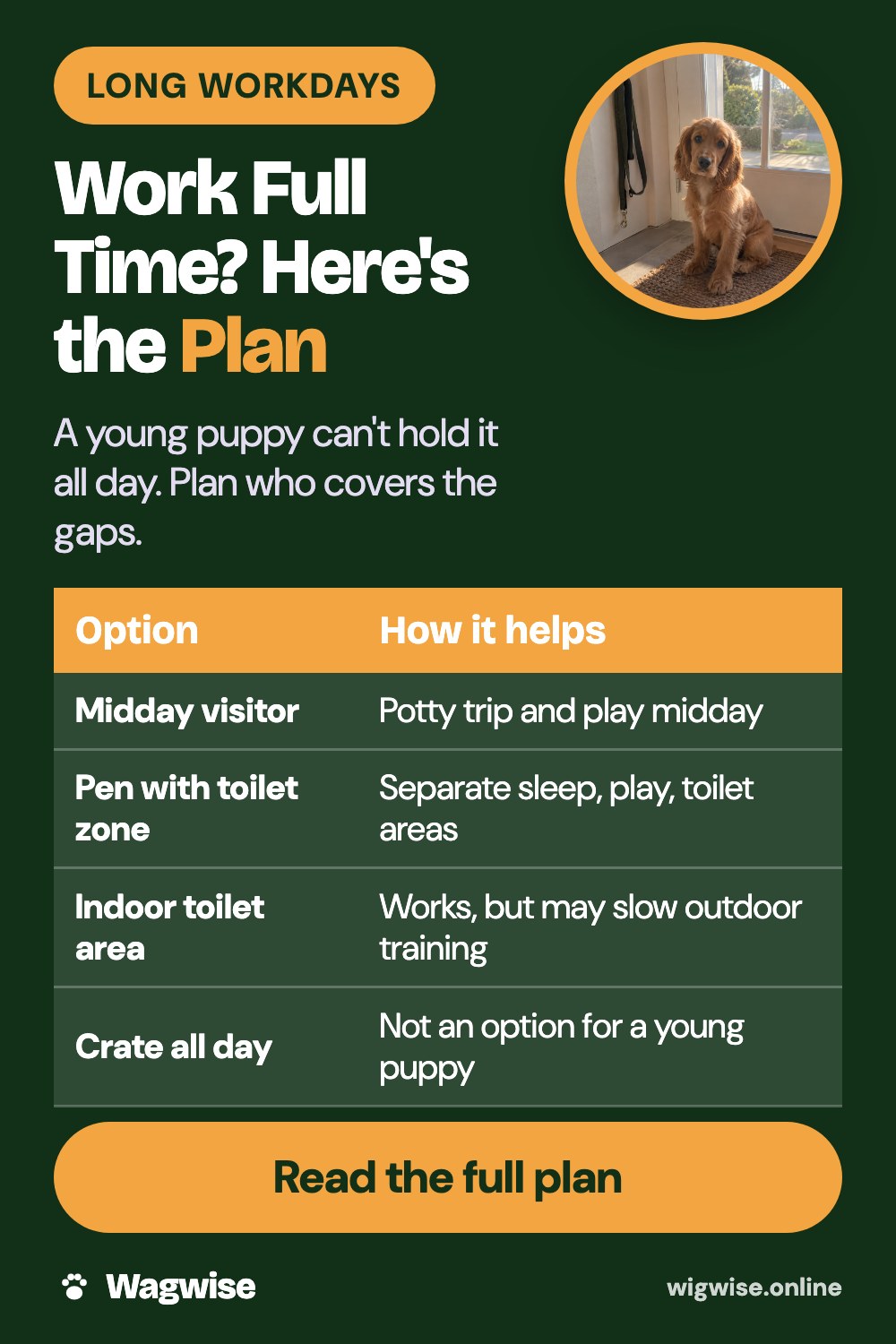
Potty training when you work full time takes an honest plan. Humane World says a young puppy may not suit a schedule with more than four or five hours away. Cover long gaps with a midday visitor and a pen with a toilet zone, and never crate a young puppy longer than they can hold it.
- Long workdays are a reason to plan, not a judgment on you.
- One source says more than four or five hours away a day may not suit a young puppy.
- A midday visitor and a pen with separate sleep, play and toilet areas beat a long crate stay.
- Crating a young puppy for longer than they can hold it risks accidents and distress.
Potty training when you work full time is not impossible, but it needs an honest plan. A young puppy cannot hold it all day, and no tip changes that. What helps is cover for the long gaps, a safe setup, and a routine you follow before and after work.
Is a long workday a problem for a young puppy?
Humane World says that if you are away more than four or five hours a day, a young puppy may not suit your schedule. That is not a judgment. It is a reason to plan before the puppy arrives, or to ask who can help.
Puppies hold it for a limited time. A common ceiling is about as many hours as their age in months, but play, excitement and drinking shorten it. Treat that as the most a calm puppy might manage, not a plan.
What are my options for the long gap?
| Option | How it works | Watch for |
|---|---|---|
| Midday visitor | A neighbor, friend or sitter takes your puppy to the spot, plays, and goes | They need your spot, cue and treats |
| Pen with a toilet zone | Separate sleep, play and toilet areas | Keep the toilet corner away from bed and water |
| Indoor toilet area | Works, but has trade-offs | Indoor training can make outdoor training take longer |
Crating a young puppy for longer than they can hold it is not an option. It risks accidents and distress. If a long gap is unavoidable, a pen and a visitor beat a crate.
How do I brief a sitter or walker?
Write it down so everyone gives the same message. Include:
- The toilet spot and the cue word
- Trip times and the treats to use
- What to do: leash on, wait quietly, reward after your puppy finishes, then a short walk, and log the trip
- What not to do: scold or punish, and ring you or the vet if anything seems odd
What does a working-day routine look like?
Keep the six triggers exactly as they are: waking, after eating, after drinking, after play, last thing at night, and before you leave and when you return.
- Wake, then go straight to the spot.
- Breakfast, then another trip, then short play.
- A trip right before you leave.
- Puppy goes to the pen, with a bed, water and chew.
- Your visitor covers the middle of the day.
- A trip the moment you are home, before you do anything else.
- An evening of eyes-on supervision, with trips on every trigger.
Write down every trip. Your log shows whether the gaps are working. If the plan produces repeated accidents, shorten the gap or add cover. See crate training for potty for what a crate is and is not for.
What if I live in an apartment?
A short route to one spot matters even more. See potty training a puppy in an apartment for the routes. Calm time apart is its own skill and is best built gradually, so do not rush it.
When should I get help?
If your puppy strains, cries or seems uncomfortable when forced to wait, call your vet. If they seem distressed when alone, ask a qualified, reward-based behavior professional. The House-Train Your Puppy guide has a handover sheet for sitters and the full plan.
Frequently asked questions
Can I potty train a puppy if I work full time?
It can be done, but be honest about the gaps. Humane World says if you are away more than four or five hours a day, a young puppy may not suit your schedule. That is a reason to plan, with a visitor and a pen.
Can I crate my puppy while I work?
Crating a young puppy for longer than they can hold it is not an option. It risks accidents and distress. If a long gap is unavoidable, a pen and a visitor beat a crate.
What should a pen for a working owner include?
Separate sleep, play and toilet areas, so your puppy can sleep away from where they go.
Do pee pads solve long days?
Experts differ. An indoor toilet area works, but it has trade-offs, like slowing outdoor training. Ask your vet if unsure.
More Wagwise guides for dog owners
 Stop Puppy BitingA gentle 4-week plan to stop the nipping and get through teething.$17 · instant PDFSee the guide →
 Get Rid of Dog Pee SmellRemove urine odor for good, then stop the accidents with a 14-day reset.$17 · instant PDFSee the guide →
 Stop Dog BarkingA quiz finds why your dog barks, then a plan made for that reason.$17 · instant PDFSee the guide →
 Help Your Itchy DogTrack triggers, soothe skin safely and know when to see the vet.$17 · instant PDFSee the guide →
 Stop Leash PullingA 4-week force-free plan for calmer walks and a loose leash.$17 · instant PDFSee the guide →
 Leave Your Dog AloneFilm, sort and build calm alone time with a vet-first plan and a step-by-step ladder.$17 · instant PDFSee the guide →
 Puppy Sleeps Through the NightA realistic, age-by-age plan for calmer nights, without cry-it-out or crate fights.$17 · instant PDFSee the guide →
 Less Dog Hair, Less SmellA 4-week brushing, bath and home routine for a calmer-smelling house.$17 · instant PDFSee the guide →
Want all four? Get the complete library for $49.
Sources
This article is general education, not veterinary advice. It does not replace an examination by your vet or help from a qualified behaviourist.