
Puppy sleep
When Your Puppy Cries: What to Check
Quick answer
For puppy whining at night, check the toilet, then comfort, then tiredness, then safety and health, and keep your response small and kind. Pause 10 to 20 seconds to see if it is only grumbling. Escalating or panicky crying always needs a response.
- Run the Cry Check in order: toilet, comfort, tiredness, then safety and health.
- Use a response ladder: pause, toilet trip, calm presence, stay beside the crate, then call your vet if it escalates.
- Respond to the need and keep your response flat and quiet. No games and no treats for crying.
- The Wagwise guide does not use cry-it-out for a young, newly arrived puppy.
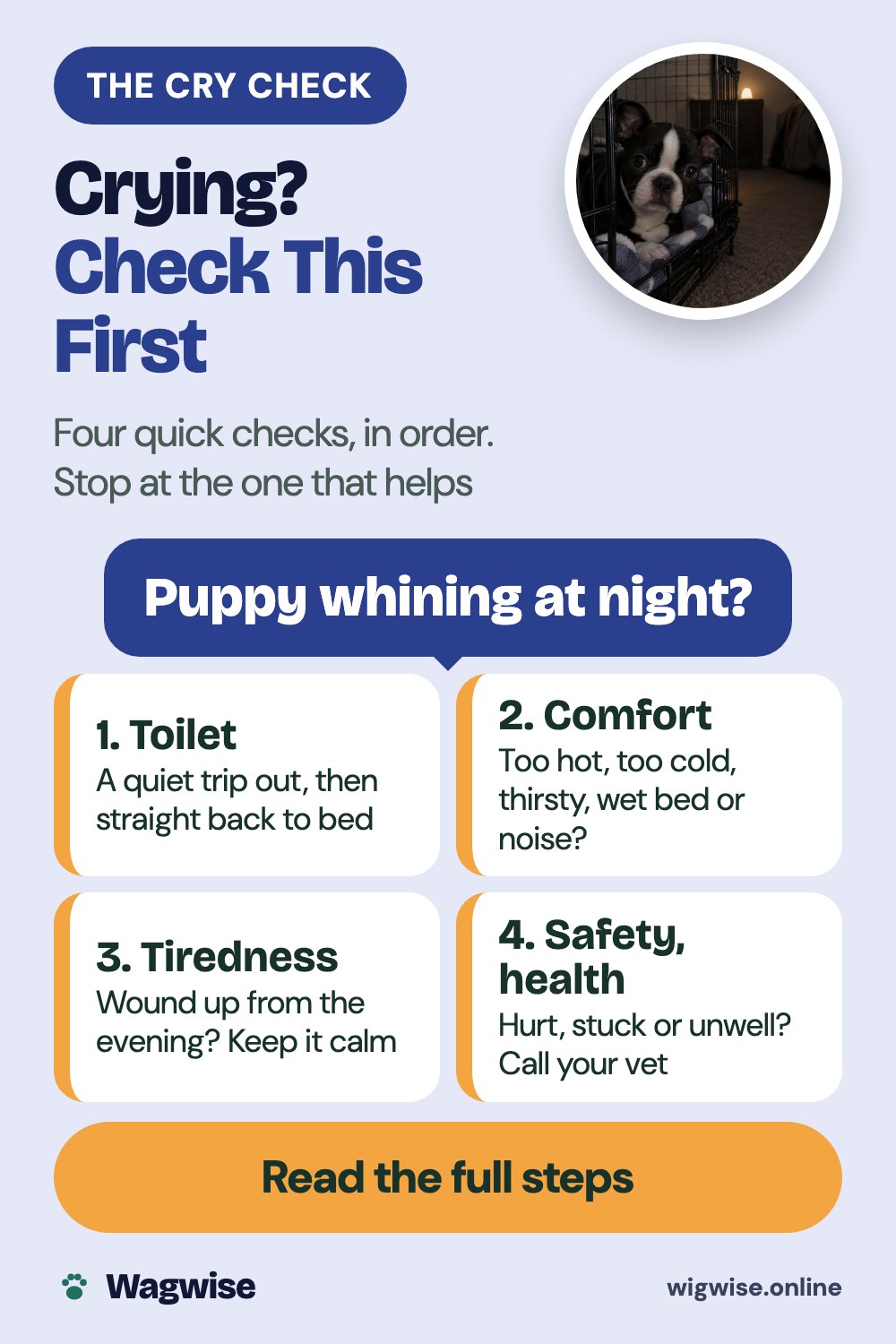
Puppy whining at night is easier to handle when you check the same things in the same order. Look at the toilet, then comfort, then tiredness, then safety and health. Each check takes under a minute, and none needs a long, loud response.
What is the Cry Check for puppy whining at night?
- Toilet. A quiet trip out.
- Comfort. Hot, cold, thirsty, a wet bed or a noise?
- Tiredness. Overtired or wound up from the evening?
- Safety and health. Anything stuck, hurt or unwell?
What is the response ladder?
Use these steps in order and stop when your puppy settles.
- Pause 10 to 20 seconds. Is it grumbling as they settle? That does not need a response. This is the guide’s suggestion, not a sourced rule.
- Toilet trip, if there is a real call.
- Calm presence: a hand near the crate, a quiet voice, a gentle stroke.
- Stay beside the crate until your puppy settles. Expect this in the first nights.
- Escalating panic? Stop and call your vet.
Should I ignore a crying puppy?
Experts differ, and the difference is mostly about what “ignore” means.
| Source | What it says |
|---|---|
| Wood Green | Do not ignore a young puppy’s cries. Take them out calmly. If they go, praise gently. If not, offer reassurance. |
| Dogs Trust | The first step with a crying dog is to find out why. If a puppy cries when you move its bed, go back a step. |
| Humane World | Once the crate steps are followed and needs are met, try to ignore whining. After several minutes, take the dog out for a purposeful trip, never for play. |
| AKC and RSPCA UK | Wait for a pause before opening the door, unless the puppy likely needs the toilet. |
The Wagwise guide separates two cases. In daytime crate practice, wait for a pause before you open the door, so noise does not open it. For night crying in a young, newly arrived puppy, respond to the first real call with a toilet check and calm presence, and keep it small and boring. There is no “wait it out for 30 minutes.” That is a judgment call, not a rule.
Why doesn’t this guide use cry-it-out?
“Cry-it-out” means leaving a puppy to cry alone until they stop. We do not use it for three reasons. A new puppy may be truly frightened. One veterinary practitioner argues it can be a precursor for separation-related behaviors, though that is one author’s view, not a trial. And the research is thin, so we pick the approach that costs you little.
A small randomized study from the Royal Veterinary College and Dogs Trust, with 34 owners, found no significant overall effect of gradual alone time or calm departures advice on specific separation-distress signs. The authors say a larger study is needed.
How do I avoid rewarding noise without ignoring need?
Respond to the need, and keep your response flat and quiet. No games and no treats for crying. In daytime crate practice, open the door on a pause in the noise. Pick one calm phrase and say it the same way each time.
What if it will not stop?
Step back to the last distance that worked. If crying is intense or is not improving over several nights, call your vet. For red flags, see Why Puppies Cry at Night.
Keep the Cry Check where you can see it in the dark, and write down what helped each time your puppy cries. After a week, that note becomes your own best guide, because it shows what works for your puppy rather than what works in general. Agree at home that nobody shouts at or bangs the crate.
Frequently asked questions
Should I ignore puppy whining at night?
Sources mean different things by ignore. Wood Green says do not ignore a young puppy's cries. Humane World says to try to ignore plain whining once needs are met and the crate is trained. The Wagwise guide separates daytime crate practice from night crying in a newly arrived puppy.
What is cry-it-out, and why doesn't the guide use it?
It means leaving a puppy to cry alone until they stop. A new puppy may be truly frightened, one veterinary practitioner argues it can be a precursor for separation-related behaviors, and the research is thin. So the guide picks a short, kind check instead.
Will going to my puppy teach them to cry more?
A brand-new puppy is not crying to train you. A short, kind, boring check meets a real need and costs you little.
What should I say to my crying puppy?
Pick one calm phrase and say it quietly the same way. 'I'm here' for a young puppy in the first nights, 'Bed' for an older puppy testing the door, 'Back to sleep' after a toilet trip.
More Wagwise guides for dog owners
 Stop Puppy BitingA gentle 4-week plan to stop the nipping and get through teething.$17 · instant PDFSee the guide →
 Get Rid of Dog Pee SmellRemove urine odor for good, then stop the accidents with a 14-day reset.$17 · instant PDFSee the guide →
 Stop Dog BarkingA quiz finds why your dog barks, then a plan made for that reason.$17 · instant PDFSee the guide →
 Help Your Itchy DogTrack triggers, soothe skin safely and know when to see the vet.$17 · instant PDFSee the guide →
 House-Train Your PuppyA kind 4-week plan with a schedule by age, a night plan and printable trackers.$17 · instant PDFSee the guide →
 Stop Leash PullingA 4-week force-free plan for calmer walks and a loose leash.$17 · instant PDFSee the guide →
 Leave Your Dog AloneFilm, sort and build calm alone time with a vet-first plan and a step-by-step ladder.$17 · instant PDFSee the guide →
 Less Dog Hair, Less SmellA 4-week brushing, bath and home routine for a calmer-smelling house.$17 · instant PDFSee the guide →
Want all four? Get the complete library for $49.
Sources
This article is general education, not veterinary advice. It does not replace an examination by your vet or help from a qualified behaviourist.