
Puppy sleep
Why Puppies Cry at Night
Quick answer
Why do puppies cry at night? There are six usual reasons: feeling alone, basic needs like the toilet, being overtired, noise or a startle, pain or illness, and panic or fear. Most can be checked in under a minute, so you do not have to guess.
- Six usual reasons explain night crying, and most can be checked in under a minute.
- Nights 1 to 3 are often the hardest because everything is new.
- The same sound can mean toilet, lonely or scared, which is why you check rather than guess.
- Pain, illness, panic and fear need your vet, not more crate practice.
Why do puppies cry at night? There are six usual reasons, and most of them can be checked in under a minute. Your puppy has just left their mom and littermates, so some crying is expected. Work through the list in order instead of guessing.
Why does my puppy cry at night? The six usual reasons
| Reason | What it looks like | First check |
|---|---|---|
| 1. Feeling alone | Everything is new. Nights 1 to 3 are often the hardest. | Are they close to you? |
| 2. Basic needs | Toilet, hunger, thirst, a wet bed, too hot or too cold. | A quiet toilet trip |
| 3. Overtired or wound up | Evening zoomies usually mean a tired puppy. | The evening wind-down |
| 4. Noise or a startle | A door, a pipe, a neighbor, a bark outside. | A dim, quiet room |
| 5. Pain or illness | Crying with vomiting, diarrhea, low energy or an upset belly. | Call your vet |
| 6. Panic or fear | Frantic escape attempts, drooling, hard panting. | Stop crate work and call your vet |
Is it loneliness on the first nights?
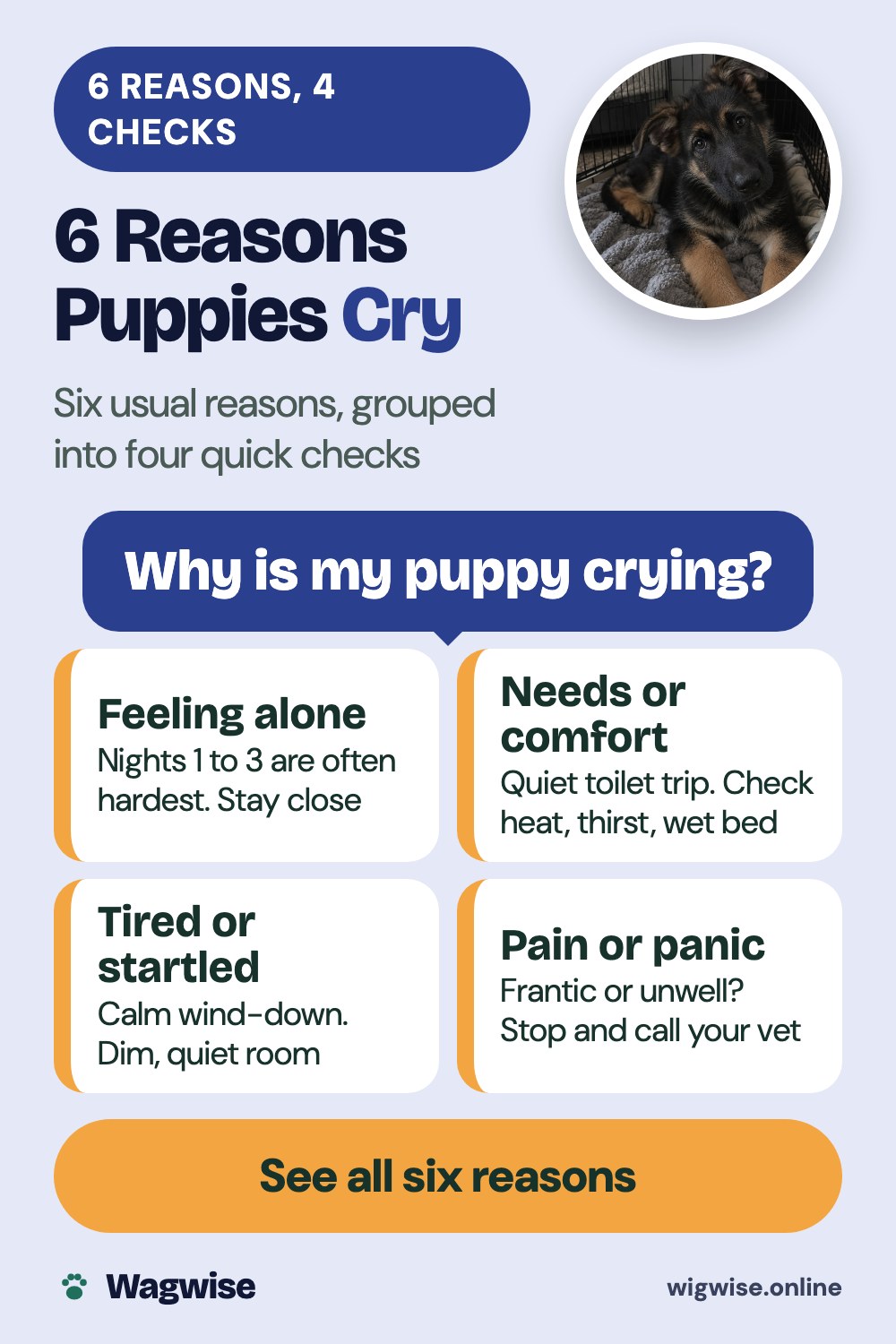
On the first nights, the most common reason is simply that everything has changed. Your puppy is sleeping alone in a dark room after being with their mom and littermates. That is a big deal for a baby animal. Starting your puppy close to you, with a crate or pen beside your bed, is the usual first move.
Could it be the toilet or comfort?
A small bladder is the other big first-week reason. A quiet toilet trip is the first check, with low light and no play. Then look at comfort: is the room too warm or cold, is the bed wet, is your puppy thirsty? Fix it quietly and go back to bed.
Is my puppy overtired?
An overtired puppy is harder to settle. If the evening is full of zoomies and mouthing, that usually means a tired puppy that needs sleep, not an energetic one. A calm wind-down in the last 30 minutes before bed helps more than trying to wear the puppy out. For a full wind-down, see The Puppy Bedtime Routine.
Noise or a startle? A door, a pipe or a bark outside can wake a puppy. Keep the room dim and quiet, and try one sound idea at a time. Never shout at the crate.
When is the crying pain, illness or panic?
Crying together with vomiting, diarrhea, very low energy or an upset belly is not a settling problem. Call your vet. Panic looks different: frantic escape attempts, drooling and hard panting. If you see those, stop crate work and call your vet. They can check for illness and refer you to a qualified behavior professional if needed.
Do puppies cry less as they grow?
Yes, for most puppies the pattern changes with age. Night wake-ups fade as bladder control grows. Wood Green says most puppies sleep through by about 16 weeks, and the AKC says middle-of-the-night trips usually end by 4 to 5 months. Some take longer, so the honest range is wide. Fewer and shorter episodes are the sign that things are moving the right way, not a specific number of hours.
A short log helps here. Write down the time your puppy cried, what you checked and what helped. After a few nights you can often see whether the reason is the toilet, the bedtime or the room, instead of guessing again each night.
Why check instead of guess?
The same sound can mean “I need the toilet,” “I’m lonely” or “I’m scared.” That is why a quick check beats a guess. A little grumbling as a puppy settles does not need a response, but escalating, panicky crying always does. For a step-by-step version, read When Your Puppy Cries: What to Check.
Frequently asked questions
Is my puppy crying to manipulate me?
No. A new puppy is not crying to train you. Crying is communication, and a short, kind check meets a real need.
Why does my puppy cry most on the first nights?
Your puppy has left their mom and littermates and is sleeping alone in a dark room. That is a big deal for a baby animal, and nights 1 to 3 are often the hardest.
Do evening zoomies mean my puppy has too much energy?
Evening zoomies usually mean a tired puppy that needs sleep. A calm wind-down helps more than a long, exciting evening.
When is crying not just a normal puppy thing?
Crying with vomiting, diarrhea, low energy or an upset belly, or crying with frantic escape attempts, drooling or hard panting, needs your vet.
More Wagwise guides for dog owners
 Stop Puppy BitingA gentle 4-week plan to stop the nipping and get through teething.$17 · instant PDFSee the guide →
 Get Rid of Dog Pee SmellRemove urine odor for good, then stop the accidents with a 14-day reset.$17 · instant PDFSee the guide →
 Stop Dog BarkingA quiz finds why your dog barks, then a plan made for that reason.$17 · instant PDFSee the guide →
 Help Your Itchy DogTrack triggers, soothe skin safely and know when to see the vet.$17 · instant PDFSee the guide →
 House-Train Your PuppyA kind 4-week plan with a schedule by age, a night plan and printable trackers.$17 · instant PDFSee the guide →
 Stop Leash PullingA 4-week force-free plan for calmer walks and a loose leash.$17 · instant PDFSee the guide →
 Leave Your Dog AloneFilm, sort and build calm alone time with a vet-first plan and a step-by-step ladder.$17 · instant PDFSee the guide →
 Less Dog Hair, Less SmellA 4-week brushing, bath and home routine for a calmer-smelling house.$17 · instant PDFSee the guide →
Want all four? Get the complete library for $49.
Sources
This article is general education, not veterinary advice. It does not replace an examination by your vet or help from a qualified behaviourist.