
Home alone
Distress, Boredom, Mischief or Not House-Trained?
Quick answer
Dog separation anxiety or boredom? Start with the red-flag check, because any yes means vet first. Then match your footage to four patterns: distress, boredom, teen mischief, or not house-trained. It is a sorter that points, not a diagnosis. If you are unsure, treat it as possible distress.
- Red-flag screen first. Any yes means call your vet, and start covering the long hours while you wait.
- Four patterns to match: distress, boredom, teen mischief, and not house-trained.
- Dogs can have more than one pattern. Re-film every two weeks and update your sort.
- If the behavior happens while you are home, it is probably not separation anxiety.
Dog separation anxiety or boredom? You can’t tell from the mess alone, but your footage can point the way. Start with the red-flag check, then match what you see to four patterns. Think of it as a sorter that points, not a verdict.
The four patterns are distress, boredom, teen mischief, and house-training that isn’t finished.
Step one: the red-flag check
Answer this before anything else. Any “yes” means vet first, and you can start covering the long hours while you wait.
- A new or sudden change in behavior, or more fear or clinginess than before.
- Self-injury or escape attempts: bleeding paws, broken teeth, frantic scraping at doors or windows.
- An older dog (around 8 or more) with new fears, restless nights or confusion.
- Body clues: drinking and toileting more, accidents when you are home, limping or stiffness.
- Any bite or attempted bite, including at a person leaving.
- Panic-level signs: crying for most of the footage, or refusing all food.
Medical causes can look like anxiety, and the other way around. Your vet will want to rule out pain, illness, incontinence, medication side effects, age-related changes, excitement or submissive urination, and reactions to sights and sounds that also happen when you are home.
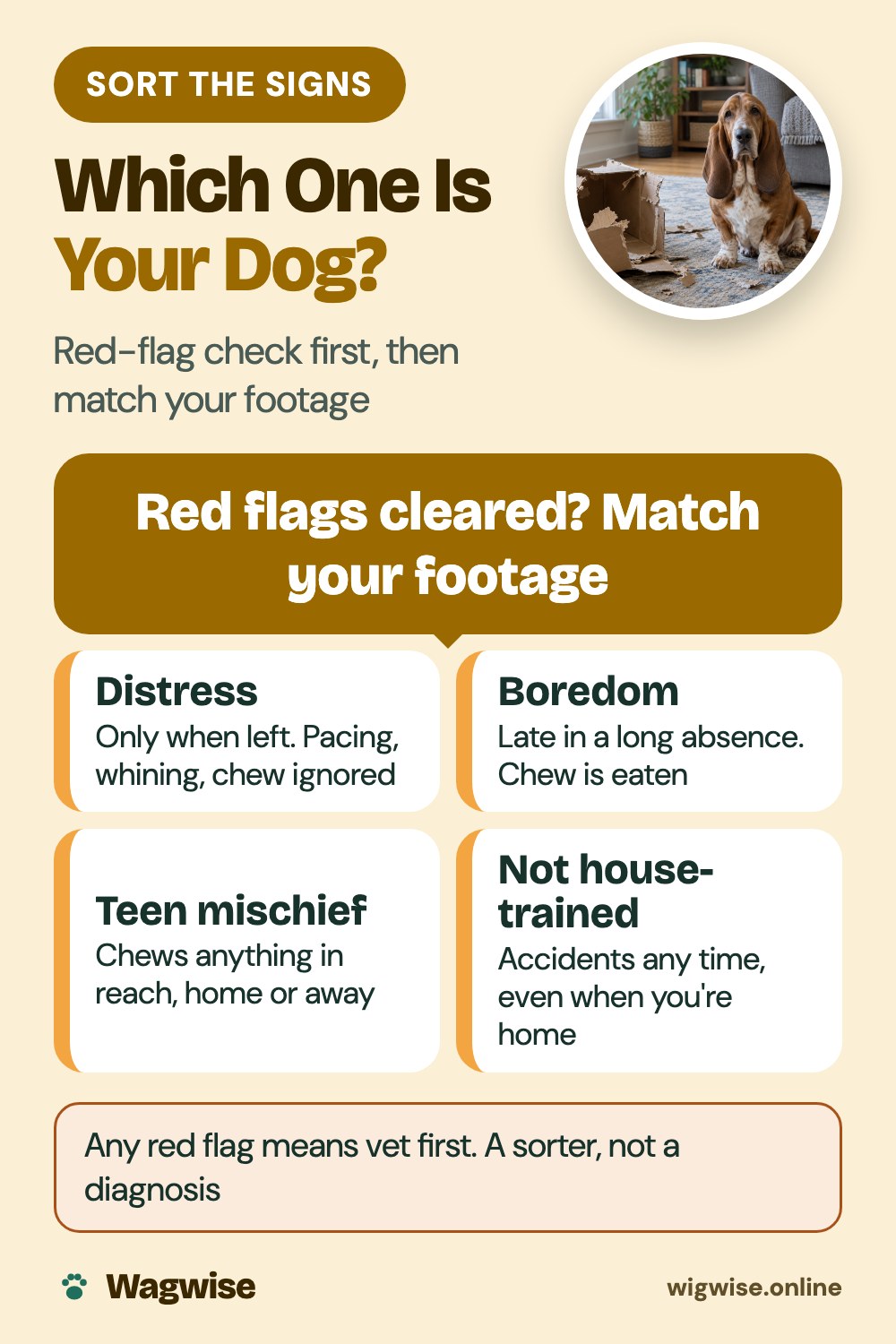
Dog separation anxiety or boredom: match your footage
| Pattern | What it tends to look like |
|---|---|
| Distress | Only when left, often starting as you get ready to go. Pacing, whining, drooling, the door. Chew ignored. Damage at doors and windows. Frantic greeting. |
| Boredom | Late in a long absence, on and off. Wanders, then settles or sleeps. Chew eaten, then looks for more to do. Random household items. |
| Teen mischief | Home or away. Settles, then picks things up. Chews whatever is in reach, like shoes and furniture. |
| Not house-trained | Any time, including when you are home. Normal until it toilets. Chew eaten. |
One column will usually stand out. Toileting is a useful clue: with distress it is often frequent even in a house-trained dog, while with boredom or mischief it is rare.
Why is teenage chewing so easy to mistake?
Teething usually ends around seven months, but some dogs have a second chewing phase near their first birthday. The RSPCA says adolescence can run from about 6 to 12 months up to 18 to 24 months, and that fear and anxiety can show up as destructiveness or house soiling in adolescent dogs too. Teen chewing and distress can overlap, so don’t assume either one.
Boredom is real too, and it can grow. Dogs Trust notes that boredom and frustration can develop into anxiety, so both need attention. Timing is only a clue, not the answer.
What do you do with your sort?
These are our rules of thumb, built on advice that says to rule out other common causes first.
- Any red flag: vet first. Cover the long hours while you wait.
- Two or more distress markers: get professional help, then follow a gradual plan.
- Mostly boredom or mischief and a relaxed video: add enrichment and safe setup, then re-film in two weeks.
- Accidents while you’re home: vet check, then restart house-training.
- Mixed or unclear: treat it as possible distress, and start gently.
Dogs can have more than one pattern. A teenage chewer can also be a worried dog, so re-film every two weeks.
If you haven’t yet, film your dog first. Then see who to call and when. The Wagwise home alone guide has the full sorter as a printable. It is general education and can’t replace an exam.
Frequently asked questions
How can I tell if it is separation anxiety or boredom?
Film your dog and compare. Distress often starts as you get ready to go, and shows as pacing, whining, drooling and an ignored chew. Boredom tends to show late in a long absence, and the chew gets eaten.
Does chewing only when I'm out mean it is anxiety?
It can point that way, especially if the damage is at doors and windows. But teenage chewing is real too, so use the footage and your vet rather than guessing.
My dog has accidents even when I'm home. Is that anxiety?
Accidents when you are home point away from separation anxiety. See your vet to check for health causes, then restart house-training.
What if I can't tell which one it is?
Treat it as possible distress. Start gently and keep your dog well below its limits, because wrongly leaving a distressed dog longer costs more than being gentle with a bored one.
More Wagwise guides for dog owners
 Stop Puppy BitingA gentle 4-week plan to stop the nipping and get through teething.$17 · instant PDFSee the guide →
 Get Rid of Dog Pee SmellRemove urine odor for good, then stop the accidents with a 14-day reset.$17 · instant PDFSee the guide →
 Stop Dog BarkingA quiz finds why your dog barks, then a plan made for that reason.$17 · instant PDFSee the guide →
 Help Your Itchy DogTrack triggers, soothe skin safely and know when to see the vet.$17 · instant PDFSee the guide →
 House-Train Your PuppyA kind 4-week plan with a schedule by age, a night plan and printable trackers.$17 · instant PDFSee the guide →
 Stop Leash PullingA 4-week force-free plan for calmer walks and a loose leash.$17 · instant PDFSee the guide →
 Puppy Sleeps Through the NightA realistic, age-by-age plan for calmer nights, without cry-it-out or crate fights.$17 · instant PDFSee the guide →
 Less Dog Hair, Less SmellA 4-week brushing, bath and home routine for a calmer-smelling house.$17 · instant PDFSee the guide →
Want all four? Get the complete library for $49.
Sources
This article is general education, not veterinary advice. It does not replace an examination by your vet or help from a qualified behaviourist.