Home alone
Film Your Dog: What to Look For
Quick answer
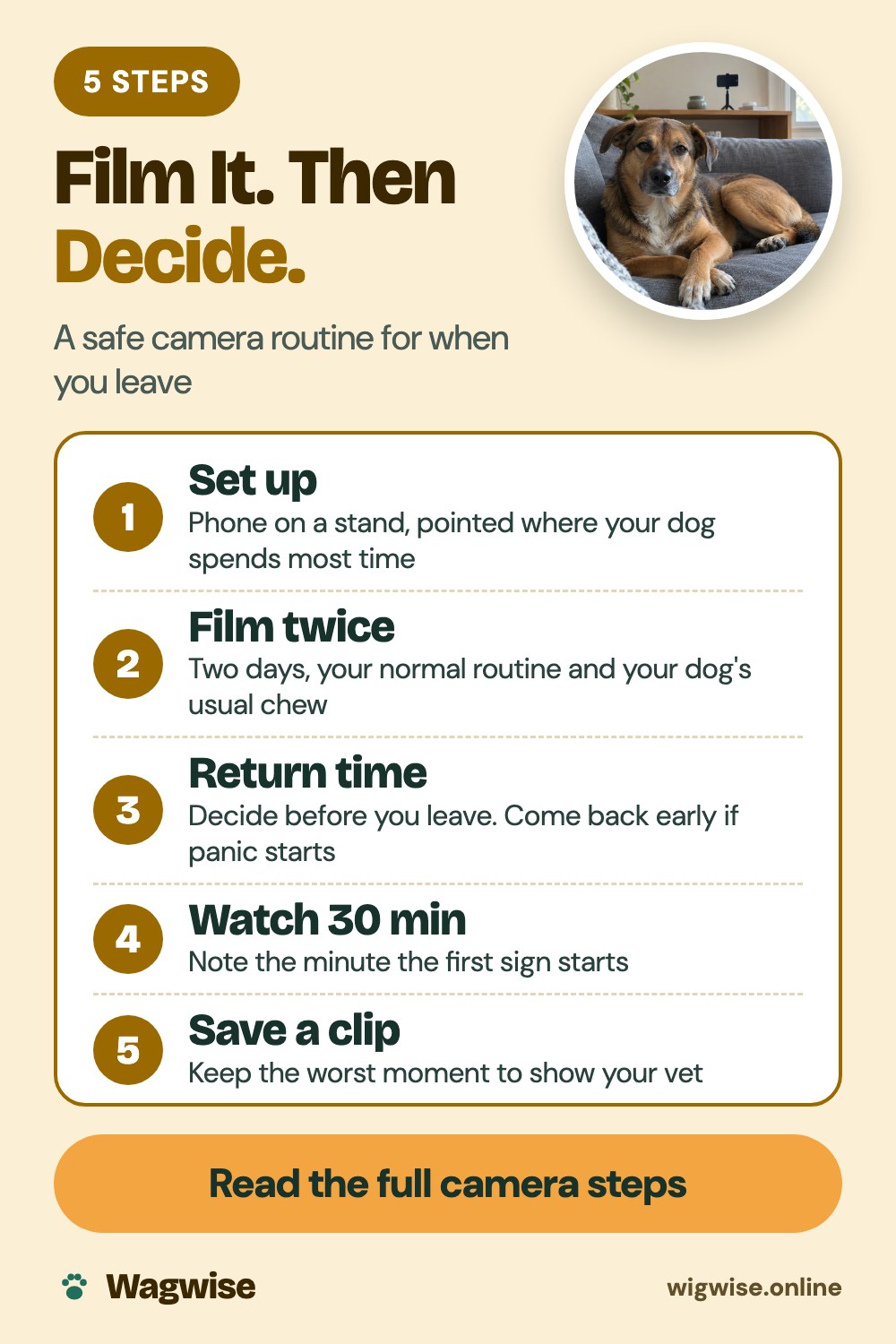
Film your dog when you leave to see what you can't: use a phone on a stand, point it where your dog spends most of its time, and film at least the first 30 minutes on two different days. Note the minute the first sign starts, and return before panic.
- Thirty to sixty minutes of video tells you more than weeks of guessing.
- Film two sessions on different days with your normal routine and your dog's usual chew.
- Note when the first sign starts, then body, voice, doors and windows, the chew, and settling.
- Decide your return time in advance. If your dog panics or hurts itself, go back in calmly and stop for the day.
To film your dog when you leave, put a phone on a stand where your dog spends most of its time, hit record, and go out for a short, planned time. Thirty to sixty minutes of video tells you more than weeks of guessing. It also gives your vet something real to look at.
About half of dogs with separation-related behavior show no signs while the owner is home, so a camera sees what you can’t.
How do I film my dog when I leave?
Use a phone on a stand, a second old phone, or a pet camera. Point it where your dog spends most of its time, and try more than one spot if you are not sure. Film two sessions on different days, using your normal routine and your dog’s usual chew. If you can, watch live from outside or on a video call.
Safety comes first:
- Decide your return time before you leave.
- Don’t rush in on every bark.
- Never leave a distressed dog to “film more”.
- If your dog is panicking, hurting itself or trying to escape, go back in calmly and stop filming for that day.
Why is video worth the effort?
Merck calls video “an invaluable diagnostic tool”. In one trial, many owners who believed their dog had separation anxiety did not meet the criteria on a 60-minute video. So the camera helps in both directions: it can show real distress, and it can show a dog who is bored or simply a teenager.
What should I look for in the first 30 minutes?
Experts differ on when signs start. Dogs Trust, ASPCA and RSPCA describe signs within minutes of you leaving, or even as you get ready. One review reports an average of about 3 minutes for vocalizing and 7 minutes for destruction. Merck says signs typically start 15 to 30 minutes in. So film at least the first 30 minutes and treat the start time as a clue, not a rule.
| Look at | What to note |
|---|---|
| When | The minute the first sign starts |
| Body | Panting, pacing, drooling, trembling |
| Voice | Barking, howling, whining |
| Doors and windows | Scratching, chewing, watching |
| The chew | Eaten, ignored, or carried around |
| Settling | Does your dog lie down or sleep, and how soon? |
A dog who eats or plays only when you are there may be anxious.
An example of reading the footage
This sheet is made up, just to show how to take notes:
- Minute 0: door closes, dog follows to the door and stands there.
- Minute 2: whining, pacing between the door and the window.
- Minute 6: barking at the door, panting.
- Minute 12: scratching the door frame, chew untouched.
- Minute 25: lies by the door, head up, still watching.
Your dog’s video will look different. It is an illustration, not a prediction.
What should I save for the vet?
- A clip of the worst moment, and a note of the minute the first sign began.
- Anything that happened while you were out, such as a delivery, a siren or a neighbor’s dog.
- Whether your dog does the same things when you are home.
If your dog is relaxed on video, boredom or mischief is more likely, so film again in two weeks. If you aren’t sure, or your dog was never relaxed, treat it as possible distress. Wrongly leaving a distressed dog longer costs more than being gentle with a dog who was only bored.
Next, see what to do tonight when your dog howls and how to sort the signs. The Wagwise home alone guide includes a printable observation sheet. Cameras are for watching, not for treatment.
Frequently asked questions
How long should I film my dog?
Film at least the first 30 minutes, and up to 30 to 60 minutes. Sources differ on when signs start, so treat the onset time as a clue, not a rule.
Where should I put the camera?
Point it where your dog spends most of its time. If you aren't sure, try more than one spot.
What if my dog is relaxed on the video?
If your dog sleeps, plays or chews and then settles, boredom or adolescent mischief is more likely. Film again in two weeks.
Do treat-tossing cameras help?
We found no independent evidence that interactive cameras or treat tossers help with distress. Use your camera to watch and to decide when to come home.
More Wagwise guides for dog owners
 Stop Puppy BitingA gentle 4-week plan to stop the nipping and get through teething.$17 · instant PDFSee the guide →
 Get Rid of Dog Pee SmellRemove urine odor for good, then stop the accidents with a 14-day reset.$17 · instant PDFSee the guide →
 Stop Dog BarkingA quiz finds why your dog barks, then a plan made for that reason.$17 · instant PDFSee the guide →
 Help Your Itchy DogTrack triggers, soothe skin safely and know when to see the vet.$17 · instant PDFSee the guide →
 House-Train Your PuppyA kind 4-week plan with a schedule by age, a night plan and printable trackers.$17 · instant PDFSee the guide →
 Stop Leash PullingA 4-week force-free plan for calmer walks and a loose leash.$17 · instant PDFSee the guide →
 Puppy Sleeps Through the NightA realistic, age-by-age plan for calmer nights, without cry-it-out or crate fights.$17 · instant PDFSee the guide →
 Less Dog Hair, Less SmellA 4-week brushing, bath and home routine for a calmer-smelling house.$17 · instant PDFSee the guide →
Want all four? Get the complete library for $49.
Sources
This article is general education, not veterinary advice. It does not replace an examination by your vet or help from a qualified behaviourist.