Home alone
Make Keys and the Door Boring: Departure Cues
Quick answer
Departure cues for dogs, like keys, coat and shoes, can become warning signs once they predict you leaving. Make them predict nothing: pick up the cue, put it down, and carry on without leaving. Repeat many times a day, in random order, and expect it to take weeks.
- Many dogs react as soon as you pick up your keys, because those things have started to predict you leaving.
- Score each cue from 0 to 3, then start practice with your lowest-scoring cue.
- Repeat many times a day, in random order, at random times, and don't leave.
- Keep goodbyes and hellos calm: no long hug, same quiet words every time.
Departure cues for dogs are the small things that tell your dog you’re about to go: picking up your keys, putting on a coat, touching the door handle. Many dogs react as soon as you pick up your keys, because those things have started to predict you leaving. The fix is to make them predict nothing at all.
Which departure cues does your dog react to?
Watch your dog when you do each of these without leaving. Score 0 = no reaction, 1 = looks up, 2 = follows or whines, 3 = anxious or frantic.
| Cue | Score 0 to 3 |
|---|---|
| Pick up keys | |
| Put on coat | |
| Put on shoes | |
| Pick up bag or laptop | |
| Touch door handle | |
| Alarm or phone ring |
Add your own cues if your dog notices something else. The goal is simple: keys picked up, dog doesn’t care.
How do you make departure cues for dogs boring?
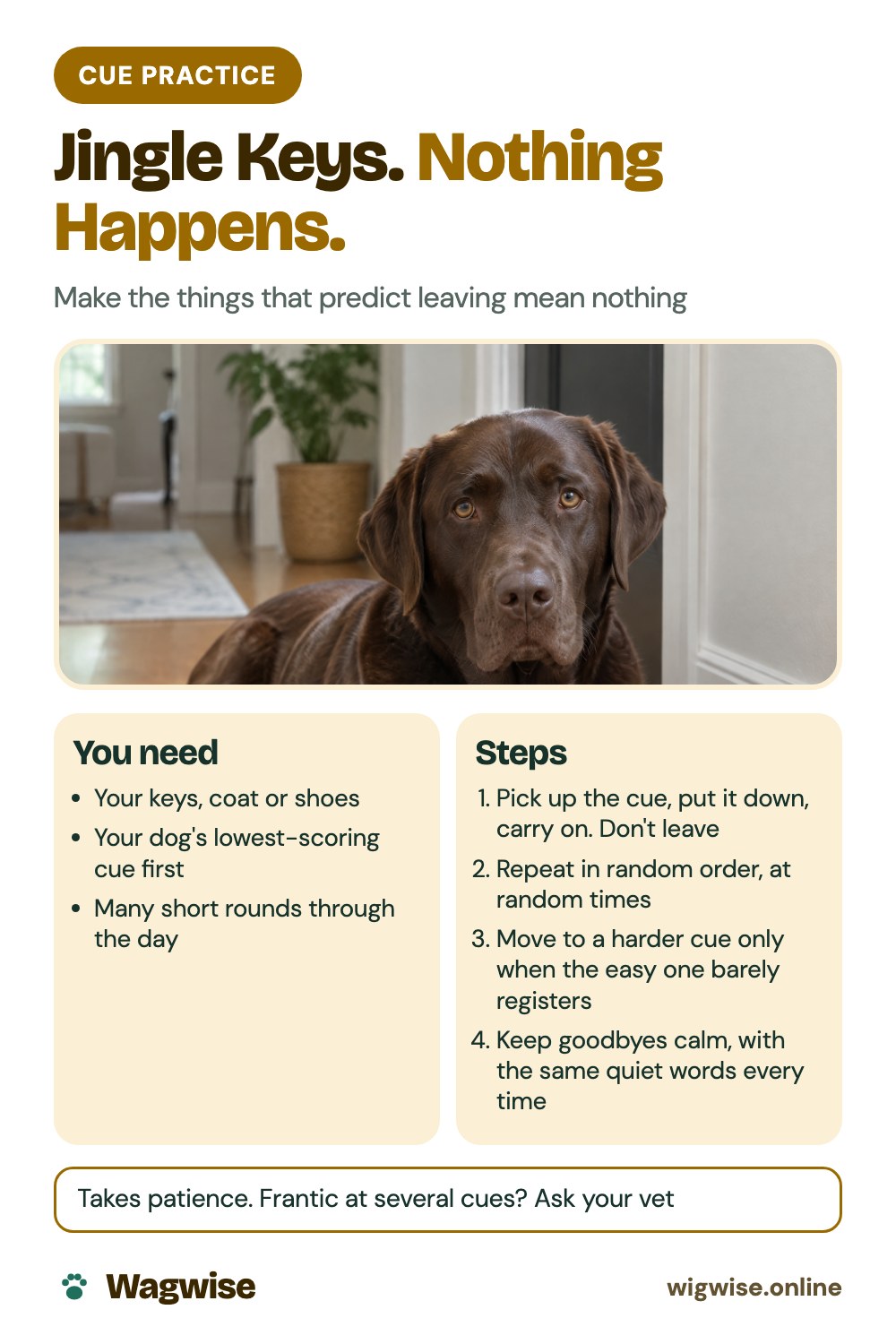
- Start with your lowest-scoring cue. Pick it up, put it down, and carry on with ordinary life. Don’t leave.
- Repeat many times a day, in random order, at random times.
- Only move to a harder cue when your dog barely reacts to the easy one.
How long does it take?
Be patient. ASPCA’s own wording is “several times a day for many weeks”. In one follow-up, owners were much less willing to change their departure cues than to do the easy things, like stopping punishment and giving a chew at departure. This is exactly the harder part that is easy to skip, so it gets its own focus.
If your dog scores 3 on several cues, don’t try to push through on your own. Ask your vet for a referral to a qualified behaviorist, because that may point to real distress.
What does a day of cue practice look like?
Keep it ordinary. In the morning, pick up your keys while you make coffee and put them down again. At lunch, put on your shoes to answer the door, then take them off. In the evening, touch the door handle on your way to fetch something, then sit back down. None of these end in leaving.
The random order matters. If the keys always come right before you walk out, they keep predicting a departure. When the keys sometimes come before nothing at all, they lose their meaning. Move on to a harder cue only when your dog barely reacts to the easy one, and if a cue suddenly gets a bigger reaction, go back to the easier one for a few days.
What does a calm goodbye look like?
- No long hug or chat.
- Your dog is already settled with its chew.
- The same quiet words every time.
- A calm return too: wait for four paws on the floor, then say hello.
Agree one goodbye phrase with everyone in your home, so every exit sounds the same.
Can a safety signal help?
Merck describes using a novel object or sound used only for practice departures, not linked to old ones. If your dog’s distress is severe, only try this under a professional’s advice.
A good plan for today:
- Score your six cues, or add your own.
- Pick up the lowest-scoring cue five times, then sit back down.
- Agree one goodbye phrase.
Cue work sits alongside teaching a settle, and both prepare your dog for the graded-absence ladder. The Wagwise home alone guide has the full cue chapter. It is general education, not a diagnosis, and results vary by dog.
Frequently asked questions
Why does my dog react when I pick up my keys?
Keys, a coat or shoes have started to predict you leaving. Some dogs react as soon as they see these cues, before you've even reached the door.
How long does cue practice take?
ASPCA's own wording is several times a day for many weeks. Don't expect this to be quick.
Is a big goodbye kind to my dog?
A calm goodbye is kinder: no long hug or chat, your dog already settled with its chew, and the same quiet words every time. Keep the return calm too.
Can I add a special signal for practice departures?
Merck describes using a novel object or sound used only for practice departures, not linked to old ones. If your dog's distress is severe, only add this under a professional's advice.
More Wagwise guides for dog owners
 Stop Puppy BitingA gentle 4-week plan to stop the nipping and get through teething.$17 · instant PDFSee the guide →
 Get Rid of Dog Pee SmellRemove urine odor for good, then stop the accidents with a 14-day reset.$17 · instant PDFSee the guide →
 Stop Dog BarkingA quiz finds why your dog barks, then a plan made for that reason.$17 · instant PDFSee the guide →
 Help Your Itchy DogTrack triggers, soothe skin safely and know when to see the vet.$17 · instant PDFSee the guide →
 House-Train Your PuppyA kind 4-week plan with a schedule by age, a night plan and printable trackers.$17 · instant PDFSee the guide →
 Stop Leash PullingA 4-week force-free plan for calmer walks and a loose leash.$17 · instant PDFSee the guide →
 Puppy Sleeps Through the NightA realistic, age-by-age plan for calmer nights, without cry-it-out or crate fights.$17 · instant PDFSee the guide →
 Less Dog Hair, Less SmellA 4-week brushing, bath and home routine for a calmer-smelling house.$17 · instant PDFSee the guide →
Want all four? Get the complete library for $49.
Sources
This article is general education, not veterinary advice. It does not replace an examination by your vet or help from a qualified behaviourist.