Home alone
The Graded-Absence Ladder
Quick answer
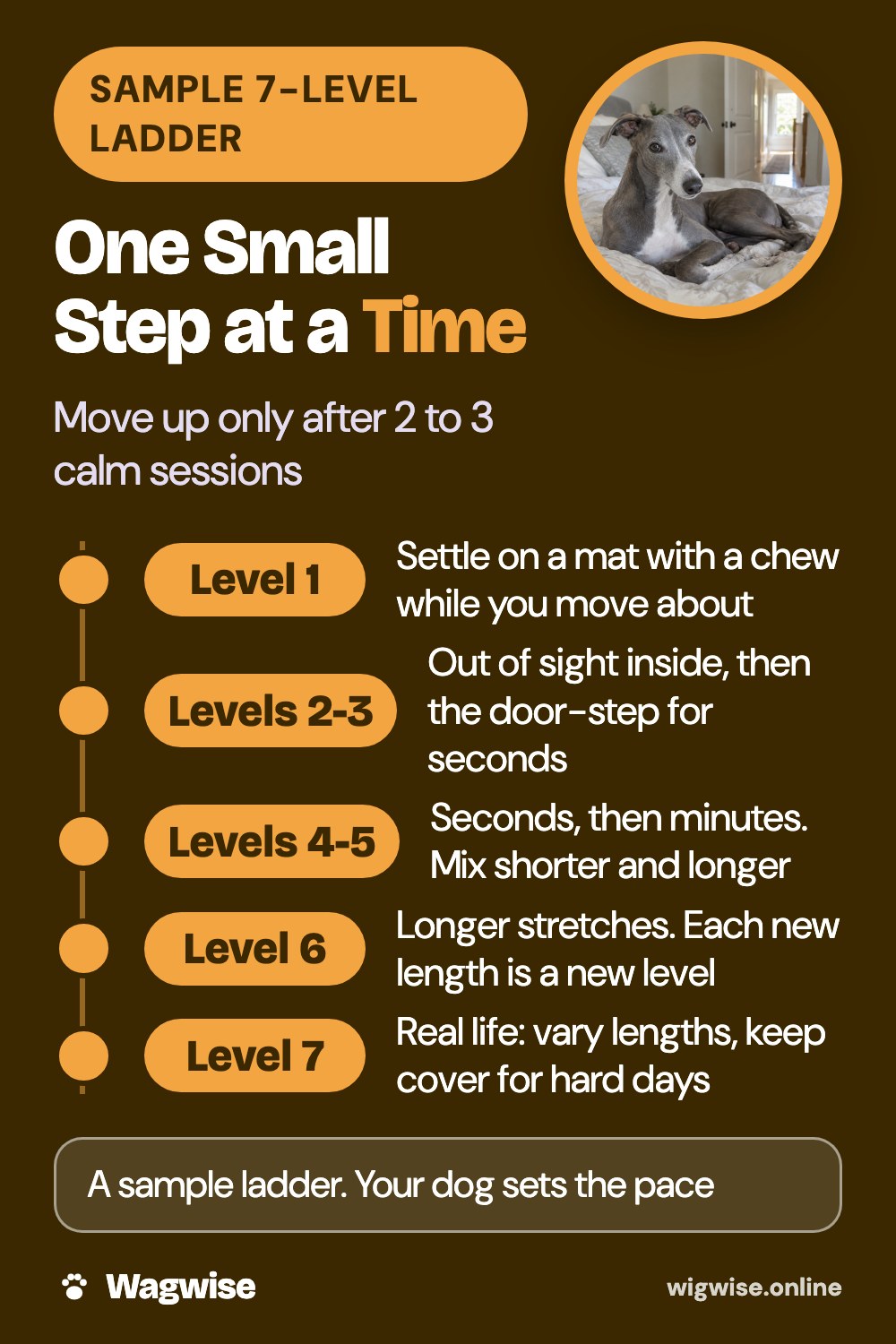
Graded absence training for dogs builds time alone in small steps below the point where your dog shows stress. A sample ladder runs from resting on a mat at home up to real-life absences. Move up after 2 to 3 calm sessions, mix the lengths, and come back before distress. Your dog sets the pace.
- Gradual desensitization is the best-supported approach we have, but the research is small and it isn't proven to work for every dog.
- Go up only after 2 to 3 calm sessions at your level. One stress sign means a shorter next absence. Two in a row means go back two levels.
- Mix the lengths so your dog can't predict the next one, and come back before distress.
- Never use practice as a test. End every session while your dog is still comfortable.
Graded absence training for dogs means building alone time in small steps, always below the point where your dog shows stress. The sample ladder below is built by the Wagwise editors from the principles in the sources. It is not a published protocol, and your dog sets the pace.
Gradual desensitization is the best-supported approach we have, but the research is small and often based on owner reports. It isn’t proven to work for every dog.
Before you climb the ladder
- You have read about the vet and behaviorist route, and a professional is involved if any red flag shows.
- A camera is set up.
- Cover is arranged for the long hours.
- Foundations and cues are done.
A sample graded absence ladder
| Level | What you do | Move up when |
|---|---|---|
| 1 | Settle and cues at home: dog rests on a mat with a chew while you move about | The last 2 to 3 sessions were calm: loose body, chew eaten |
| 2 | Out of sight, inside: behind a gate or inner door, then a bedroom door, for seconds | Calm in most repetitions over 2 to 3 sessions |
| 3 | Door-step: open the exit door, step out, close it, step back in | Dog barely looks up and settles quickly |
| 4 | Seconds: short absences, food toy given just before | Calm when you vary the lengths, not just lengthen them |
| 5 | Minutes: lengthen in small steps, mixing shorter and longer | Calm across several different lengths and sessions |
| 6 | Longer stretches: tens of minutes, then an hour or more | Steady, relaxed footage at each length, over many days |
| 7 | Real life: vary lengths, keep a cover plan for hard days | This is maintenance, not an end point |
ASPCA’s sample starts door-steps at 1 to 2 seconds, using the back door first if you usually leave by the front. Treat each new length at level 6 as a new level, with your professional’s input.
How do you move up, stay or step back?
- Go up only after 2 to 3 calm sessions at the level you’re on.
- Mix the lengths, for example short, shorter, longer, short, so your dog can’t predict the next one.
- Come back before distress. Plan your return time in advance and never wait for your dog to go quiet.
- Any stress sign? Make the next absence shorter. Two in a row? Go back two levels and stop for the day.
- Bad day or long unplanned absence? Drop a level for a day or two. Stuck for two weeks? Call your professional.
How fast should graded absence training go?
Experts differ. ASPCA’s published example moves from seconds to hours in weeks. Merck says a graduated-departure program for moderate to severe cases can take months. We use the cautious end. Treat ASPCA’s numbers as the shape of the ladder, not a timetable.
A sample first week might be: day 1 film and sort; days 2 to 3 foundations and cues; days 4 to 7 levels 1 and 2 only, short and calm. Don’t rush to the door-step.
Don’t use practice as a test
The aim is never to find out how long your dog can cope. It is to end every practice while your dog is still comfortable. Leaving a few minutes longer “to see” is how dogs slip backwards.
Green signs are a loose body, lying down or asleep, eating the chew and a calm hello. Amber signs, like yawning, lip-licking and watching the door, mean shorten the next one. Red signs, like drooling, trembling, barking, scratching and ignoring the chew, mean come back calmly and go down a level.
Read about departure cues first, and see the first four weeks. The Wagwise home alone guide includes the ladder as a printable log. It is general education and can’t promise how things will go for your dog.
Frequently asked questions
How long does graded absence training take?
Sources differ. ASPCA's published sample moves from seconds to hours over weeks, while Merck says moderate to severe cases can take months. We plan for the cautious end, and your dog sets the pace.
How many sessions a day?
As a starting point, one or two sessions a day with three to five repetitions each, and a few minutes between them until your dog is fully relaxed.
What counts as a stress sign?
Dilated pupils, panting, yawning, drooling, trembling, pacing and overexcited greetings are on ASPCA's list. Learn your dog's own earliest sign from your footage.
What if my dog goes quiet?
Silence is not progress. A dog who goes quiet can be a dog who has stopped asking for help. Count relaxed behavior, not just the lack of noise.
More Wagwise guides for dog owners
 Stop Puppy BitingA gentle 4-week plan to stop the nipping and get through teething.$17 · instant PDFSee the guide →
 Get Rid of Dog Pee SmellRemove urine odor for good, then stop the accidents with a 14-day reset.$17 · instant PDFSee the guide →
 Stop Dog BarkingA quiz finds why your dog barks, then a plan made for that reason.$17 · instant PDFSee the guide →
 Help Your Itchy DogTrack triggers, soothe skin safely and know when to see the vet.$17 · instant PDFSee the guide →
 House-Train Your PuppyA kind 4-week plan with a schedule by age, a night plan and printable trackers.$17 · instant PDFSee the guide →
 Stop Leash PullingA 4-week force-free plan for calmer walks and a loose leash.$17 · instant PDFSee the guide →
 Puppy Sleeps Through the NightA realistic, age-by-age plan for calmer nights, without cry-it-out or crate fights.$17 · instant PDFSee the guide →
 Less Dog Hair, Less SmellA 4-week brushing, bath and home routine for a calmer-smelling house.$17 · instant PDFSee the guide →
Want all four? Get the complete library for $49.
Sources
This article is general education, not veterinary advice. It does not replace an examination by your vet or help from a qualified behaviourist.