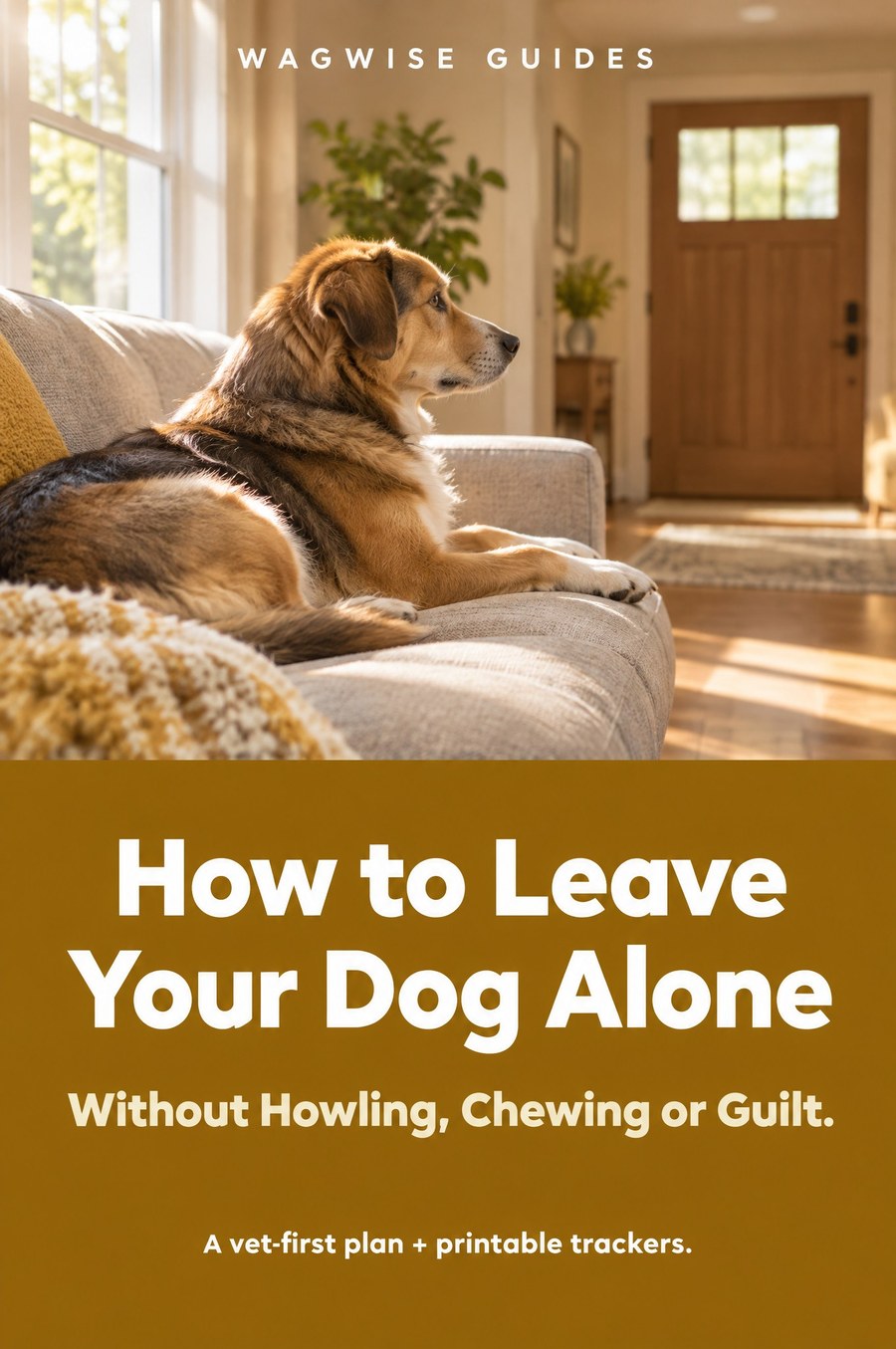
Home alone
The Settle, the I'm Busy Signal and the Chew
Quick answer
To teach your dog to settle alone, start at home with you in the house: give a safe chew on a mat behind a gate, remove a signal item when the chew is done, then build short waits and small movements. If your dog struggles at any step, shorten the wait and rebuild from where your dog was relaxed.
- Before any absences, teach your dog that resting away from you is safe and pleasant, with you at home.
- The 'I'm busy' signal builds in six small steps, and a struggle just means shortening the wait.
- Do the chew test: if your dog ignores the chew when you're out, it may be worried.
- Food toys are not for every dog. If your dog ignores food when you're out, move on to a gradual plan and talk to your vet.
You can teach your dog to settle alone by starting small, at home, with you in the house. Before any absences, your dog needs to learn that resting away from you is safe and pleasant. These skills are what a graded plan stands on later.
Teach your dog to settle alone: the pre-departure routine
A simple routine makes the lead-up predictable and calm.
- Walk first, so your dog can toilet and stretch.
- Come home about 30 minutes before you leave and give a small meal or a food toy.
- Settle your dog in the safe space with a long-lasting chew you’ve checked is safe.
- Leave calmly, with no big goodbye.
ASPCA suggests about 30 minutes of aerobic exercise a day, ideally before you leave.
The “I’m busy” signal in six steps
This is based on the steps in Dogs Trust’s published advice, rewritten in our own words. Do the steps at home, with you in the house.
- Prepare. After a walk, set out a signal item, such as a particular blanket, a baby gate and a chew.
- Chew time. Give the chew and let your dog work on it. Ignore your dog until it’s done.
- Signal away. When the chew is finished, remove the signal item.
- Wait, then build. Wait about a minute after the chew, then lengthen the time in small steps.
- Add movement. Walk about, tidy up, and take a few steps out of the room, while your dog stays relaxed.
- Vary and extend. Mix the waits (for example 3, 1, then 4 minutes). Cover the gate and spend longer out of sight, checking on camera.
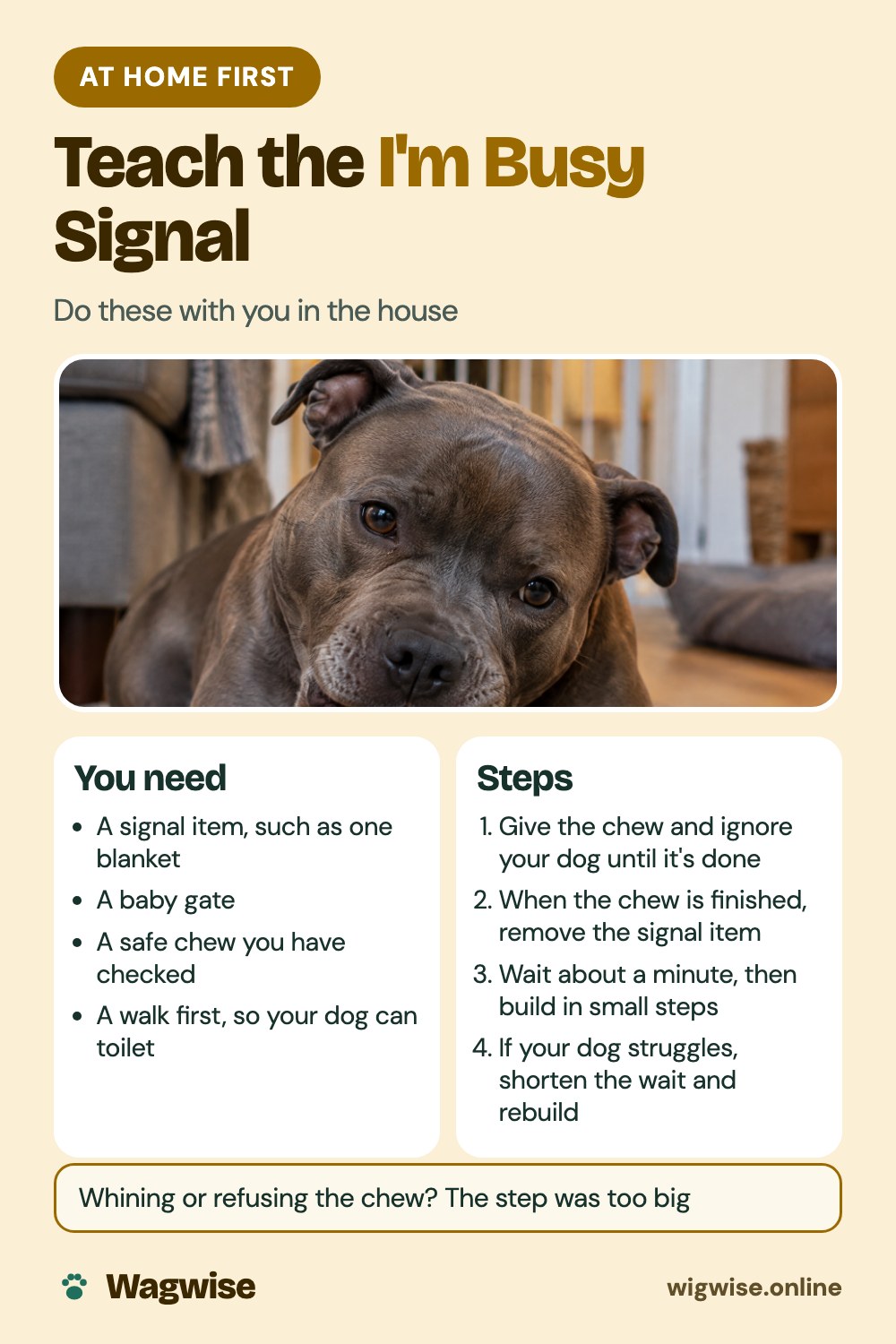
If your dog struggles at any step, shorten the wait and rebuild from where your dog was relaxed. That is not a failure. It is the method.
What does a good session look like?
A typical evening: walk, dog on mat, chew in, gate shut, and you read a book in the same room. When the chew is done, the signal blanket goes away, you wait a quiet minute, then stand up, fetch water and sit back down. If your dog stays loose and settled, that is a good session. Stop there.
| Green: go on | Amber: go back a step |
|---|---|
| Loose, soft body | Panting, pacing, lip-licking |
| Eating the chew | Yawning or drooling |
| Lying down within a minute or two | Watching the gate |
The chew test and independence at home
Give your dog a chew it enjoys while you’re home. Then leave a similar chew when you’re out and watch the footage. If your dog ignores it when you’re out, it may be worried. That is a sign of worry, not a reason to buy a better chew.
At home, reward resting on the mat or bed while you do ordinary things. Don’t reward following you around. Build gentle gaps: a closed baby gate for a minute, then two, while you’re still in the house. Keep greetings calm.
ASPCA notes that food toys are not for every dog. If your dog ignores food when you’re out, move on to the gradual plan rather than buying more toys, and ask your vet which chews are safe.
Next, make keys and the door boring, and see enrichment ideas. The Wagwise home alone guide has a 7-day foundations tracker. It is general education and can’t replace a qualified behaviorist.
Frequently asked questions
How do I teach my dog to settle on a mat?
Reward your dog for resting on its mat or bed while you do ordinary things at home. Don't reward shadowing you around, and ask for a calm stay on the bed while you're in the kitchen.
What does a good session look like?
A loose, wiggly-soft body, eating the chew, and lying down within a minute or two. Sleep is a great sign. Panting, pacing, lip-licking, yawning, drooling or watching the gate means go back a step.
What is the chew test?
Give your dog a chew it enjoys while you're home, then leave a similar chew when you're out and watch the footage. If your dog ignores it when you're out, it may be worried.
Do food toys fix a dog who panics alone?
No. ASPCA notes that a stuffed toy works only for mild cases, because highly anxious dogs often won't eat alone. Enrichment isn't treatment.
More Wagwise guides for dog owners
 Stop Puppy BitingA gentle 4-week plan to stop the nipping and get through teething.$17 · instant PDFSee the guide →
 Get Rid of Dog Pee SmellRemove urine odor for good, then stop the accidents with a 14-day reset.$17 · instant PDFSee the guide →
 Stop Dog BarkingA quiz finds why your dog barks, then a plan made for that reason.$17 · instant PDFSee the guide →
 Help Your Itchy DogTrack triggers, soothe skin safely and know when to see the vet.$17 · instant PDFSee the guide →
 House-Train Your PuppyA kind 4-week plan with a schedule by age, a night plan and printable trackers.$17 · instant PDFSee the guide →
 Stop Leash PullingA 4-week force-free plan for calmer walks and a loose leash.$17 · instant PDFSee the guide →
 Puppy Sleeps Through the NightA realistic, age-by-age plan for calmer nights, without cry-it-out or crate fights.$17 · instant PDFSee the guide →
 Less Dog Hair, Less SmellA 4-week brushing, bath and home routine for a calmer-smelling house.$17 · instant PDFSee the guide →
Want all four? Get the complete library for $49.
Sources
This article is general education, not veterinary advice. It does not replace an examination by your vet or help from a qualified behaviourist.