
Puppy sleep
Puppy Night Log (Printable)
Quick answer
A puppy night log is a simple table you fill in each morning: bedtime, last toilet, wake-up times, trips out, crying minutes, what helped and whether it was a good night. It helps you see patterns instead of guessing. Fewer and shorter wake-ups are the wins.
- Fill in the log each morning, before you do anything else.
- Look for patterns, not perfection. Fewer and shorter wake-ups are the wins.
- Add a one-word mood after each wake-up: calm, grumbly, whiny or frantic.
- Bring the log, and a short video, to the vet if crying does not improve.
A puppy night log is the simplest way to stop guessing at 3 a.m. You fill it in each morning, and after a few days it shows patterns. Fewer and shorter wake-ups are the wins, not a particular number of hours.
What goes in a puppy night log?
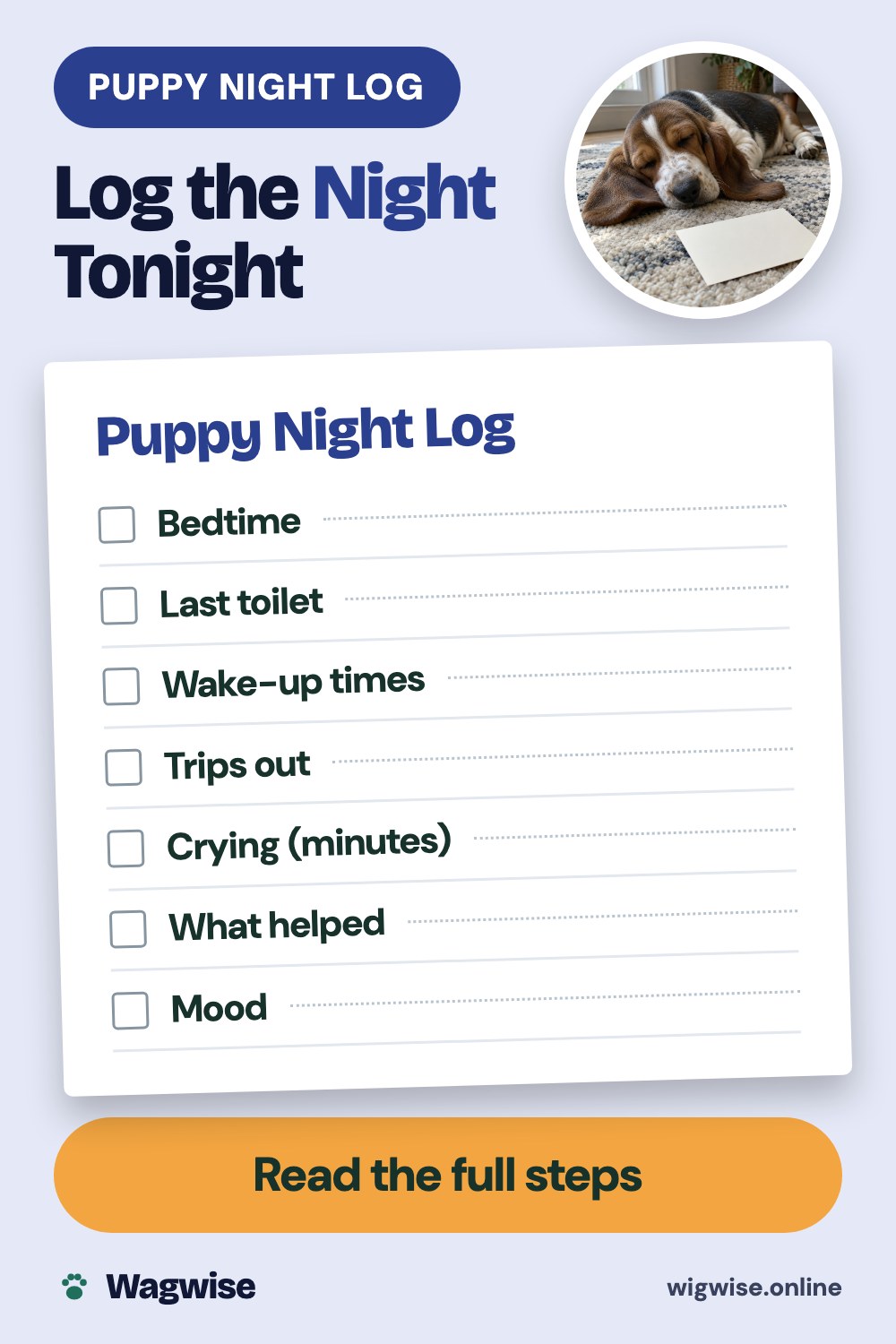
Copy this table onto paper and fill in one row per night.
| Column | What to write |
|---|---|
| Date | The night you are logging |
| Bedtime | When your puppy went into the crate or pen |
| Last toilet | The final trip before bed |
| Wake-up times | Each time your puppy woke |
| Trips out | How many times you went outside |
| Crying (minutes) | Roughly how long |
| What helped | Toilet, a hand near the crate, a quiet voice |
| Mood | One word: calm, grumbly, whiny or frantic |
| Good night? | A tick or a cross |
How do I read the log like a coach?
- Fewer wake-ups. Even one fewer is progress.
- Shorter crying. Minutes matter more than hours.
- Faster return to sleep. A quick settle after a trip is a win.
Aim for patterns, not perfection. A bad night after two good ones does not erase the progress. Change one thing at a time so the log can tell you what worked.
What should I total each week?
At the end of each week, copy the totals: wake-ups, trips out, crying minutes and good nights out of seven. Then compare with last week: wake-ups fewer, same or more, and crying shorter, same or longer. Add one line: one thing I will change this week.
How does the log fit the 4-week plan?
The log feeds a simple weekly score: average wake-ups per night, average crying minutes and your biggest win. Wins are fewer wake-ups and shorter crying, not a number of hours. For the plan itself, read Day Sleep, Alone Time and the 4-Week Plan.
Why write it down at all?
At 3 a.m. everything feels like the worst night ever. A log gives you a calmer view. It shows how many wake-ups and trips you actually had, how long the crying lasted and what helped, so you can stop judging and start spotting patterns. It also makes it easy to answer the two questions that matter: is it getting better, and what changed?
Agree one realistic goal first, such as one toilet trip and a calm return to bed, and tell yourself that whatever happens tonight, you are writing it down, not judging it. A good night for now means a calm night, not a long one.
Mood pattern. Write one word for your puppy’s mood after each wake-up: calm, grumbly, whiny or frantic. A run of calm and grumbly wake-ups that get shorter is a good sign. Frantic or panicked more than once is not something to log and wait on. Call your vet.
When should I take the log to the vet?
If your puppy is frantic or panicked more than once, if crying is not improving over several nights or after the first few weeks, or if something changes suddenly in a settled puppy, call your vet. Bring the log, your puppy’s vaccine records and a short video of the crying, filmed from the side if you can. For the red, amber and green signs, read When Puppy Crying Isn’t Normal.
Is there a printable version?
The full Wagwise guide includes a printable 7-night log, a 4-week tracker and a vet visit sheet. The table above gives you the same columns to start on paper tonight.
Frequently asked questions
Why keep a night log?
It lets you see patterns instead of guessing. Most owners find a pattern after a few days, such as a wake-up that matches the sun coming through the curtains.
What counts as progress?
Fewer wake-ups, shorter crying and a faster return to sleep. Even one fewer wake-up is progress, and minutes matter more than hours.
What do I do if my puppy is frantic more than once?
Frantic or panicked more than once is a reason to call your vet.
Does the guide include a printable version?
Yes. The full Wagwise guide includes a printable 7-night log, a 4-week tracker and a vet visit sheet.
More Wagwise guides for dog owners
 Stop Puppy BitingA gentle 4-week plan to stop the nipping and get through teething.$17 · instant PDFSee the guide →
 Get Rid of Dog Pee SmellRemove urine odor for good, then stop the accidents with a 14-day reset.$17 · instant PDFSee the guide →
 Stop Dog BarkingA quiz finds why your dog barks, then a plan made for that reason.$17 · instant PDFSee the guide →
 Help Your Itchy DogTrack triggers, soothe skin safely and know when to see the vet.$17 · instant PDFSee the guide →
 House-Train Your PuppyA kind 4-week plan with a schedule by age, a night plan and printable trackers.$17 · instant PDFSee the guide →
 Stop Leash PullingA 4-week force-free plan for calmer walks and a loose leash.$17 · instant PDFSee the guide →
 Leave Your Dog AloneFilm, sort and build calm alone time with a vet-first plan and a step-by-step ladder.$17 · instant PDFSee the guide →
 Less Dog Hair, Less SmellA 4-week brushing, bath and home routine for a calmer-smelling house.$17 · instant PDFSee the guide →
Want all four? Get the complete library for $49.
Sources
This article is general education, not veterinary advice. It does not replace an examination by your vet or help from a qualified behaviourist.