House-training
Signs Your Puppy Needs to Go
Quick answer
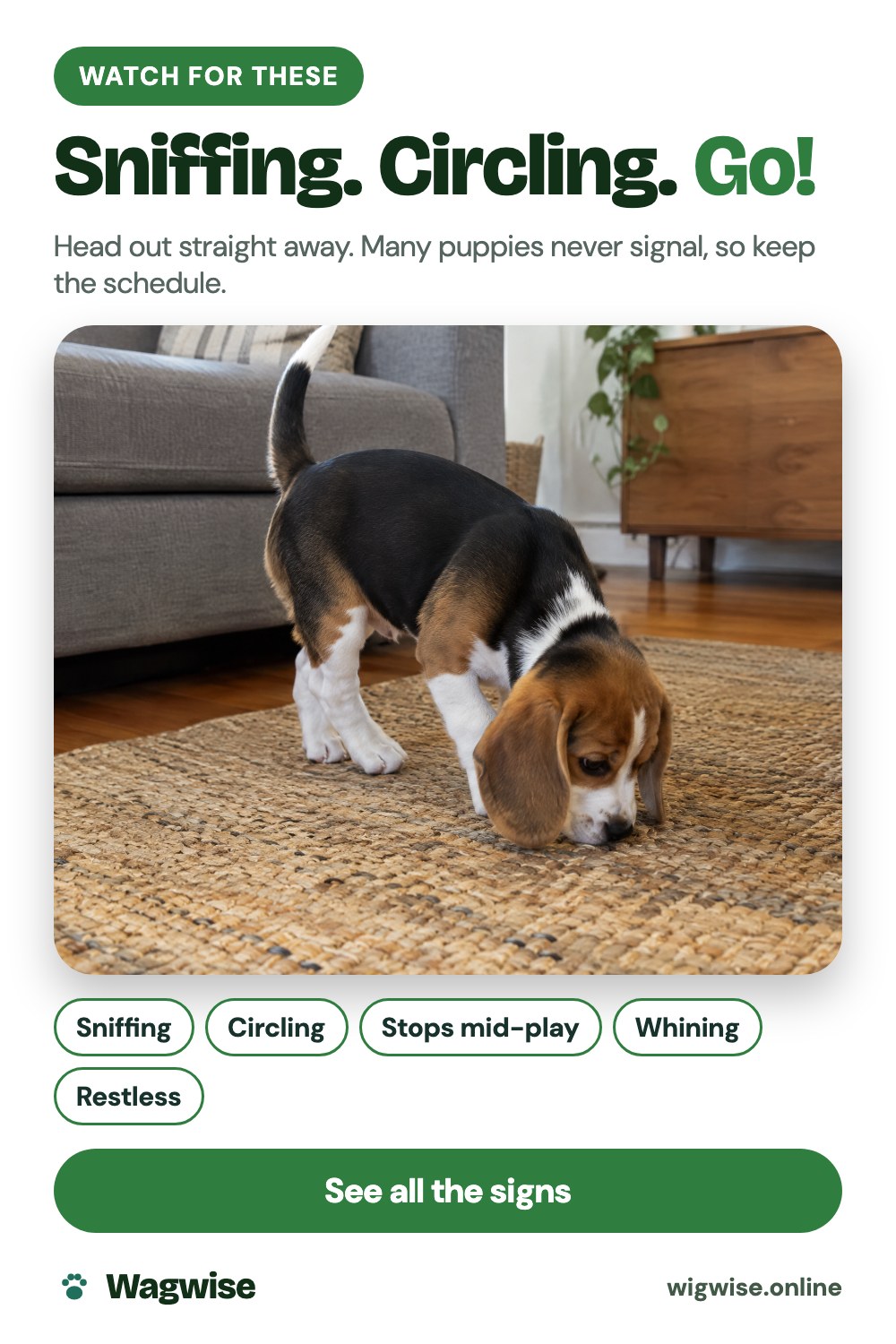
The signs your puppy needs to go are sniffing the floor, circling, suddenly stopping play, whining or scratching at a door, and restlessness. They are most likely after naps, meals and being left alone. Head out straight away, and do not wait for your puppy to ask.
- Common signs are sniffing, circling, stopping mid-play, whining or scratching at the door, and restlessness.
- The signs are most likely after naps, feeding and being left alone.
- Many puppies never signal in a way owners notice, so keep the schedule.
- A puppy that strains or cries while going needs a vet, not more training.
The signs your puppy needs to go are easy to miss if you are not looking for them. A few seconds of sniffing or circling is often the only warning before a puddle. Learn the signals, and you can get your puppy outside in time.
What are the signs a puppy needs to pee or poop?
Watch for these, and head to the toilet spot straight away when you see one.
| Sign | What it looks like |
|---|---|
| Sniffing | Nose down on the floor or a spot |
| Circling | Turning around before a squat |
| Stopping | Suddenly pausing in the middle of play |
| Whining or scratching | At a door, or in a crate |
| Restlessness | Cannot settle, wandering |
When are these signs most likely?
Most likely after naps, feeding and being left alone. Those match the triggers that call for a trip anyway: waking, after eating, after drinking, after play, last thing at night, and before you leave or when you return. If a trigger just happened, do not wait for a sign. Go out.
Evenings are tricky too. A puppy that looks asleep may sneak off to go, so stay eyes-on until you know their habits.
Why does my puppy not signal at all?
Many puppies never signal in a way owners notice. Penn Vet notes that “not all dogs learn automatically to signal the need to eliminate, in a way that their owners understand.” That is not a failure. It means the schedule has to do the work, and the signs are a bonus.
So do not wait for your puppy to ask. Go out on every trigger, and use the age table in your plan as a starting point. A log, not the clock, tells you when to stretch.
How can I make the signs easier to see?
You can only spot sniffing and circling when your puppy is in sight. Every minute should be one of two modes: eyes-on, or safely confined.
- Keep your puppy in the same room and in sight.
- Or clip a 6-foot leash to your belt or a heavy chair while you cook or work.
- Do not leave a puppy on a leash unattended.
- If you cannot watch, use the pen.
Try the leash-to-belt method for one hour today and notice what your puppy does before they go. Our eyes-on or confined rules explain both modes.
Can I teach my puppy to ask to go out?
Yes, slowly. Use the same door every time. Some owners add a bell or a bark-at-the-door cue once the routine is stable, but keep the schedule going even when a signal appears. A signal is something you build on top of a good routine, not a replacement for one.
When your puppy does something that looks like a signal, take them out, reward at the spot, and write it in the log. Over time you will see the pattern. For the trip itself, see potty cues and the potty trip routine.
When is it a health sign instead?
Straining, crying or blood while going is never a training problem. If your puppy circles and strains but little comes out, or seems uncomfortable going, phone your vet. A puppy who suddenly needs far more trips than usual should be checked too. The House-Train Your Puppy guide has a vet check strip in every chapter.
Frequently asked questions
What are the signs a puppy needs to pee?
Sniffing the floor or a spot, circling before a squat, suddenly stopping play, whining or scratching at a door, and restlessness. In a crate, look for whining, scratching and restlessness.
When are puppies most likely to need to go?
After naps, after feeding and after being left alone. Head out straight away at those times.
Will my puppy tell me when they need to go?
Not always. Penn Vet notes that not all dogs learn automatically to signal the need in a way their owners understand, so keep the schedule even if a signal appears.
How can I teach my puppy to ask to go out?
Use the same door every time. Some owners add a bell or a bark-at-the-door cue once the routine is stable, but keep the schedule going.
Why does my puppy sneak off when it looks asleep?
Evenings are tricky. A puppy that looks asleep may sneak off to go, so stay eyes-on.
More Wagwise guides for dog owners
 Stop Puppy BitingA gentle 4-week plan to stop the nipping and get through teething.$17 · instant PDFSee the guide →
 Get Rid of Dog Pee SmellRemove urine odor for good, then stop the accidents with a 14-day reset.$17 · instant PDFSee the guide →
 Stop Dog BarkingA quiz finds why your dog barks, then a plan made for that reason.$17 · instant PDFSee the guide →
 Help Your Itchy DogTrack triggers, soothe skin safely and know when to see the vet.$17 · instant PDFSee the guide →
 Stop Leash PullingA 4-week force-free plan for calmer walks and a loose leash.$17 · instant PDFSee the guide →
 Leave Your Dog AloneFilm, sort and build calm alone time with a vet-first plan and a step-by-step ladder.$17 · instant PDFSee the guide →
 Puppy Sleeps Through the NightA realistic, age-by-age plan for calmer nights, without cry-it-out or crate fights.$17 · instant PDFSee the guide →
 Less Dog Hair, Less SmellA 4-week brushing, bath and home routine for a calmer-smelling house.$17 · instant PDFSee the guide →
Want all four? Get the complete library for $49.
Sources
This article is general education, not veterinary advice. It does not replace an examination by your vet or help from a qualified behaviourist.