Leash pulling
Teenage Dog Pulling: The Adolescent Phase
Quick answer
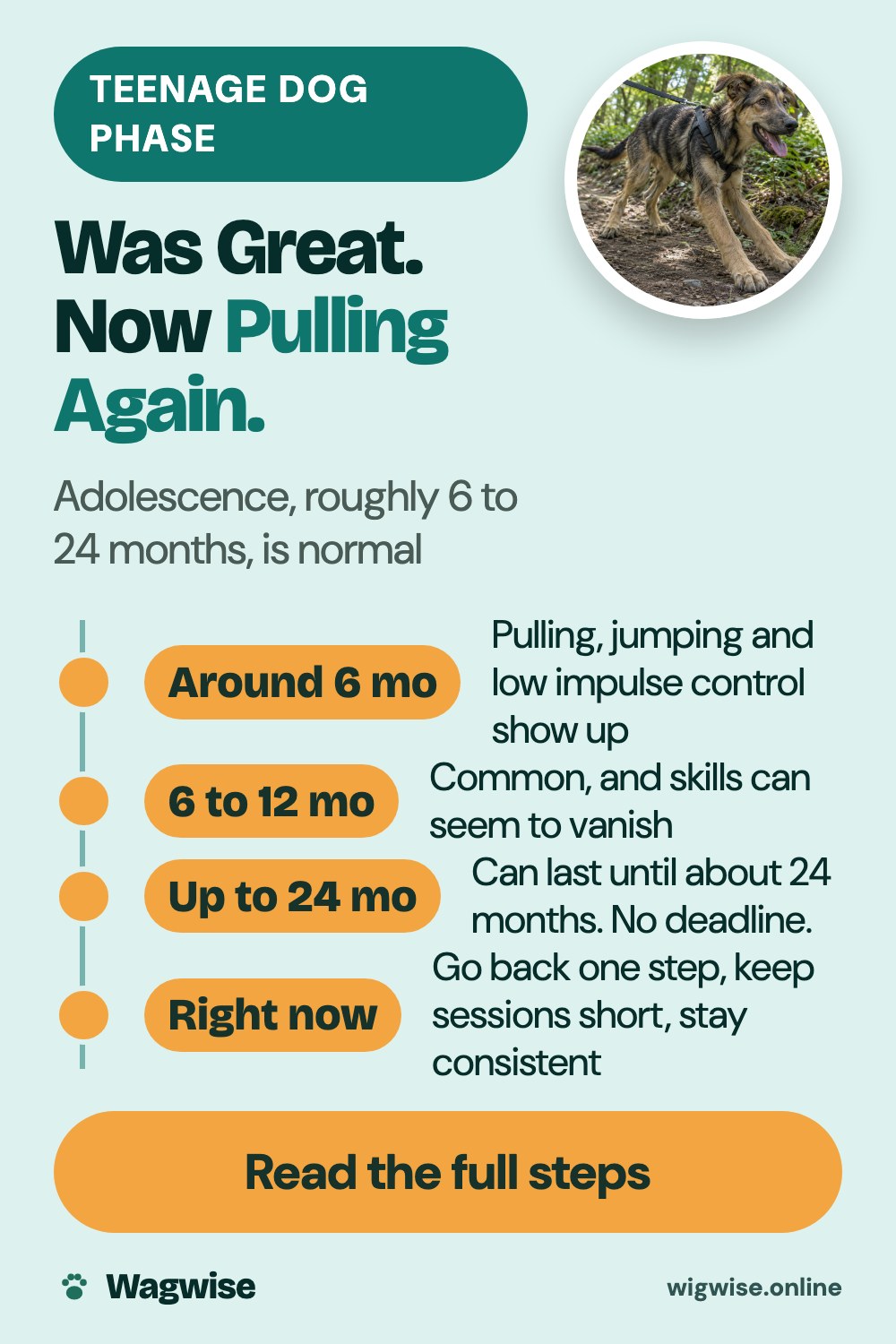
Adolescent dog pulling on leash is common from about 6 months and can last until around 24 months, when pulling, jumping and poor impulse control all get worse. It isn't a sign you failed. Go back one step in your plan, shorten sessions, stay consistent and add exercise before walks.
- Pulling, jumping and poor impulse control are common from about 6 months and can last to around 24 months.
- A teenager who seems to have forgotten everything is normal, not a failure.
- Go back one step, shorten sessions and stay consistent. This is our advice, not a studied protocol.
- Extra exercise and play before training walks can help, and a tense handler can wind a dog up.
Adolescent dog pulling on leash is normal, and it can feel like a slap after weeks of progress. Pulling, jumping and poor impulse control are common from about 6 months and can last until around 24 months. If your teenager seems to have forgotten everything, that is the phase, not a sign you did anything wrong.
Why is my dog pulling again?
Young dogs find self-control hard, and adolescence makes it harder. Your dog still knows the skills. The skills just get harder to use when the world is exciting and impulse control is low.
It also helps to remember what pulling is. It is natural behavior, not defiance. PDSA advises against punishment, and a tense handler can wind a dog up further, so loosen your grip, breathe out and slow down.
How long does the teenage phase last?
Dogs Trust Ireland describes adolescence as roughly 6 to 24 months. Pulling and poor impulse control are common from around 6 to 12 months and can last to about 24 months. Every dog is different, so don’t set a deadline.
Do this, not that
Trainers differ on the best approach for teens, from loosening expectations to adding structure. Our advice, which is editorial and not a studied protocol, is to go back one step, shorten sessions and stay consistent.
| Do | Don’t |
|---|---|
| Expect a step back and go back one step in your plan | Take it personally or tighten up |
| Shorten sessions and end on a win | Skip the games at home. They matter more now |
| Add extra exercise and play before training walks | Jerk, pop or scold the leash |
| Keep the household rules the same | Stop paying for loose-leash moments |
What does going back one step look like?
If your plan had you walking on a busier street, return to the quiet street. If you were doing quiet streets, spend a few days on the backyard or driveway. Replay the foundation games at home: the marker, the name check-in, the sweet spot and the turn. Move up again once you get 8 good reps out of 10, which is our rule of thumb, not a studied number.
Keep a few things steady while you do it:
- Use soft treats and the same marker word.
- Keep a tight leash meaning we stop, for every walker.
- Add a play session before the walk to burn off some energy. PDSA suggests this.
- Use a well-fitted harness or flat collar, and ask a trainer or the shop to check the fit as your dog finishes growing.
When is it more than adolescence?
Most teenage pulling is ordinary excitement. But if the change is sudden, or your dog lags, limps, coughs or seems stiff, see your vet first. If your dog lunges with barking, growling or snapping, that is more than pulling. Read When Pulling Is Really Reactivity and get a qualified behavior professional involved.
What should I do this week?
Pick one quiet place, one marker word and one 5-minute session a day. Count the stops and write them down. If you are not sure how to restart, our 4-week leash walking plan gives you a simple structure, and the Stop Leash Pulling guide has the printable tracker. For the early years, read Puppy Pulling on the Leash.
Frequently asked questions
Why is my dog pulling again after being good on the leash?
Adolescence. Pulling, jumping and poor impulse control are common from about 6 months and can last until around 24 months.
How long does the teenage phase last?
Dogs Trust Ireland describes adolescence as about 6 to 24 months. Pulling and poor impulse control are common from around 6 to 12 months and can last to about 24.
Should I get stricter or more relaxed with my teenage dog?
Trainers differ. Our advice is to go back one step in the plan, shorten sessions and stay consistent, with no jerking or scolding.
Could the sudden pulling be a health problem?
It can be. If the change is sudden, or your dog lags, limps, coughs or seems stiff, see your vet before you train.
More Wagwise guides for dog owners
 Stop Puppy BitingA gentle 4-week plan to stop the nipping and get through teething.$17 · instant PDFSee the guide →
 Get Rid of Dog Pee SmellRemove urine odor for good, then stop the accidents with a 14-day reset.$17 · instant PDFSee the guide →
 Stop Dog BarkingA quiz finds why your dog barks, then a plan made for that reason.$17 · instant PDFSee the guide →
 Help Your Itchy DogTrack triggers, soothe skin safely and know when to see the vet.$17 · instant PDFSee the guide →
 House-Train Your PuppyA kind 4-week plan with a schedule by age, a night plan and printable trackers.$17 · instant PDFSee the guide →
 Leave Your Dog AloneFilm, sort and build calm alone time with a vet-first plan and a step-by-step ladder.$17 · instant PDFSee the guide →
 Puppy Sleeps Through the NightA realistic, age-by-age plan for calmer nights, without cry-it-out or crate fights.$17 · instant PDFSee the guide →
 Less Dog Hair, Less SmellA 4-week brushing, bath and home routine for a calmer-smelling house.$17 · instant PDFSee the guide →
Want all four? Get the complete library for $49.
Sources
This article is general education, not veterinary advice. It does not replace an examination by your vet or help from a qualified behaviourist.