House-training
The 3-Day Potty Log: What to Track
Quick answer
A puppy potty log is a simple record of every trip: time, what came just before, pee or poop, where, and the result. Keep it for three days, find when your puppy goes, then set your first trips 10 to 15 minutes before those times.
- Three days of notes turn 'he is random' into a pattern you can plan around.
- Write down time, what came before, pee or poop, where, and success or accident.
- Set your first schedule 10 to 15 minutes before the usual times. That timing is our suggestion.
- The log is also what you bring to a vet visit.
A puppy potty log is the quickest way to stop guessing. Three days of notes turn “he is random” into “he goes 10 minutes after breakfast and after every nap.” Once you can see the pattern, you can plan around it.
What should I write down?
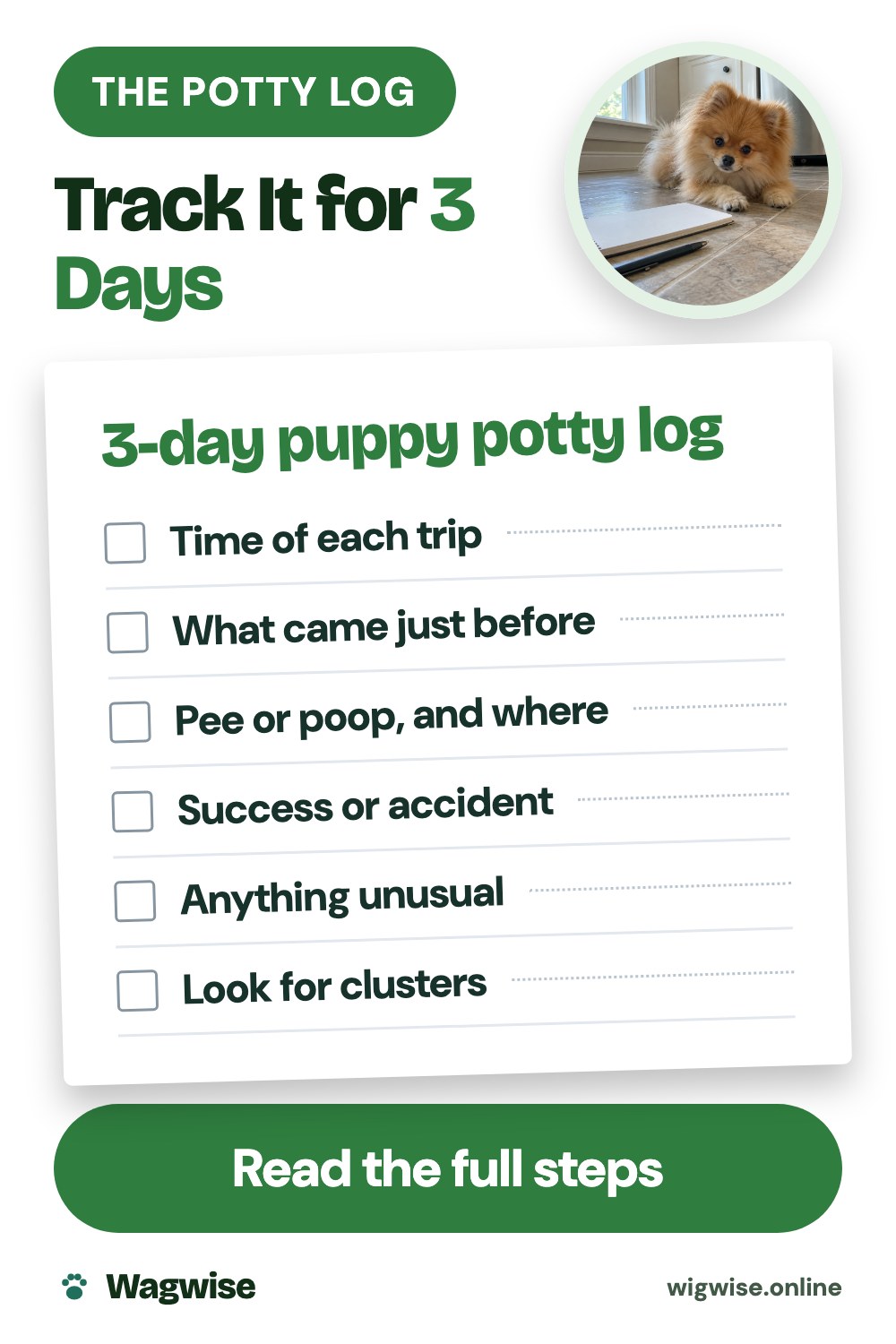
For every trip, note five things:
- Time
- What came just before: woke, ate, drank, played
- Pee or poop, and where
- Success (right spot) or accident
- Anything unusual: color, smell, effort
Keep the log by the door, next to the leash, with a pen. If it is hard to reach, you will not fill it in.
What does a log look like?
Here is an example, using a short code for what came before.
| Time | Before | Pee or poop | Where | Result |
|---|---|---|---|---|
| 7:05 | Woke | Pee | Spot | Success |
| 7:40 | Breakfast | Poop | Hall | Accident |
| 8:10 | Play | Pee | Spot | Success |
This is an example only. Even three rows tell a story: the trips after waking and after play went well, and the hall accident came after breakfast. That points to a trip sooner after meals.
How do I turn the log into a schedule?
After three days, read the log and look for clusters. When do accidents happen? How long after meals, naps and play? Then set your first trips 10 to 15 minutes before those times. That timing is our suggestion, not a clinical standard.
Keep the six triggers exactly as they are: waking, after eating, after drinking, after play, last thing at night, and before you leave and when you return. The log decides when to stretch the gaps, not the calendar.
What can the log tell me?
Read it for three things:
- Timing: how long after waking, meals, drinks and play your puppy goes.
- Place: whether accidents happen in the same room, near the same door.
- Gaps: the longest stretch between trips, and whether accidents cluster at the end of it.
A short code keeps the page tidy: W for woke, E for ate, D for drank, P for played and N for after a nap. At the end of each week, add up trips, successes and accidents, and note when accidents cluster. Then pick one gap to stretch only after three clean days, and set phone alarms for the next three triggers you can predict.
How long should I keep the log?
Log every trip for three days to find the pattern. Then keep it up until you have had 8 weeks with no accidents. A veterinary behaviorist’s benchmark for “house-trained” is 8 weeks or more with none. It is slower than a day count, but it is a more honest finish line.
Add a weekly check: trips, successes, accidents, and when accidents cluster. If one accident happens, write down the three answers: Was my puppy watched? Was a trip overdue? Was the space too big?
Can I use the log with my vet?
Yes, and you should if anything looks off. Bring a log summary to the appointment, with the date house-training started, how many accidents a day, when accidents began or changed, and any changes in drinking, appetite or energy. Ask the clinic how they want a urine sample collected before you try. Do not guess, and never give human medicine or home remedies.
Our guide to medical red flags before training lists what to watch for, and a calm 4-week potty training plan shows where the log fits in the weeks ahead. The House-Train Your Puppy guide includes a printable log, daily planner and vet visit sheet.
Frequently asked questions
What should I write in a puppy potty log?
The time, what came just before (woke, ate, drank, played), pee or poop and where, whether it was a success or an accident, and anything unusual like color, smell or effort.
How long should I keep the log?
Log every trip for three days to find the pattern, then keep it up until you have had 8 weeks with no accidents.
How do I use the log to set a schedule?
Look for when accidents cluster, then set trips 10 to 15 minutes before those times. That timing is our suggestion.
Should I show the log to my vet?
Yes. Bring a summary to the appointment. It helps your vet see the pattern quickly. It does not diagnose anything.
More Wagwise guides for dog owners
 Stop Puppy BitingA gentle 4-week plan to stop the nipping and get through teething.$17 · instant PDFSee the guide →
 Get Rid of Dog Pee SmellRemove urine odor for good, then stop the accidents with a 14-day reset.$17 · instant PDFSee the guide →
 Stop Dog BarkingA quiz finds why your dog barks, then a plan made for that reason.$17 · instant PDFSee the guide →
 Help Your Itchy DogTrack triggers, soothe skin safely and know when to see the vet.$17 · instant PDFSee the guide →
 Stop Leash PullingA 4-week force-free plan for calmer walks and a loose leash.$17 · instant PDFSee the guide →
 Leave Your Dog AloneFilm, sort and build calm alone time with a vet-first plan and a step-by-step ladder.$17 · instant PDFSee the guide →
 Puppy Sleeps Through the NightA realistic, age-by-age plan for calmer nights, without cry-it-out or crate fights.$17 · instant PDFSee the guide →
 Less Dog Hair, Less SmellA 4-week brushing, bath and home routine for a calmer-smelling house.$17 · instant PDFSee the guide →
Want all four? Get the complete library for $49.
Sources
This article is general education, not veterinary advice. It does not replace an examination by your vet or help from a qualified behaviourist.