House-training
Why Your Puppy Pees Right After a Walk
Quick answer
When a puppy pees right after a walk, it usually means the walk was not a real potty trip, or the puppy did not finish. Do a quiet, standing potty trip first, reward at the spot, then walk. Back inside, stay eyes-on for a while.
- A puppy that pees right after a walk is showing a gap in the routine, not being stubborn or spiteful.
- Do the potty trip first, then make the walk the second reward.
- Reward after your puppy finishes, and not before, so a distracted puppy does not stop halfway.
- If nothing happened, go in eyes-on or in the pen and try again in 10 to 15 minutes.
If your puppy pees right after a walk, you are not alone, and your puppy is not being spiteful. It almost always points to a gap in the routine. The good news is that a few small changes to the trip usually close it.
Why does my puppy pee right after a walk?
Puppies have small bladders and short warning times. A walk is full of new smells and distractions, which makes it easy to miss the moment to go. Then, back inside, the job gets finished on your rug. Check these five gaps:
| What may have happened outside | What to change |
|---|---|
| It was a walk, not a potty trip | Do the toilet part first at one spot, then walk |
| Your puppy was moving, not still | Stand still and stay quiet so they can sniff and go |
| They started, got distracted and stopped halfway | Reward only after they finish, not while they go |
| Play or excitement raised the need again | Treat play as a trigger and go out again after |
| Nobody was watching once you got in | Stay eyes-on or use the pen after every trip |
Make the walk the second reward
Dogs Trust Dog School, the RSPCA UK and Penn Vet all suggest letting walk or play follow the toilet, so going does not end the fun. If the walk comes first, your puppy has no reason to focus on the job. Flip the order.
- Leash on, no chat. Go straight to the spot.
- Stand still and stay quiet. Give them a few minutes.
- Reward with a treat and calm praise when they finish.
- Then walk or play.
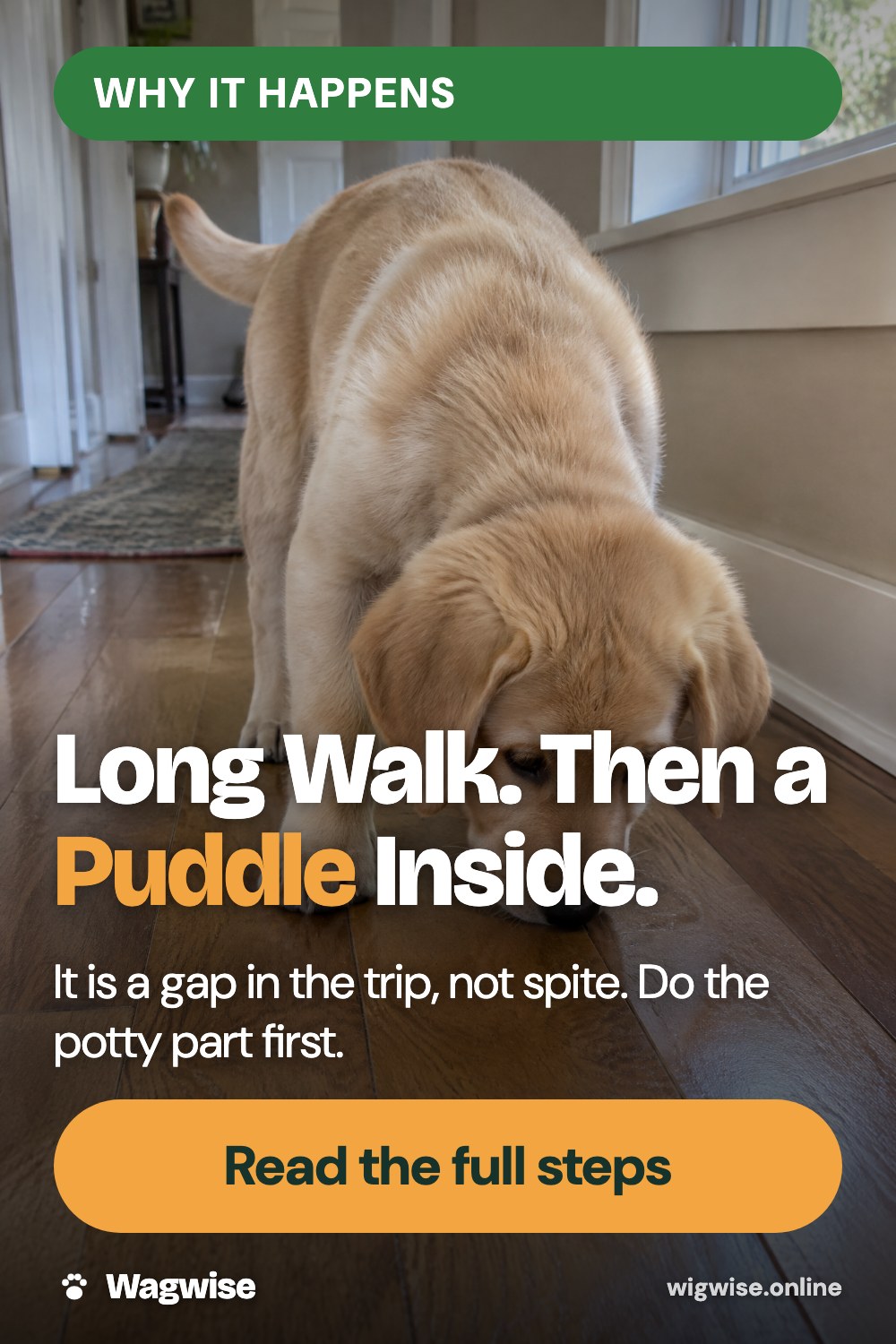
What should I do when we get back inside?
Treat the next stretch as a risk window. Either keep your puppy in sight, or on a 6-foot leash clipped to you, or put them in the pen. A puppy who is distracted outside may not have finished, and the sniffing and circling that come before a puddle are easy to spot when you are watching.
If nothing happened on the trip, go back in eyes-on or in the pen, then try again in 10 to 15 minutes. That timing is our suggestion, not a study. Poop can be slower than pee, because some dogs need to walk around first, so a longer visit to the spot may help.
What if there is an accident anyway?
Stay calm. If you catch it, call your puppy’s name in a normal voice and guide or carry them to the spot, then reward if they finish there. If you find it later, show no reaction, move your puppy to the pen, and clean up quietly. A telling-off cannot be linked to the puddle later, and it can make a puppy afraid to go in front of you.
Then ask three questions: Was my puppy watched? Was a trip overdue? Did my puppy have too much space too soon? Write the answers in a log. Our free Fresh Accident Kit has a fridge card for the cleanup.
When is it more than a training gap?
Many tiny pees, a sudden jump in how often your puppy needs to go, or any sign of discomfort is a vet question, not a schedule problem. For the full routine, see signs your puppy needs to go, potty cues and the potty trip routine, and the House-Train Your Puppy guide.
Frequently asked questions
Why does my puppy pee right after we come inside?
Often the walk was not a toilet trip, or your puppy did not finish before the fun took over. The fix is to do a still, quiet potty trip first and stay eyes-on when you come back in.
Is my puppy doing it on purpose?
No. A guilty-looking face is not proof your puppy understands. Dogs cannot link a telling-off that comes later to a puddle, and scolding can make a puppy afraid to go in front of you.
How long should I wait at the spot?
Give your puppy a few minutes, standing still and quiet. If nothing happens, go back in watched and try again in 10 to 15 minutes. That timing is our suggestion.
Should I take away water before a walk?
No. Do not hold back food or water to control toileting. If you want a different water plan at night, ask your vet first.
More Wagwise guides for dog owners
 Stop Puppy BitingA gentle 4-week plan to stop the nipping and get through teething.$17 · instant PDFSee the guide →
 Get Rid of Dog Pee SmellRemove urine odor for good, then stop the accidents with a 14-day reset.$17 · instant PDFSee the guide →
 Stop Dog BarkingA quiz finds why your dog barks, then a plan made for that reason.$17 · instant PDFSee the guide →
 Help Your Itchy DogTrack triggers, soothe skin safely and know when to see the vet.$17 · instant PDFSee the guide →
 Stop Leash PullingA 4-week force-free plan for calmer walks and a loose leash.$17 · instant PDFSee the guide →
 Leave Your Dog AloneFilm, sort and build calm alone time with a vet-first plan and a step-by-step ladder.$17 · instant PDFSee the guide →
 Puppy Sleeps Through the NightA realistic, age-by-age plan for calmer nights, without cry-it-out or crate fights.$17 · instant PDFSee the guide →
 Less Dog Hair, Less SmellA 4-week brushing, bath and home routine for a calmer-smelling house.$17 · instant PDFSee the guide →
Want all four? Get the complete library for $49.
Sources
This article is general education, not veterinary advice. It does not replace an examination by your vet or help from a qualified behaviourist.