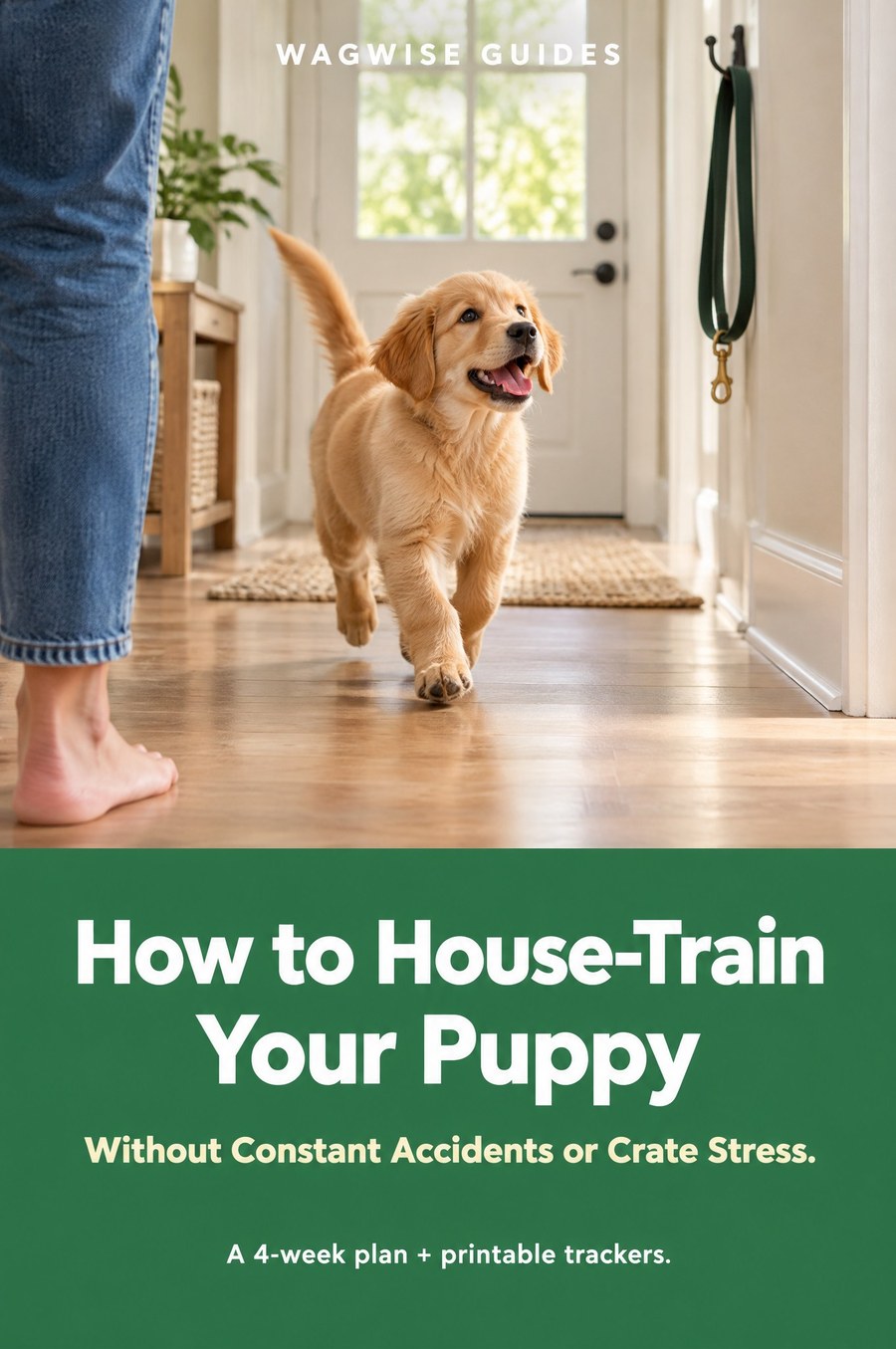
House-training
Your Puppy's First 24 Hours: The Potty Plan
Quick answer
For your puppy first 24 hours, pick one toilet spot, keep a leash and treats by the door, and go out on every trigger and about every hour while awake. Reward after your puppy finishes, keep every minute eyes-on or safely confined, and write each trip down.
- Accidents are normal at first. Each one points to a gap, not a bad puppy.
- Eight steps cover day one, and you can do all of them tonight.
- Go out on six triggers plus about every hour while awake for the youngest puppies.
- Book a vet check-up early, because health comes first.
Your puppy first 24 hours at home do not need to be perfect. You need a plan you can follow when you are tired. Your puppy is not being stubborn. Their bladder is just small, and nobody has told them where the toilet is in a house.
What should I do on day one?
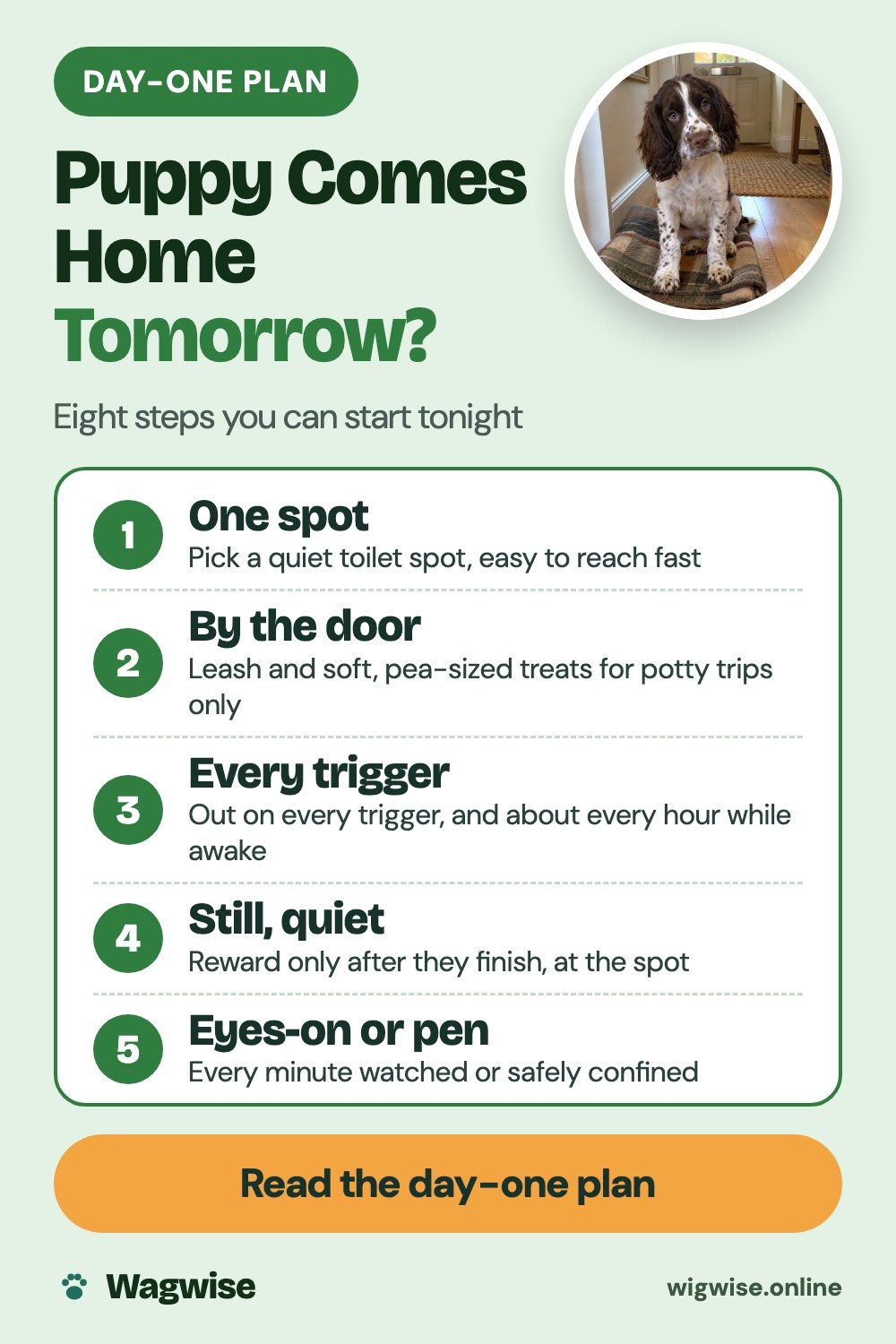
Eight steps, in order. You can do all of them tonight, and none needs special equipment.
- Pick one toilet spot. Quiet, easy to reach fast, away from where your puppy eats and sleeps.
- Set up the door. Leash and soft, pea-sized treats in a pouch, for potty trips only.
- Go out on every trigger, and about every hour while awake.
- Stand still and stay quiet. Reward only after your puppy finishes, at the spot, within a few seconds.
- Make every minute eyes-on or safely confined.
- Do a last trip right before bed, and a first trip the moment your puppy wakes.
- Write down every trip: time, what came before, pee or poop, where.
- Save your vet’s number and book a check-up.
When are the triggers?
Always go out after these six moments:
| Trigger | Example |
|---|---|
| Waking up | After a nap too |
| After eating | And after drinking |
| After play | Or excitement |
| Last thing at night | Right before bed |
| Before you leave | And when you return |
Between triggers, our suggested start for puppies of 8 to 12 weeks is about every 45 to 60 minutes. Yes, that is a lot. It is also the fastest way to fewer accidents. Sources differ on the exact number, so let your log decide.
Where does my puppy sleep tonight?
A crate or pen in your bedroom helps a new puppy feel close. Keep trips at night quiet and boring: low light, no play, straight back to bed. Set one alarm for the first weeks. Crying right after crating is usually worry, while crying in the middle of the night may be a toilet break. Our night plan has the details, and the crate should never be used as a punishment.
What if there is an accident?
Expect frequent accidents at first. That is normal. If one happens, stay calm, clean up with an enzymatic cleaner, and ask: Was my puppy watched? Was a trip overdue? Did I give too much space? No scolding, ever. A puppy cannot link a telling-off that comes later to a puddle, and scolding can make them afraid to go in front of you.
Who else needs to know the rules?
Tell everyone at home before the first trip: no scolding, ever. Agree one toilet spot, one cue word such as “go potty”, and one door in and out, so your puppy hears the same message from everyone. One adult owns the log and the leash. Children can help with the cue word and treats, but not with taking a puppy out alone.
Feed at set times, so potty times become predictable, and ask your vet how many meals suit your puppy. Do not hold back food or water to control toileting.
Be wary of anyone who promises a number of days. One veterinary behaviorist says most owners house-train within 1 to 2 months, while an animal-welfare charity says 4 to 6 months is typical. Plan for weeks to months, and go at your puppy’s pace.
What should I get ready before they arrive?
Have these by the door: a 6-foot leash, soft treats, baby gates or a pen, a crate with a divider, an enzymatic cleaner, towels and bags, and a log with a pen. See your potty training kit and zones for the full list. Book a vet check-up, and ask which outdoor areas are safe before vaccinations are complete. When you are ready for the next step, a calm 4-week potty training plan maps the weeks, and the House-Train Your Puppy guide holds the whole routine.
Frequently asked questions
How often should a new puppy go out?
For 8 to 12 weeks, our suggested start is about every 45 to 60 minutes while awake, plus the six triggers. Sources differ, so let your log decide.
Should I expect accidents on the first day?
Yes. Expect frequent accidents at first. If one happens, stay calm, clean up and ask whether your puppy was watched, a trip was overdue, or they had too much space.
Where should my puppy sleep the first night?
A crate or pen in your bedroom helps a new puppy feel close. A worn shirt of yours in the bed can help. Set one night alarm for a quiet potty trip.
When should I take my new puppy to the vet?
Book a check-up early and save your vet's number. Ask which outdoor areas are safe before vaccinations are complete.
More Wagwise guides for dog owners
 Stop Puppy BitingA gentle 4-week plan to stop the nipping and get through teething.$17 · instant PDFSee the guide →
 Get Rid of Dog Pee SmellRemove urine odor for good, then stop the accidents with a 14-day reset.$17 · instant PDFSee the guide →
 Stop Dog BarkingA quiz finds why your dog barks, then a plan made for that reason.$17 · instant PDFSee the guide →
 Help Your Itchy DogTrack triggers, soothe skin safely and know when to see the vet.$17 · instant PDFSee the guide →
 Stop Leash PullingA 4-week force-free plan for calmer walks and a loose leash.$17 · instant PDFSee the guide →
 Leave Your Dog AloneFilm, sort and build calm alone time with a vet-first plan and a step-by-step ladder.$17 · instant PDFSee the guide →
 Puppy Sleeps Through the NightA realistic, age-by-age plan for calmer nights, without cry-it-out or crate fights.$17 · instant PDFSee the guide →
 Less Dog Hair, Less SmellA 4-week brushing, bath and home routine for a calmer-smelling house.$17 · instant PDFSee the guide →
Want all four? Get the complete library for $49.
Sources
This article is general education, not veterinary advice. It does not replace an examination by your vet or help from a qualified behaviourist.